QUESTION IMAGE
Question
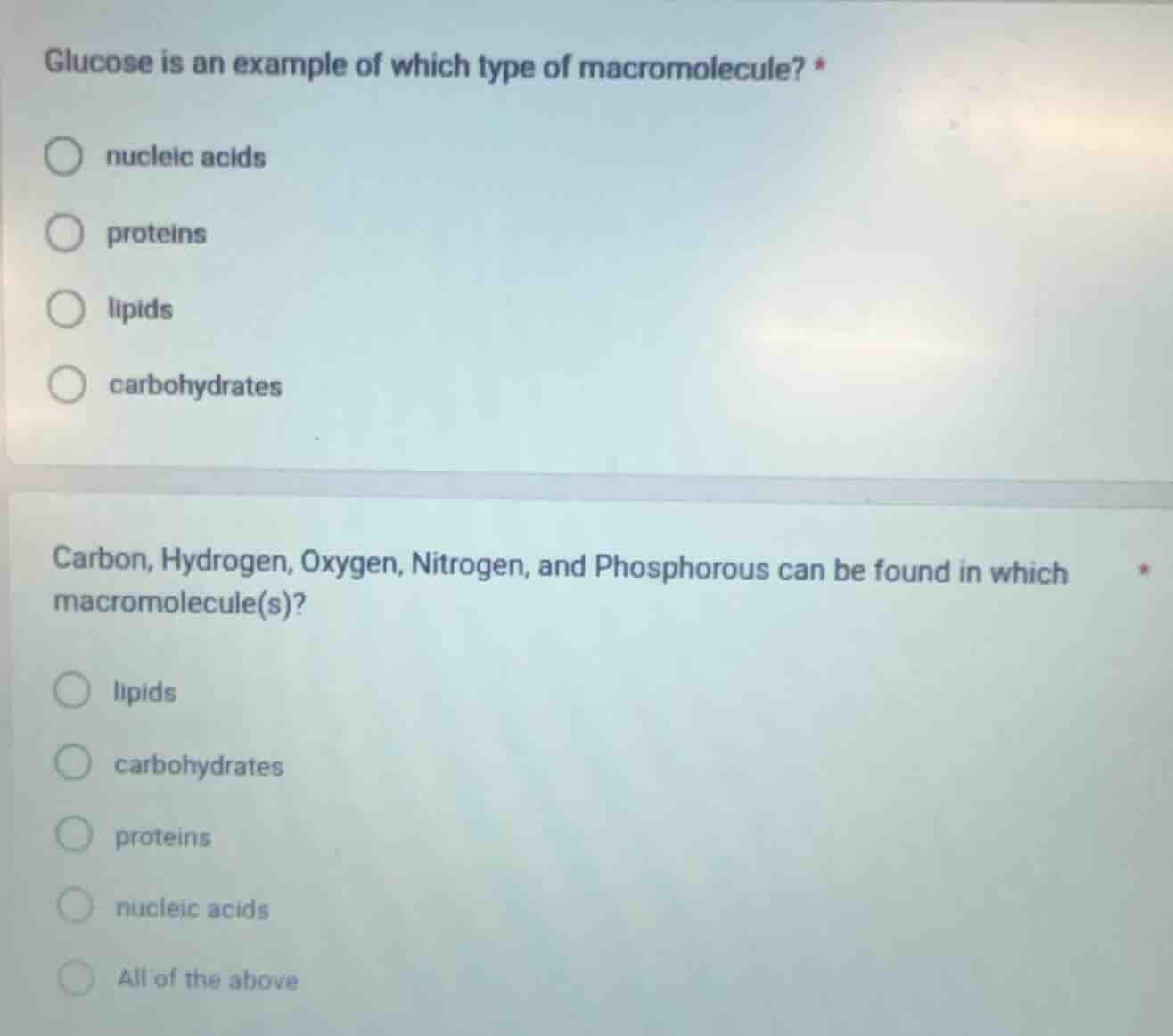
glucose is an example of which type of macromolecule? *
nucleic acids
proteins
lipids
carbohydrates
carbon, hydrogen, oxygen, nitrogen, and phosphorous can be found in which macromolecule(s)? *
lipids
carbohydrates
proteins
nucleic acids
all of the above
<pre_analysis>
{
"quality": "clear",
"question_count": 2,
"skills_matched": [
"direct_cot",
"multiple_choice_formatter",
"explain_then_answer",
"tutor"
],
"needs_drawing": false,
"concepts_used": [
"Biomolecules",
"Macromolecule Classification"
],
"new_concepts": [
"Elemental Composition of Macromolecules"
],
"current_concepts": [
"Biomolecules",
"Macromolecule Classification",
"Elemental Composition of Macromolecules"
]
}
</pre_analysis>
<reasoning>
Identify glucose classification
Using the Macromolecule Classification knowledge point, we analyze glucose. Glucose is a simple sugar (monosaccharide) with the chemical formula \(C_6H_{12}O_6\). Because it consists of carbon, hydrogen, and oxygen in a 1:2:1 ratio, it is classified as a carbohydrate.
Analyze elemental composition
Using the Biomolecules knowledge point, we examine the elements Carbon (C), Hydrogen (H), Oxygen (O), Nitrogen (N), and Phosphorus (P). While carbohydrates and lipids primarily contain C, H, and O, and proteins contain C, H, O, and N, it is nucleic acids (such as DNA and RNA) that consistently contain all five of these elements (C, H, O, N, and P) in their nucleotide subunits.
</reasoning>
<answer>
Question 1
<mcq-option>nucleic acids</mcq-option>
<mcq-option>proteins</mcq-option>
<mcq-option>lipids</mcq-option>
<mcq-correct>carbohydrates</mcq-correct>
Question 2
<mcq-option>lipids</mcq-option>
<mcq-option>carbohydrates</mcq-option>
<mcq-option>proteins</mcq-option>
<mcq-correct>nucleic acids</mcq-correct>
<mcq-option>All of the above</mcq-option>
</answer>
<post_analysis>
{
"subject": "Natural Science",
"question_type": "Multiple Choice",
"knowledge_point": [
"Natural Science",
"Biology",
"Macromolecules"
]
}
</post_analysis>
Snap & solve any problem in the app
Get step-by-step solutions on Sovi AI
Photo-based solutions with guided steps
Explore more problems and detailed explanations
<pre_analysis>
{
"quality": "clear",
"question_count": 2,
"skills_matched": [
"direct_cot",
"multiple_choice_formatter",
"explain_then_answer",
"tutor"
],
"needs_drawing": false,
"concepts_used": [
"Biomolecules",
"Macromolecule Classification"
],
"new_concepts": [
"Elemental Composition of Macromolecules"
],
"current_concepts": [
"Biomolecules",
"Macromolecule Classification",
"Elemental Composition of Macromolecules"
]
}
</pre_analysis>
<reasoning>
Identify glucose classification
Using the Macromolecule Classification knowledge point, we analyze glucose. Glucose is a simple sugar (monosaccharide) with the chemical formula \(C_6H_{12}O_6\). Because it consists of carbon, hydrogen, and oxygen in a 1:2:1 ratio, it is classified as a carbohydrate.
Analyze elemental composition
Using the Biomolecules knowledge point, we examine the elements Carbon (C), Hydrogen (H), Oxygen (O), Nitrogen (N), and Phosphorus (P). While carbohydrates and lipids primarily contain C, H, and O, and proteins contain C, H, O, and N, it is nucleic acids (such as DNA and RNA) that consistently contain all five of these elements (C, H, O, N, and P) in their nucleotide subunits.
</reasoning>
<answer>
Question 1
<mcq-option>nucleic acids</mcq-option>
<mcq-option>proteins</mcq-option>
<mcq-option>lipids</mcq-option>
<mcq-correct>carbohydrates</mcq-correct>
Question 2
<mcq-option>lipids</mcq-option>
<mcq-option>carbohydrates</mcq-option>
<mcq-option>proteins</mcq-option>
<mcq-correct>nucleic acids</mcq-correct>
<mcq-option>All of the above</mcq-option>
</answer>
<post_analysis>
{
"subject": "Natural Science",
"question_type": "Multiple Choice",
"knowledge_point": [
"Natural Science",
"Biology",
"Macromolecules"
]
}
</post_analysis>