QUESTION IMAGE
Question
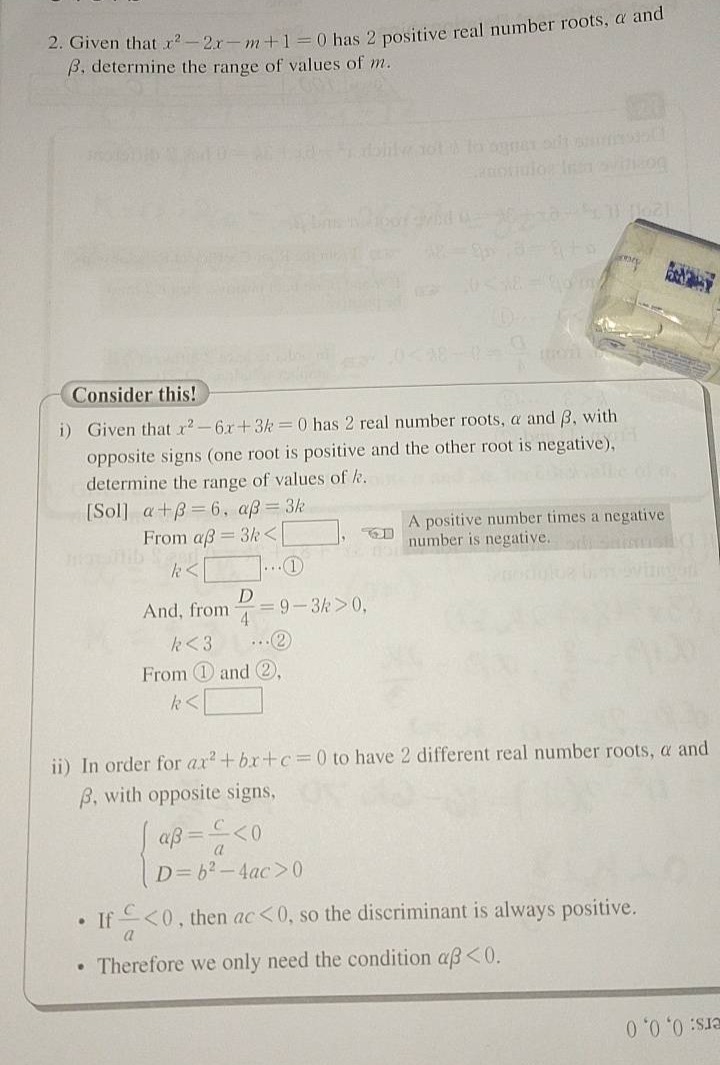
- given that (x^2 - 2x - m + 1 = 0) has 2 positive real number roots, (alpha) and (\beta), determine the range of values of (m).
consider this!
i) given that (x^2 - 6x + 3k = 0) has 2 real number roots, (alpha) and (\beta), with opposite signs (one root is positive and the other root is negative), determine the range of values of (k).
sol (alpha + \beta = 6), (alpha\beta = 3k)
from (alpha\beta = 3k < \box),
(k < \box) ... (1)
and, from (\frac{d}{4} = 9 - 3k > 0),
(k < 3) ... (2)
from (1) and (2),
(k < \box)
ii) in order for (ax^2 + bx + c = 0) to have 2 different real number roots, (alpha) and (\beta), with opposite signs,
\\\
\\
- if (\frac{c}{a} < 0), then (ac < 0), so the discriminant is always positive.
- therefore we only need the condition (alpha\beta < 0).
Step1: Set discriminant condition
For real roots, the discriminant must be non-negative:
Step2: Solve discriminant inequality
Simplify the inequality to find the range for \(m\):
Step3: Set sum of roots condition
Since both roots are positive, their sum must be positive:
Step4: Set product of roots condition
Since both roots are positive, their product must be positive:
Step5: Combine all conditions
Find the intersection of \(m \ge 0\) and \(m < 1\):

Snap & solve any problem in the app
Get step-by-step solutions on Sovi AI
Photo-based solutions with guided steps
Explore more problems and detailed explanations
\(-1 < m \le 0\)