QUESTION IMAGE
Question
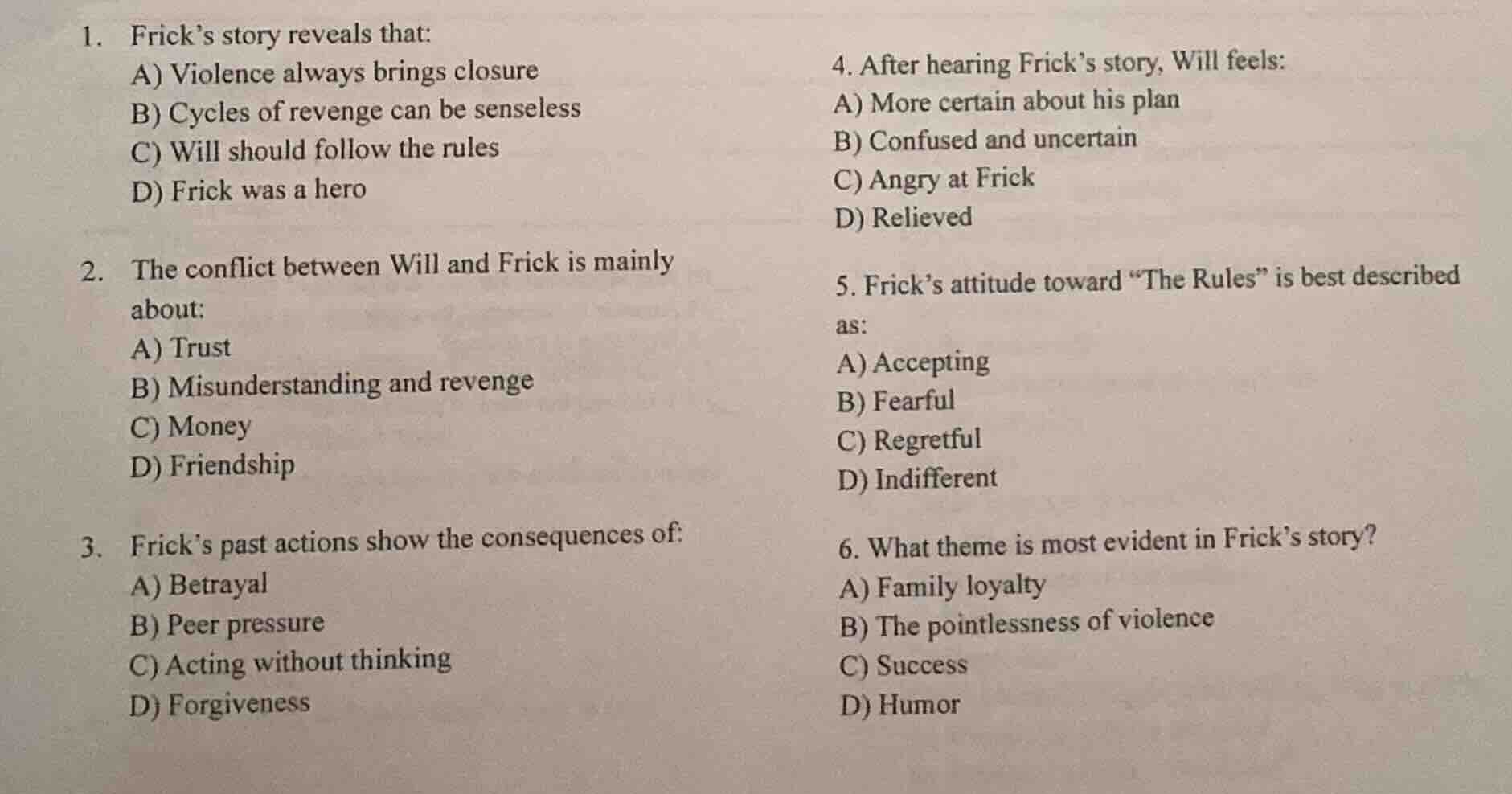
- frick’s story reveals that:
a) violence always brings closure
b) cycles of revenge can be senseless
c) will should follow the rules
d) frick was a hero
- the conflict between will and frick is mainly about:
a) trust
b) misunderstanding and revenge
c) money
d) friendship
- frick’s past actions show the consequences of:
a) betrayal
b) peer pressure
c) acting without thinking
d) forgiveness
- after hearing frick’s story, will feels:
a) more certain about his plan
b) confused and uncertain
c) angry at frick
d) relieved
- frick’s attitude toward “the rules” is best described as:
a) accepting
b) fearful
c) regretful
d) indifferent
- what theme is most evident in frick’s story?
a) family loyalty
b) the pointlessness of violence
c) success
d) humor
These are multiple - choice questions related to a story (presumably a literary work). To answer them, we need to analyze the context of Frick's story:
Question 1
- Option A: Violence does not always bring closure. In most literary and real - life contexts, violence often begets more problems, so this is incorrect.
- Option B: Cycles of revenge are often senseless as they keep perpetuating harm without a real resolution. This is a common theme in stories about revenge.
- Option C: The story of Frick doesn't seem to be centered around Will following rules. There's no indication of this from the options' context.
- Option D: Frick's story is more about the consequences of actions rather than being a hero. So, the correct answer is B.
Question 2
- Option A: Trust is not the main conflict between Will and Frick.
- Option B: Misunderstanding and revenge are common sources of conflict in stories involving characters like Will and Frick. It's likely that their conflict stems from a misunderstanding that leads to revenge - related tensions.
- Option C: Money is not indicated as the main source of conflict.
- Option D: Friendship is not the main conflict; if there was a friendship, the conflict would be of a different nature. So, the correct answer is B.
Question 3
- Option A: Betrayal's consequences are not the focus of Frick's past actions as per the options.
- Option B: Peer pressure is not indicated as the cause of Frick's past actions.
- Option C: Acting without thinking often leads to negative consequences. Frick's past actions likely show the results of impulsive behavior.
- Option D: Forgiveness is not the consequence of Frick's past actions; rather, his actions are more about the results of not thinking. So, the correct answer is C.
Question 4
- Option A: Hearing Frick's story is not likely to make Will more certain about his plan. Usually, such stories make one re - evaluate.
- Option B: After hearing a story about the senselessness of revenge or the consequences of actions, Will is likely to be confused and uncertain about his plan.
- Option C: There's no indication that Will would be angry at Frick.
- Option D: Relieved is not the likely emotion; the story's context doesn't suggest relief. So, the correct answer is B.
Question 5
- Option A: Frick's attitude toward "The Rules" is not accepting. The story's context (from the other questions) suggests a more complex attitude.
- Option B: Fearful is not the best description.
- Option C: Regretful is a likely attitude. If Frick's story involves actions with negative consequences, he would be regretful about "The Rules" (maybe the rules he followed or didn't follow).
- Option D: Indifferent is not likely as the story's events would make him care about "The Rules". So, the correct answer is C.
Question 6
- Option A: Family loyalty is not the most evident theme.
- Option B: The pointlessness of violence is a common theme in stories about revenge and impulsive actions, which aligns with Frick's story.
- Option C: Success is not the theme of Frick's story.
- Option D: Humor is not the theme. So, the correct answer is B.
Final Answers
- B) Cycles of revenge can be senseless
- B) Misunderstanding and revenge
- C) Acting without thinking
- B) Confused and uncertain
- C) Regretful
- B) The pointlessness of violence

Snap & solve any problem in the app
Get step-by-step solutions on Sovi AI
Photo-based solutions with guided steps
Explore more problems and detailed explanations
These are multiple - choice questions related to a story (presumably a literary work). To answer them, we need to analyze the context of Frick's story:
Question 1
- Option A: Violence does not always bring closure. In most literary and real - life contexts, violence often begets more problems, so this is incorrect.
- Option B: Cycles of revenge are often senseless as they keep perpetuating harm without a real resolution. This is a common theme in stories about revenge.
- Option C: The story of Frick doesn't seem to be centered around Will following rules. There's no indication of this from the options' context.
- Option D: Frick's story is more about the consequences of actions rather than being a hero. So, the correct answer is B.
Question 2
- Option A: Trust is not the main conflict between Will and Frick.
- Option B: Misunderstanding and revenge are common sources of conflict in stories involving characters like Will and Frick. It's likely that their conflict stems from a misunderstanding that leads to revenge - related tensions.
- Option C: Money is not indicated as the main source of conflict.
- Option D: Friendship is not the main conflict; if there was a friendship, the conflict would be of a different nature. So, the correct answer is B.
Question 3
- Option A: Betrayal's consequences are not the focus of Frick's past actions as per the options.
- Option B: Peer pressure is not indicated as the cause of Frick's past actions.
- Option C: Acting without thinking often leads to negative consequences. Frick's past actions likely show the results of impulsive behavior.
- Option D: Forgiveness is not the consequence of Frick's past actions; rather, his actions are more about the results of not thinking. So, the correct answer is C.
Question 4
- Option A: Hearing Frick's story is not likely to make Will more certain about his plan. Usually, such stories make one re - evaluate.
- Option B: After hearing a story about the senselessness of revenge or the consequences of actions, Will is likely to be confused and uncertain about his plan.
- Option C: There's no indication that Will would be angry at Frick.
- Option D: Relieved is not the likely emotion; the story's context doesn't suggest relief. So, the correct answer is B.
Question 5
- Option A: Frick's attitude toward "The Rules" is not accepting. The story's context (from the other questions) suggests a more complex attitude.
- Option B: Fearful is not the best description.
- Option C: Regretful is a likely attitude. If Frick's story involves actions with negative consequences, he would be regretful about "The Rules" (maybe the rules he followed or didn't follow).
- Option D: Indifferent is not likely as the story's events would make him care about "The Rules". So, the correct answer is C.
Question 6
- Option A: Family loyalty is not the most evident theme.
- Option B: The pointlessness of violence is a common theme in stories about revenge and impulsive actions, which aligns with Frick's story.
- Option C: Success is not the theme of Frick's story.
- Option D: Humor is not the theme. So, the correct answer is B.
Final Answers
- B) Cycles of revenge can be senseless
- B) Misunderstanding and revenge
- C) Acting without thinking
- B) Confused and uncertain
- C) Regretful
- B) The pointlessness of violence