QUESTION IMAGE
Question
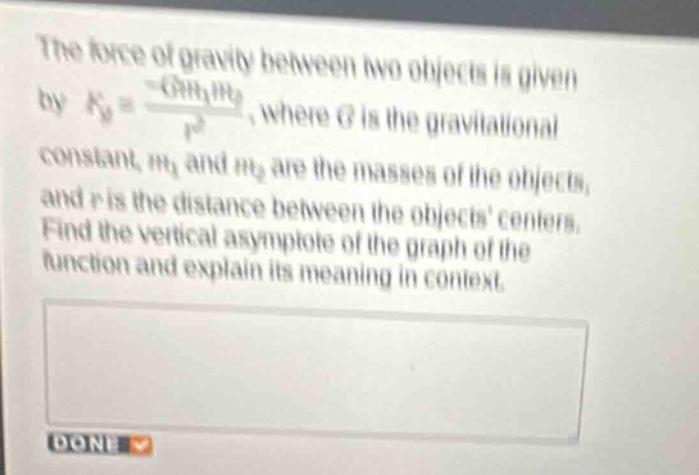
the force of gravity between two objects is given by \\(f_g = \frac{-gm_1m_2}{r^2}\\), where \\(g\\) is the gravitational constant, \\(m_1\\) and \\(m_2\\) are the masses of the objects, and \\(r\\) is the distance between the objects centers. find the vertical asymptote of the graph of the function and explain its meaning in context.
⚡ Using what you learned: Identifying Restrictions and Asymptotes
Step 1: Identify the vertical asymptote
The gravitational force function is given by:
To find the vertical asymptote, set the denominator equal to zero:
Thus, the vertical asymptote is at \( r = 0 \).
Step 2: Explain the meaning in context
The variable \( r \) represents the distance between the centers of the two objects.
- As the distance \( r \) approaches \( 0 \), the value of \( r^2 \) becomes extremely small.
- Dividing by a value close to zero causes the magnitude of the gravitational force \( F_g \) to approach infinity (\( -\infty \) due to the negative sign, representing an infinitely strong attractive force).
- Physically, this means that as two objects get infinitely close to each other, the gravitational force of attraction between them becomes infinitely large.

Snap & solve any problem in the app
Get step-by-step solutions on Sovi AI
Photo-based solutions with guided steps
Explore more problems and detailed explanations
The vertical asymptote is at \( r = 0 \). In this context, it means that as the distance between the centers of the two objects approaches zero, the gravitational force of attraction between them approaches infinity.