QUESTION IMAGE
Question
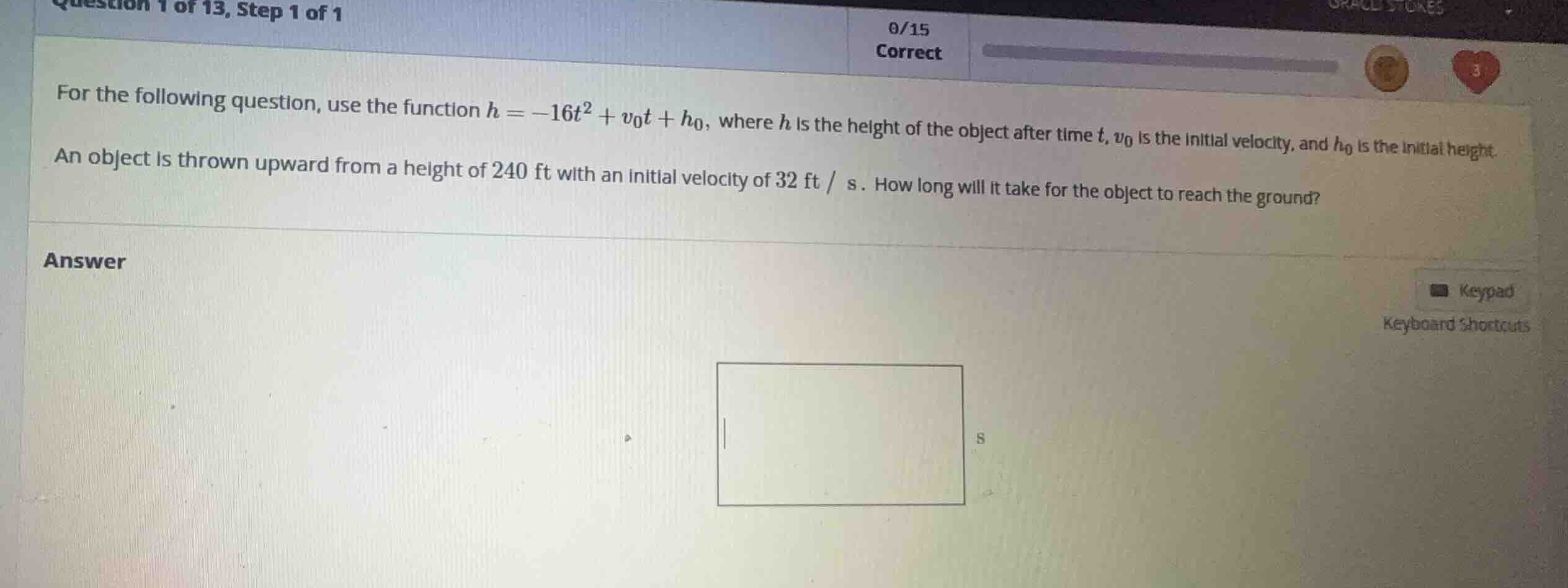
for the following question, use the function (h = -16t^2 + v_0t + h_0), where (h) is the height of the object after time (t), (v_0) is the initial velocity, and (h_0) is the initial height.
an object is thrown upward from a height of (240\text{ ft}) with an initial velocity of (32\text{ ft/s}). how long will it take for the object to reach the ground?
Identify the given values and formula
We are given the height function:
From the problem statement, we identify the following values:
- Initial height, \(h_0 = 240\text{ ft}\)
- Initial velocity, \(v_0 = 32\text{ ft/s}\)
We want to find how long it takes for the object to reach the ground, which means finding the time \(t\) when the height \(h = 0\).
Set up the quadratic equation
Using the Quadratic Functions concept, we substitute the given values into our height equation:
Simplify the equation
To make solving easier, we can divide the entire equation by its greatest common divisor, \(-16\):
Factor the quadratic equation
Using the Solving Quadratic Equations concept, we factor the simplified quadratic expression:
We look for two numbers that multiply to \(-15\) and add to \(-2\). These numbers are \(-5\) and \(3\).
Solve for time
Set each factor to zero:
Since time \(t\) must be a non-negative value in this context, we discard the negative solution.
Thus, \(t = 5\text{ seconds}\).

Snap & solve any problem in the app
Get step-by-step solutions on Sovi AI
Photo-based solutions with guided steps
Explore more problems and detailed explanations
How long will it take for the object to reach the ground? <blank>5</blank> s