QUESTION IMAGE
Question
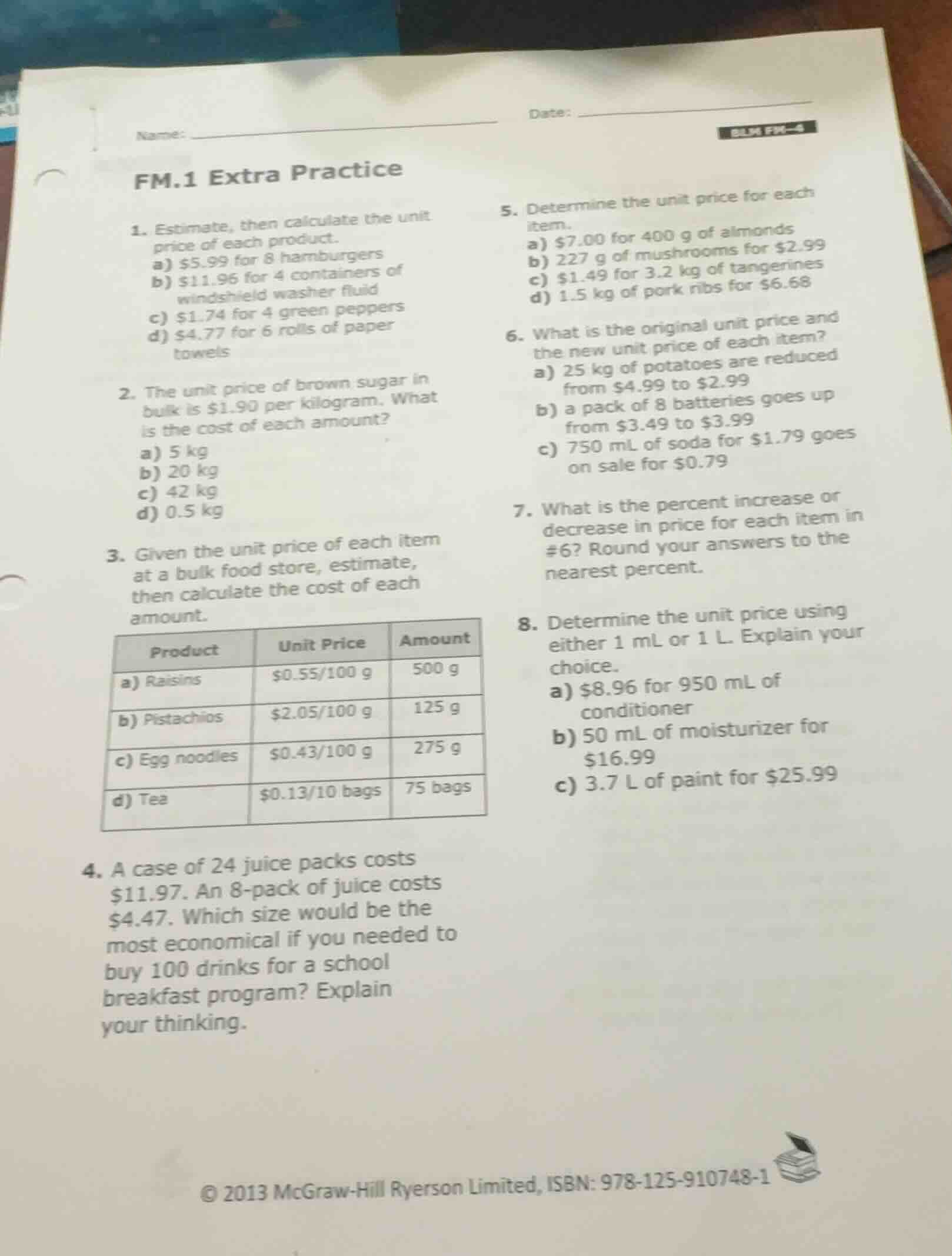
fm.1 extra practice
- estimate, then calculate the unit price of each product.
a) $5.99 for 8 hamburgers
b) $11.96 for 4 containers of windshield washer fluid
c) $1.74 for 4 green peppers
d) $4.77 for 6 rolls of paper towels
- the unit price of brown sugar in bulk is $1.90 per kilogram. what is the cost of each amount?
a) 5 kg
b) 20 kg
c) 42 kg
d) 0.5 kg
- given the unit price of each item at a bulk food store, estimate, then calculate the cost of each amount.
\
- a case of 24 juice packs costs $11.97. an 8-pack of juice costs $4.47. which size would be the most economical if you needed to buy 100 drinks for a school breakfast program? explain your thinking.
- determine the unit price for each item.
a) $7.00 for 400 g of almonds
b) 227 g of mushrooms for $2.99
c) $1.49 for 3.2 kg of tangerines
d) 1.5 kg of pork ribs for $6.68
- what is the original unit price and the new unit price of each item?
a) 25 kg of potatoes are reduced from $4.99 to $2.99
b) a pack of 8 batteries goes up from $3.49 to $3.99
c) 750 ml of soda for $1.79 goes on sale for $0.79
- what is the percent increase or decrease in price for each item in #6? round your answers to the nearest percent.
- determine the unit price using either 1 ml or 1 l. explain your choice.
a) $8.96 for 950 ml of conditioner
b) 50 ml of moisturizer for $16.99
c) 3.7 l of paint for $25.99
Calculate unit prices for Question 1
Using the Linear Equations knowledge point, we divide the total cost by the quantity to find the unit price.
a) Estimate: \( \$6.00 \div 8 = \$0.75 \) per hamburger.
Calculation: \( \$5.99 \div 8 \approx \$0.75 \) per hamburger.
b) Estimate: \( \$12.00 \div 4 = \$3.00 \) per container.
Calculation: \( \$11.96 \div 4 = \$2.99 \) per container.
c) Estimate: \( \$1.80 \div 4 = \$0.45 \) per green pepper.
Calculation: \( \$1.74 \div 4 \approx \$0.44 \) per green pepper.
d) Estimate: \( \$4.80 \div 6 = \$0.80 \) per roll.
Calculation: \( \$4.77 \div 6 \approx \$0.80 \) per roll.
Calculate costs for Question 2
Using the Linear Equations knowledge point, we multiply the unit price of \( \$1.90/\text{kg} \) by each mass.
a) \( 5\text{ kg} \times \$1.90/\text{kg} = \$9.50 \)
b) \( 20\text{ kg} \times \$1.90/\text{kg} = \$38.00 \)
c) \( 42\text{ kg} \times \$1.90/\text{kg} = \$79.80 \)
d) \( 0.5\text{ kg} \times \$1.90/\text{kg} = \$0.95 \)
Calculate costs for Question 3
Using the Linear Equations knowledge point, we scale the unit prices to the given amounts.
a) Raisins: \( 500\text{ g} \) is \( 5 \times 100\text{ g} \).
Estimate: \( 5 \times \$0.60 = \$3.00 \).
Calculation: \( 5 \times \$0.55 = \$2.75 \).
b) Pistachios: \( 125\text{ g} \) is \( 1.25 \times 100\text{ g} \).
Estimate: \( 1.25 \times \$2.00 = \$2.50 \).
Calculation: \( 1.25 \times \$2.05 \approx \$2.56 \).
c) Egg noodles: \( 275\text{ g} \) is \( 2.75 \times 100\text{ g} \).
Estimate: \( 3 \times \$0.40 = \$1.20 \).
Calculation: \( 2.75 \times \$0.43 \approx \$1.18 \).
d) Tea: \( 75\text{ bags} \) is \( 7.5 \times 10\text{ bags} \).
Estimate: \( 7.5 \times \$0.10 = \$0.75 \).
Calculation: \( 7.5 \times \$0.13 \approx \$0.98 \).
Compare juice pack economy for Question 4
Using the Linear Equations knowledge point, we find the cost to buy exactly 100 drinks.
- Case of 24: To get 100 drinks, we need \( \lceil 100 \div 24
ceil = 5 \) cases (120 drinks).
Cost: \( 5 \times \$11.97 = \$59.85 \).
Unit price: \( \$11.97 \div 24 \approx \$0.50 \) per pack.
- Pack of 8: To get 100 drinks, we need \( \lceil 100 \div 8
ceil = 13 \) packs (104 drinks).
Cost: \( 13 \times \$4.47 = \$58.11 \).
Unit price: \( \$4.47 \div 8 \approx \$0.56 \) per pack.
Even though the 24-pack has a lower unit price (\( \$0.50 \) vs \( \$0.56 \)), buying thirteen 8-packs is cheaper overall (\( \$58.11 \) vs \( \$59.85 \)) because it minimizes excess leftover drinks.
Calculate unit prices for Question 5
Using the Linear Equations knowledge point, we calculate the unit prices.
a) \( \$7.00 \div 400\text{ g} = \$0.0175/\text{g} \) (or \( \$1.75/100\text{ g} \)).
b) \( \$2.99 \div 227\text{ g} \approx \$0.0132/\text{g} \) (or \( \$1.32/100\text{ g} \)).
c) \( \$1.49 \div 3.2\text{ kg} \approx \$0.47/\text{kg} \).
d) \( \$6.68 \div 1.5\text{ kg} \approx \$4.45/\text{kg} \).
Determine original and new unit prices for Question 6
Using the Linear Equations knowledge point, we find the unit rates before and after.
a) Original: \( \$4.99 \div 25\text{ kg} \approx \$0.20/\text{kg} \).…

Snap & solve any problem in the app
Get step-by-step solutions on Sovi AI
Photo-based solutions with guided steps
Explore more problems and detailed explanations
Question 1
a) Estimate: \( \$0.75/\text{hamburger} \), Calculation: \( \$0.75/\text{hamburger} \)
b) Estimate: \( \$3.00/\text{container} \), Calculation: \( \$2.99/\text{container} \)
c) Estimate: \( \$0.45/\text{pepper} \), Calculation: \( \$0.44/\text{pepper} \)
d) Estimate: \( \$0.80/\text{roll} \), Calculation: \( \$0.80/\text{roll} \)
Question 2
a) \( \$9.50 \)
b) \( \$38.00 \)
c) \( \$79.80 \)
d) \( \$0.95 \)
Question 3
a) Estimate: \( \$3.00 \), Calculation: \( \$2.75 \)
b) Estimate: \( \$2.50 \), Calculation: \( \$2.56 \)
c) Estimate: \( \$1.20 \), Calculation: \( \$1.18 \)
d) Estimate: \( \$0.75 \), Calculation: \( \$0.98 \)
Question 4
The 8-pack is more economical. Buying thirteen 8-packs costs \( \$58.11 \) (104 drinks), whereas buying five 24-packs costs \( \$59.85 \) (120 drinks).
Question 5
a) \( \$1.75/100\text{ g} \) (or \( \$0.0175/\text{g} \))
b) \( \$1.32/100\text{ g} \) (or \( \$0.0132/\text{g} \))
c) \( \$0.47/\text{kg} \)
d) \( \$4.45/\text{kg} \)
Question 6
a) Original: \( \$0.20/\text{kg} \), New: \( \$0.12/\text{kg} \)
b) Original: \( \$0.44/\text{battery} \), New: \( \$0.50/\text{battery} \)
c) Original: \( \$0.24/100\text{ mL} \), New: \( \$0.11/100\text{ mL} \)
Question 7
a) \( 40\% \) decrease
b) \( 14\% \) increase
c) \( 56\% \) decrease
Question 8
a) 1 L; \( \$9.43/\text{L} \) (950 mL is close to 1 L, making 1 L a practical unit)
b) 1 mL; \( \$0.34/\text{mL} \) (50 mL is a very small package, so 1 mL is more appropriate)
c) 1 L; \( \$7.02/\text{L} \) (3.7 L is a large volume, making 1 L a practical unit)