QUESTION IMAGE
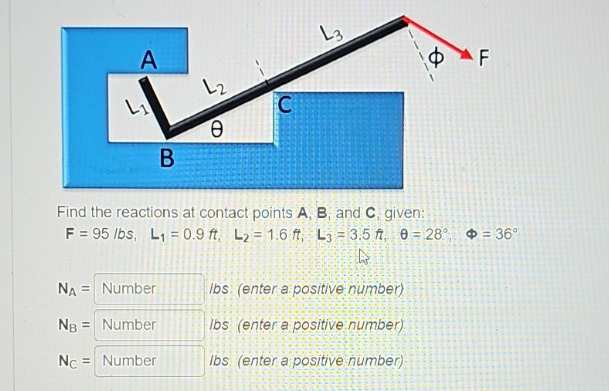
Question
find the reactions at contact points a, b, and c, given:
\\(f = 95\text{ lbs}\\), \\(l_1 = 0.9\text{ ft}\\), \\(l_2 = 1.6\text{ ft}\\), \\(l_3 = 3.5\text{ ft}\\), \\(\theta = 28^\circ\\), \\(\phi = 36^\circ\\)
\\(n_a =\\) number \\(\text{lbs}\\) (enter a positive number)
\\(n_b =\\) number \\(\text{lbs}\\) (enter a positive number)
\\(n_c =\\) number \\(\text{lbs}\\) (enter a positive number)
🆕 New Concept Discovered: Static Equilibrium of Rigid Bodies
Balancing forces and moments on a member in contact with smooth surfaces.
Step 1: Identify the contact forces (reactions)
The member is in contact with smooth surfaces at points \(A\), \(B\), and \(C\). Since the surfaces are smooth, the reaction forces are normal (perpendicular) to the contacting surfaces:
- At \(A\), the contact is horizontal, so the reaction force \(N_A\) is vertical (pointing downwards on the member to prevent it from moving up).
- At \(B\), the contact is horizontal, so the reaction force \(N_B\) is vertical (pointing upwards on the member).
- At \(C\), the corner contact acts perpendicular to the inclined member \(BC\). Thus, the reaction force \(N_C\) is perpendicular to the bar, pointing upwards and to the left at an angle of \(\theta\) with the vertical (or \(90^\circ - \theta\) with the horizontal).
Let's set up a coordinate system where the \(x\)-axis is horizontal (positive to the right) and the \(y\)-axis is vertical (positive upwards):
- \(N_A\) acts vertically downwards: \(\vec{N}_A = -N_A \hat{j}\)
- \(N_B\) acts vertically upwards: \(\vec{N}_B = N_B \hat{j}\)
- \(N_C\) is perpendicular to the bar. The bar is inclined at angle \(\theta = 28^\circ\) above the horizontal. The normal force \(N_C\) points perpendicular to this incline (upwards and leftwards):
Step 2: Resolve the applied force \(F\)
The force \(F = 95\text{ lbs}\) is applied at the free end. The angle \(\phi = 36^\circ\) is measured relative to the dashed line, which is perpendicular to the bar.
- The bar is inclined at \(\theta = 28^\circ\) above the horizontal.
- The dashed line perpendicular to the bar points downwards and to the right, making an angle of \(\theta = 28^\circ\) with the vertical (or \(90^\circ - \theta = 62^\circ\) below the horizontal).
- The force \(F\) is rotated by \(\phi = 36^\circ\) clockwise from this perpendicular line.
- Therefore, the angle of \(F\) below the horizontal is:
- The components of \(\vec{F}\) are:
Step 3: Set up the equations of equilibrium
For the system to be in static equilibrium, the sum of forces in both directions and the sum of moments about any point must equal zero.
1. Force balance in the \(x\)-direction:
2. Moment balance about point \(B\):
Let's define the coordinates of the points relative to \(B(0,0)\):
- The segment \(BA\) of length \(L_1 = 0.9\text{ ft}\) is perpendicular to the horizontal, so it is vertical. Thus, point \(A\) is at:
- Point \(C\) is along the inclined bar of length \(L_2 = 1.6\text{ ft}\) at angle \(\theta = 28^\circ\):
- The end of the bar where \(F\) is applied is at a distance of \(L_2 + L_3 = 1.6 + 3.5 = 5.1\text{ ft}\) from \(B\):
Now, calculate the sum of moments about…

Snap & solve any problem in the app
Get step-by-step solutions on Sovi AI
Photo-based solutions with guided steps
Explore more problems and detailed explanations
- \(N_A = 239.0\) lbs
- \(N_B = 120.0\) lbs
- \(N_C = 181.9\) lbs