QUESTION IMAGE
Question
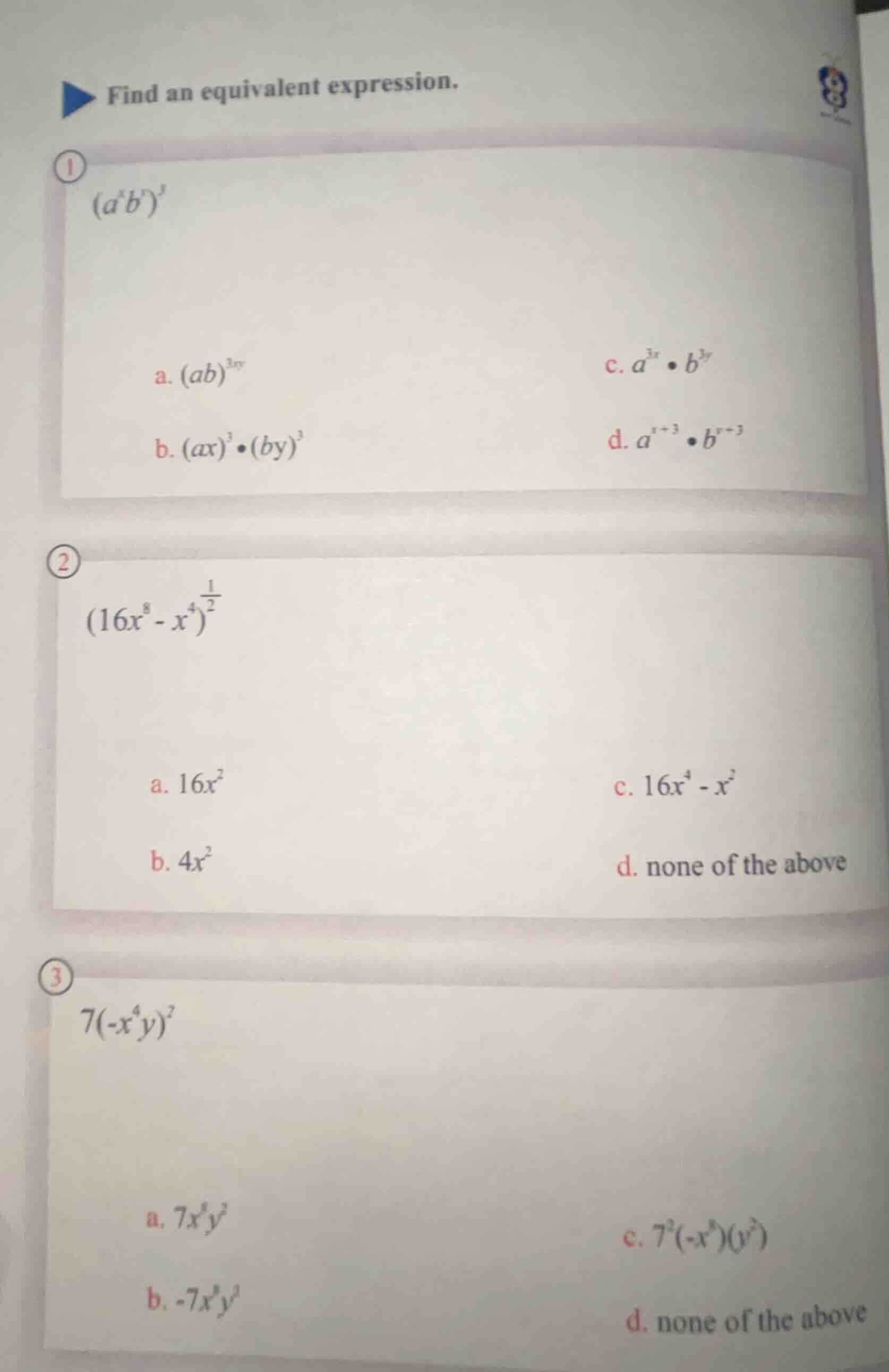
find an equivalent expression.
1
$(a^x b^y)^3$
a. $(ab)^{3xy}$ c. $a^{3x} \bullet b^{3y}$
b. $(ax)^3 \bullet (by)^3$ d. $a^{x + 3} \bullet b^{y + 3}$
2
$(16x^8 - x^4)^{\frac{1}{2}}$
a. $16x^2$ c. $16x^4 - x^2$
b. $4x^2$ d. none of the above
3
$7(-x^4 y)^2$
a. $7x^8 y^2$ c. $7^2 (-x^8)(y^2)$
b. $-7x^8 y^2$ d. none of the above
Question 1
Step1: Recall the power of a product rule
The power of a product rule states that \((xy)^n = x^n y^n\). For the expression \((a^{x}b^{y})^{3}\), we apply this rule.
\[
(a^{x}b^{y})^{3}=(a^{x})^{3}\cdot(b^{y})^{3}
\]
Step2: Recall the power of a power rule
The power of a power rule states that \((x^m)^n=x^{mn}\). Applying this to \((a^{x})^{3}\) and \((b^{y})^{3}\):
\[
(a^{x})^{3}=a^{3x}, \quad (b^{y})^{3}=b^{3y}
\]
So, \((a^{x}b^{y})^{3}=a^{3x}\cdot b^{3y}\)
Step1: Analyze the expression \((16x^{8}-x^{4})^{\frac{1}{2}}\)
The square root (which is the same as the \(\frac{1}{2}\) power) does not distribute over subtraction in the way the options suggest. Let's check each option:
- Option a: \(16x^{2}\) is not equal to \(\sqrt{16x^{8}-x^{4}}\) because \((16x^{2})^2 = 256x^{4}
eq16x^{8}-x^{4}\)
- Option b: \(4x^{2}\), \((4x^{2})^2=16x^{4}
eq16x^{8}-x^{4}\)
- Option c: \(16x^{4}-x^{2}\), \((16x^{4}-x^{2})^2 = 256x^{8}-32x^{6}+x^{4}
eq16x^{8}-x^{4}\)
So none of the options a, b, c are correct.
Step1: Apply the power of a product rule
First, apply the power of a product rule \((xy)^n=x^n y^n\) to \((-x^{4}y)^{2}\):
\[
(-x^{4}y)^{2}=(-x^{4})^{2}\cdot y^{2}
\]
Step2: Apply the power of a power rule and square of a negative
The square of a negative number is positive, so \((-x^{4})^{2}=x^{8}\) (since \((-1)^2 = 1\) and \((x^{4})^{2}=x^{8}\)). Then \(y^{2}\) remains as is. So \((-x^{4}y)^{2}=x^{8}y^{2}\)
Step3: Multiply by 7
Now multiply by 7: \(7(-x^{4}y)^{2}=7\cdot x^{8}y^{2}=7x^{8}y^{2}\)

Snap & solve any problem in the app
Get step-by-step solutions on Sovi AI
Photo-based solutions with guided steps
Explore more problems and detailed explanations
c. \(a^{3x} \cdot b^{3y}\)