QUESTION IMAGE
Question
fill in the blanks:
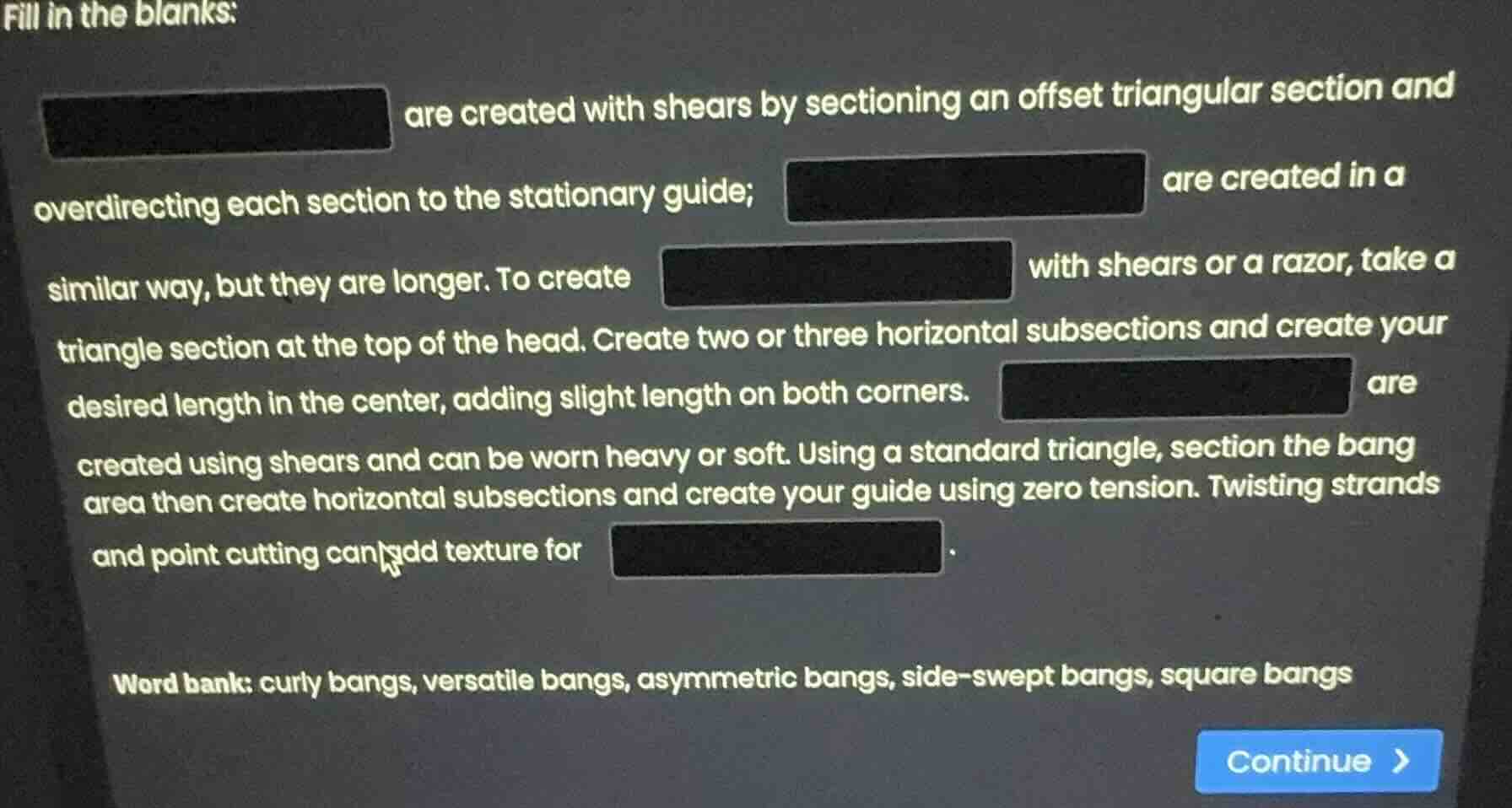
blank are created with shears by sectioning an offset triangular section and overdirecting each section to the stationary guide; blank are created in a similar way, but they are longer. to create blank with shears or a razor, take a triangle section at the top of the head. create two or three horizontal subsections and create your desired length in the center, adding slight length on both corners. blank are created using shears and can be worn heavy or soft. using a standard triangle, section the bang area then create horizontal subsections and create your guide using zero tension. twisting strands and point cutting can add texture for blank.
word bank: curly bangs, versatile bangs, asymmetric bangs, side-swept bangs, square bangs
Identify the cutting techniques
Using the Overdirection knowledge point, we analyze the specific geometric sectioning and elevation methods described in the text to match them with the correct terminology from the word bank:
- First blank: "created with shears by sectioning an offset triangular section and overdirecting each section to the stationary guide". This describes asymmetric bangs.
- Second blank: "are created in a similar way, but they are longer". This describes side-swept bangs.
- Third blank: "To create [blank] with shears or a razor, take a triangle section at the top of the head. Create two or three horizontal subsections and create your desired length in the center, adding slight length on both corners." This describes versatile bangs.
- Fourth blank: "[blank] are created using shears and can be worn heavy or soft. Using a standard triangle, section the bang area then create horizontal subsections and create your guide using zero tension." This describes square bangs.
- Fifth blank: "Twisting strands and point cutting can add texture for [blank]." This describes curly bangs.
Verify with cosmetology standards
We cross-reference these descriptions with standard cosmetology textbook guidelines (such as Milady Standard Cosmetology):
- Asymmetric bangs use an offset triangle and overdirection to a stationary guide.
- Side-swept bangs are cut similarly to asymmetric bangs but left longer.
- Versatile bangs are designed to be worn in multiple ways, starting with a center guide and adding length toward the corners.
- Square bangs are cut straight across with zero tension, using a standard triangle section.
- Curly bangs benefit from twisting and point cutting to manage curl patterns and add texture.

Snap & solve any problem in the app
Get step-by-step solutions on Sovi AI
Photo-based solutions with guided steps
Explore more problems and detailed explanations
Fill in the blanks:
<blank>Asymmetric bangs</blank> are created with shears by sectioning an offset triangular section and overdirecting each section to the stationary guide; <blank>side-swept bangs</blank> are created in a similar way, but they are longer. To create <blank>versatile bangs</blank> with shears or a razor, take a triangle section at the top of the head. Create two or three horizontal subsections and create your desired length in the center, adding slight length on both corners. <blank>Square bangs</blank> are created using shears and can be worn heavy or soft. Using a standard triangle, section the bang area then create horizontal subsections and create your guide using zero tension. Twisting strands and point cutting can add texture for <blank>curly bangs</blank>.
Word bank: curly bangs, versatile bangs, asymmetric bangs, side-swept bangs, square bangs