QUESTION IMAGE
Question
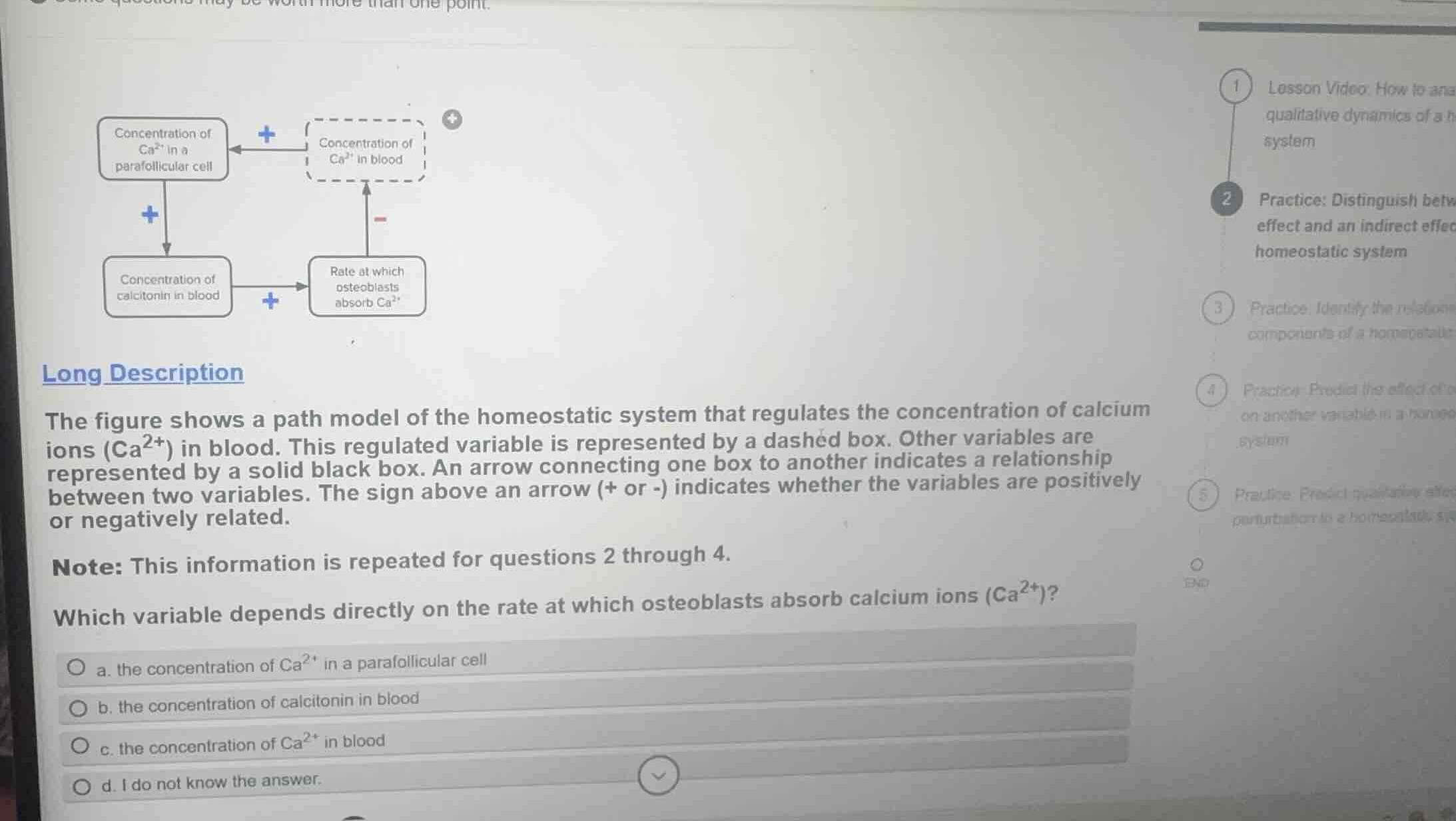
the figure shows a path model of the homeostatic system that regulates the concentration of calcium ions (\\(\text{ca}^{2+}\\)) in blood. this regulated variable is represented by a dashed box. other variables are represented by a solid black box. an arrow connecting one box to another indicates a relationship between two variables. the sign above an arrow (+ or -) indicates whether the variables are positively or negatively related.
note: this information is repeated for questions 2 through 4.
which variable depends directly on the rate at which osteoblasts absorb calcium ions (\\(\text{ca}^{2+}\\))?
a. the concentration of \\(\text{ca}^{2+}\\) in a parafollicular cell
b. the concentration of calcitonin in blood
c. the concentration of \\(\text{ca}^{2+}\\) in blood
d. i do not know the answer.
Identify the source variable in the question
The question asks which variable depends directly on the "Rate at which osteoblasts absorb \(Ca^{2+}\)". In causal diagrams, if variable B depends directly on variable A, there must be a direct arrow pointing from A to B.
Trace the outgoing arrow from the source variable
Using the Path Models and Causal Diagrams knowledge points:
The arrow originating from the box "Rate at which osteoblasts absorb \(Ca^{2+}\)" points directly to the dashed box "Concentration of \(Ca^{2+}\) in blood" with a negative sign. Therefore, the concentration of \(Ca^{2+}\) in blood depends directly on this rate.

Snap & solve any problem in the app
Get step-by-step solutions on Sovi AI
Photo-based solutions with guided steps
Explore more problems and detailed explanations
- a. the concentration of \(Ca^{2+}\) in a parafollicular cell
- b. the concentration of calcitonin in blood
- c. the concentration of \(Ca^{2+}\) in blood (Correct answer)
- d. I do not know the answer.