Sovi.AI - AI Math Tutor

Scan to solve math questions

QUESTION IMAGE

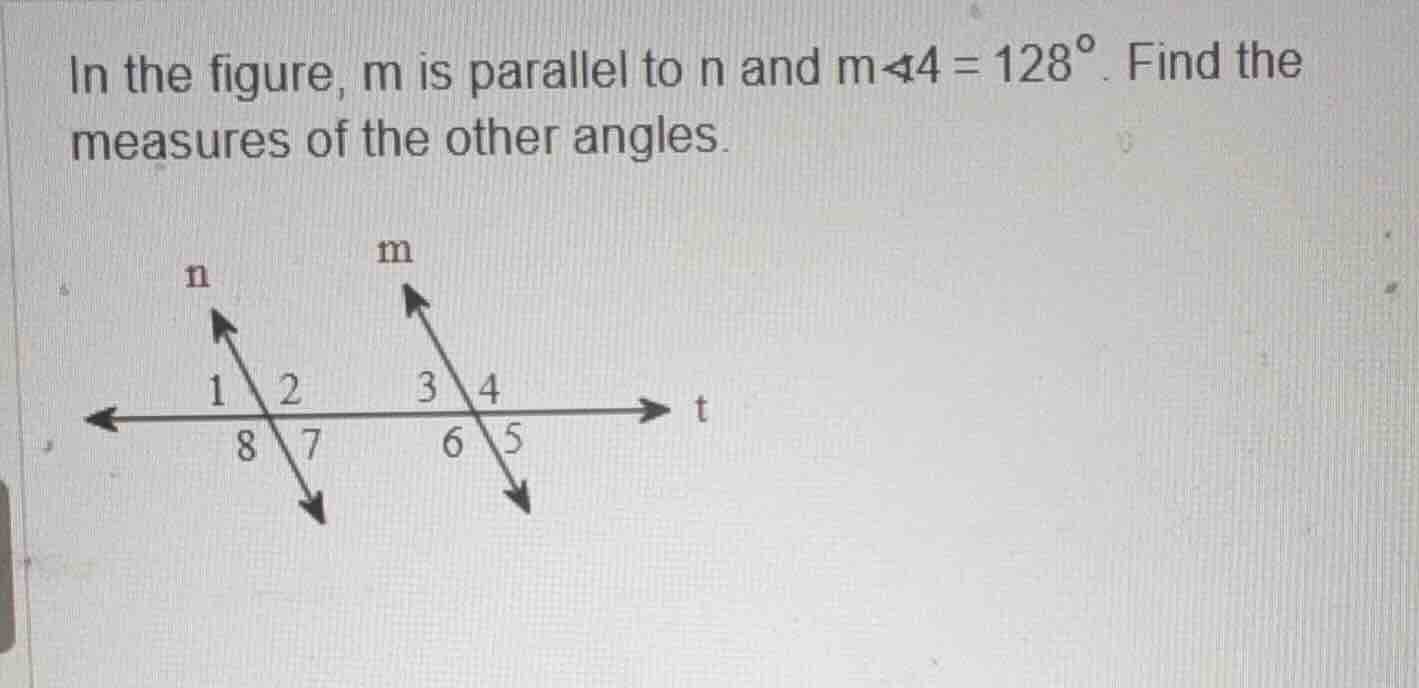
in the figure, m is parallel to n and \\(m\\angle 4 = 128^{\\circ}\\). …

Question

in the figure, m is parallel to n and \\(m\angle 4 = 128^{\circ}\\). find the measures of the other angles.

Explanation:

Response

<pre_analysis>
{
"quality": "clear",
"question_count": 1,
"skills_matched": [
"step_cot",
"explain_then_answer",
"tutor",
"mastery_adaptive_brevity"
],
"needs_drawing": false,
"concepts_used": [
"Supplementary Angles"
],
"new_concepts": [
"Parallel Lines Cut by a Transversal",
"Vertical Angles",
"Corresponding Angles"
],
"current_concepts": [
"Supplementary Angles",
"Parallel Lines Cut by a Transversal",
"Vertical Angles",
"Corresponding Angles"
]
}
</pre_analysis>

<reasoning>

Find supplementary angles to angle 4

Using the Supplementary Angles knowledge point
\[

$$\begin{aligned} &m\angle 3 + m\angle 4 = 180^\circ \implies m\angle 3 = 180^\circ - 128^\circ = 52^\circ\\ &m\angle 5 + m\angle 4 = 180^\circ \implies m\angle 5 = 180^\circ - 128^\circ = 52^\circ \end{aligned}$$

\]

Find vertical angle to angle 4

We use the vertical angles theorem to find the measure of angle 6.
Since vertical angles are equal:
\[
m\angle 6 = m\angle 4 = 128^\circ
\]

Find corresponding angles on line n

Since line \(m\) is parallel to line \(n\), corresponding angles are equal.
We match each angle on line \(m\) with its corresponding angle on line \(n\):
\[

$$\begin{aligned} &m\angle 1 = m\angle 3 = 52^\circ\\ &m\angle 2 = m\angle 4 = 128^\circ\\ &m\angle 7 = m\angle 5 = 52^\circ\\ &m\angle 8 = m\angle 6 = 128^\circ \end{aligned}$$

\]
</reasoning>

<answer>
\[

$$\begin{aligned} m\angle 1 &= 52^\circ \\ m\angle 2 &= 128^\circ \\ m\angle 3 &= 52^\circ \\ m\angle 5 &= 52^\circ \\ m\angle 6 &= 128^\circ \\ m\angle 7 &= 52^\circ \\ m\angle 8 &= 128^\circ \end{aligned}$$

\]
</answer>

<post_analysis>
{
"subject": "Mathematics",
"question_type": "Free Response",
"knowledge_point": [
"Mathematics",
"Geometry",
"Parallel Lines Cut by a Transversal"
]
}
</post_analysis>

Answer:

<pre_analysis>
{
"quality": "clear",
"question_count": 1,
"skills_matched": [
"step_cot",
"explain_then_answer",
"tutor",
"mastery_adaptive_brevity"
],
"needs_drawing": false,
"concepts_used": [
"Supplementary Angles"
],
"new_concepts": [
"Parallel Lines Cut by a Transversal",
"Vertical Angles",
"Corresponding Angles"
],
"current_concepts": [
"Supplementary Angles",
"Parallel Lines Cut by a Transversal",
"Vertical Angles",
"Corresponding Angles"
]
}
</pre_analysis>

<reasoning>

Find supplementary angles to angle 4

Using the Supplementary Angles knowledge point
\[

$$\begin{aligned} &m\angle 3 + m\angle 4 = 180^\circ \implies m\angle 3 = 180^\circ - 128^\circ = 52^\circ\\ &m\angle 5 + m\angle 4 = 180^\circ \implies m\angle 5 = 180^\circ - 128^\circ = 52^\circ \end{aligned}$$

\]

Find vertical angle to angle 4

We use the vertical angles theorem to find the measure of angle 6.
Since vertical angles are equal:
\[
m\angle 6 = m\angle 4 = 128^\circ
\]

Find corresponding angles on line n

Since line \(m\) is parallel to line \(n\), corresponding angles are equal.
We match each angle on line \(m\) with its corresponding angle on line \(n\):
\[

$$\begin{aligned} &m\angle 1 = m\angle 3 = 52^\circ\\ &m\angle 2 = m\angle 4 = 128^\circ\\ &m\angle 7 = m\angle 5 = 52^\circ\\ &m\angle 8 = m\angle 6 = 128^\circ \end{aligned}$$

\]
</reasoning>

<answer>
\[

$$\begin{aligned} m\angle 1 &= 52^\circ \\ m\angle 2 &= 128^\circ \\ m\angle 3 &= 52^\circ \\ m\angle 5 &= 52^\circ \\ m\angle 6 &= 128^\circ \\ m\angle 7 &= 52^\circ \\ m\angle 8 &= 128^\circ \end{aligned}$$

\]
</answer>

<post_analysis>
{
"subject": "Mathematics",
"question_type": "Free Response",
"knowledge_point": [
"Mathematics",
"Geometry",
"Parallel Lines Cut by a Transversal"
]
}
</post_analysis>