QUESTION IMAGE
Question
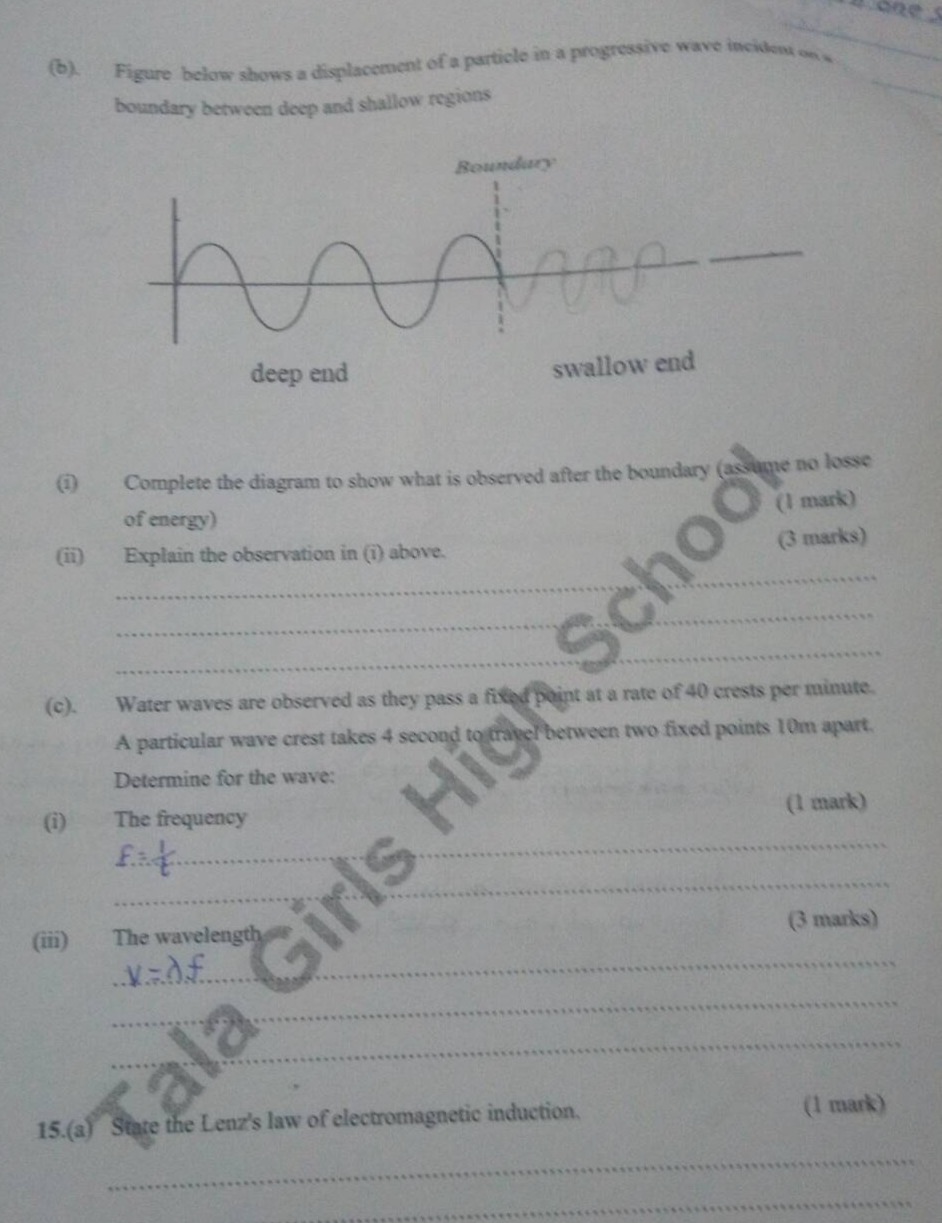
(b). figure below shows a displacement of a particle in a progressive wave incident on a boundary between deep and shallow regions
(i) complete the diagram to show what is observed after the boundary (assume no losses of energy)
(1 mark)
(ii) explain the observation in (i) above.
(3 marks)
(c). water waves are observed as they pass a fixed point at a rate of 40 crests per minute. a particular wave crest takes 4 second to travel between two fixed points 10m apart. determine for the wave:
(i) the frequency
(1 mark)
(iii) the wavelength
(3 marks)
15.(a) state the lenzs law of electromagnetic induction.
(1 mark)
🆕 New Concept Discovered: Wave Behavior at Boundaries
How waves change speed, wavelength, and frequency across media.
Step 1: Complete the Wave Diagram at the Shallow End
When a water wave travels from a deep region to a shallow region, its speed decreases.
Because the source of the wave does not change, the frequency \( f \) (the number of wave crests passing a point per second) remains constant.
Using the wave equation:
If the speed \( v \) decreases while the frequency \( f \) remains constant, the wavelength \( \lambda \) (the distance between consecutive crests) must decrease. Therefore, in the shallow region, the waves should be drawn closer together (shorter wavelength).
Additionally, assuming no loss of energy, the amplitude of the wave in the shallower water typically increases slightly or remains comparable, but the primary observable change is the significant reduction in wavelength.
Step 2: Explain the Observation at the Boundary
- Frequency remains constant: The frequency of a wave is determined solely by the source producing it, so it does not change when crossing the boundary.
- Speed decreases: Water waves travel slower in shallower water due to increased interaction with the boundary bed.
- Wavelength decreases: Since \( v = f \lambda \) and \( f \) is constant, the decrease in speed \( v \) directly results in a shorter wavelength \( \lambda \).
Step 3: Calculate the Frequency of the Wave
The problem states that 40 crests pass a fixed point in one minute (60 seconds).
Frequency \( f \) is the number of cycles (or crests) per second:
Step 4: Calculate the Wavelength of the Wave
First, find the speed \( v \) of the wave. A crest travels a distance of \( d = 10\text{ m} \) in a time of \( t = 4\text{ s} \):
Next, use the wave equation to find the wavelength \( \lambda \):
Step 5: State Lenz's Law of Electromagnetic Induction
Lenz's law states that the direction of an induced electromotive force (emf) or current is always such that it opposes the change in magnetic flux that produces it.
---

Snap & solve any problem in the app
Get step-by-step solutions on Sovi AI
Photo-based solutions with guided steps
Explore more problems and detailed explanations
(b) Wave Behavior at the Boundary
- (i) Diagram Completion: In the "shallow end" region, draw a continuous wave with a shorter wavelength (crests spaced closer together) compared to the deep end.
- (ii) Explanation: As water waves enter shallower water, their speed decreases. Since the frequency of the wave remains constant (determined by the source), the wavelength must decrease to satisfy the wave equation \( v = f \lambda \).
---
(c) Wave Calculations
- (i) Frequency:
- (ii) Wavelength:
- Speed: \( v = \frac{10\text{ m}}{4\text{ s}} = 2.5\text{ m/s} \)
- Wavelength: \( \lambda = \frac{v}{f} = \frac{2.5}{\frac{2}{3}} = 3.75\text{ m} \)
---
15. (a) Lenz's Law
Lenz's law states that the direction of an induced current/emf is always such that it opposes the change in magnetic flux that created it.