QUESTION IMAGE
Question
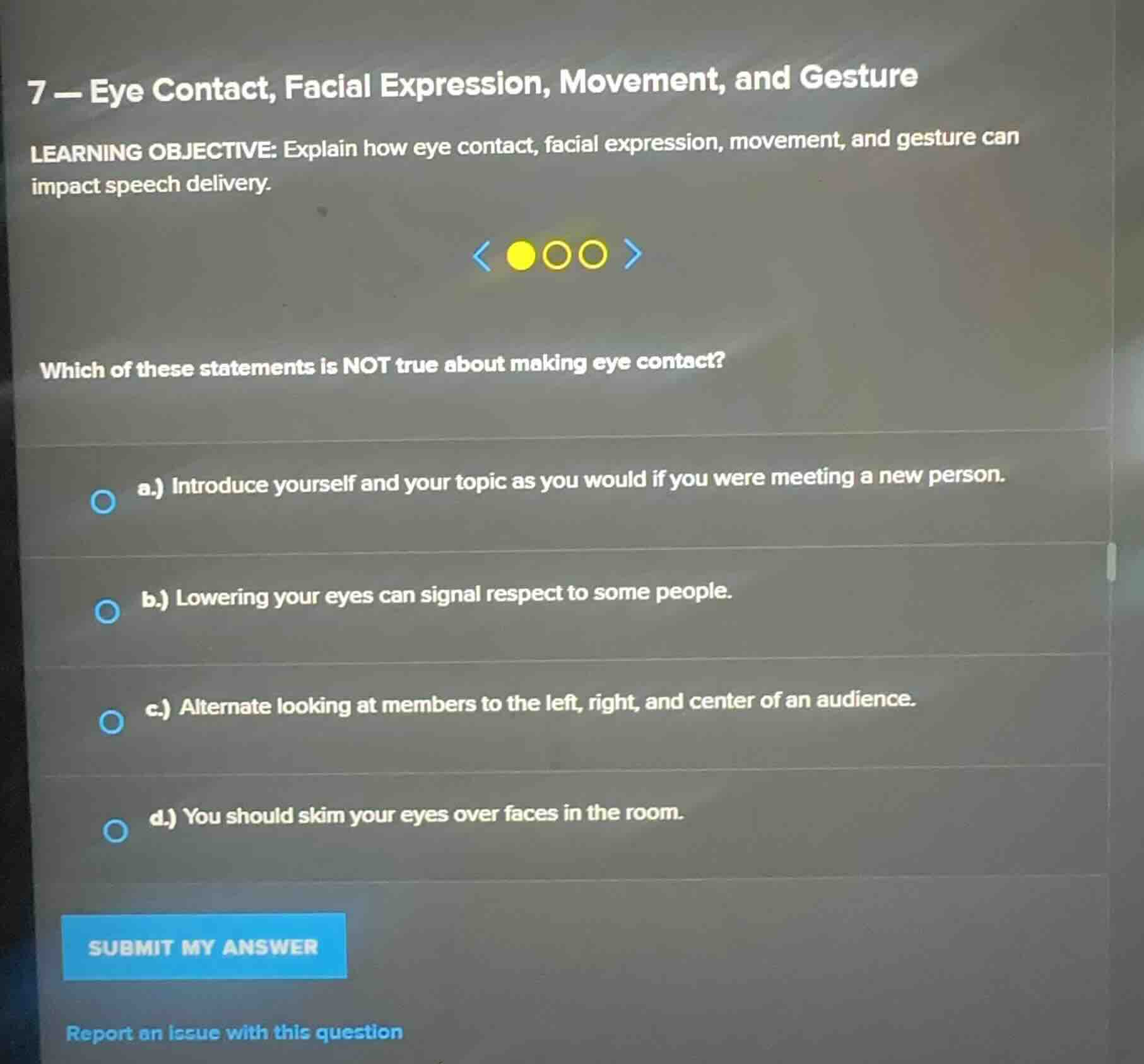
7 - eye contact, facial expression, movement, and gesture
learning objective: explain how eye contact, facial expression, movement, and gesture can impact speech delivery.
which of these statements is not true about making eye contact?
a.) introduce yourself and your topic as you would if you were meeting a new person.
b.) lowering your eyes can signal respect to some people.
c.) alternate looking at members to the left, right, and center of an audience.
d.) you should skim your eyes over faces in the room.
Analyze the question and options
The question asks to identify which statement is NOT true about making eye contact during public speaking.
Evaluate each option
- Option (a) is a true guideline: introducing yourself and your topic with direct eye contact mimics natural interpersonal connection.
- Option (b) is a true cultural/contextual fact: in some cultures, lowering one's eyes is a sign of respect.
- Option (c) is a true delivery technique: scanning different sections of the audience (left, right, center) helps engage the entire room.
- Option (d) is NOT true: skimming or scanning over faces without actually making brief, direct eye contact (often called "the lighthouse effect" or "blank staring") is discouraged because it makes the speaker look disconnected or nervous. Instead, speakers should make brief, genuine eye contact with individual people.
Determine the correct choice
Option (d) is the statement that is NOT true.

Snap & solve any problem in the app
Get step-by-step solutions on Sovi AI
Photo-based solutions with guided steps
Explore more problems and detailed explanations
- a.) Introduce yourself and your topic as you would if you were meeting a new person.
- b.) Lowering your eyes can signal respect to some people.
- c.) Alternate looking at members to the left, right, and center of an audience.
- d.) You should skim your eyes over faces in the room. (Correct answer)