QUESTION IMAGE
Question
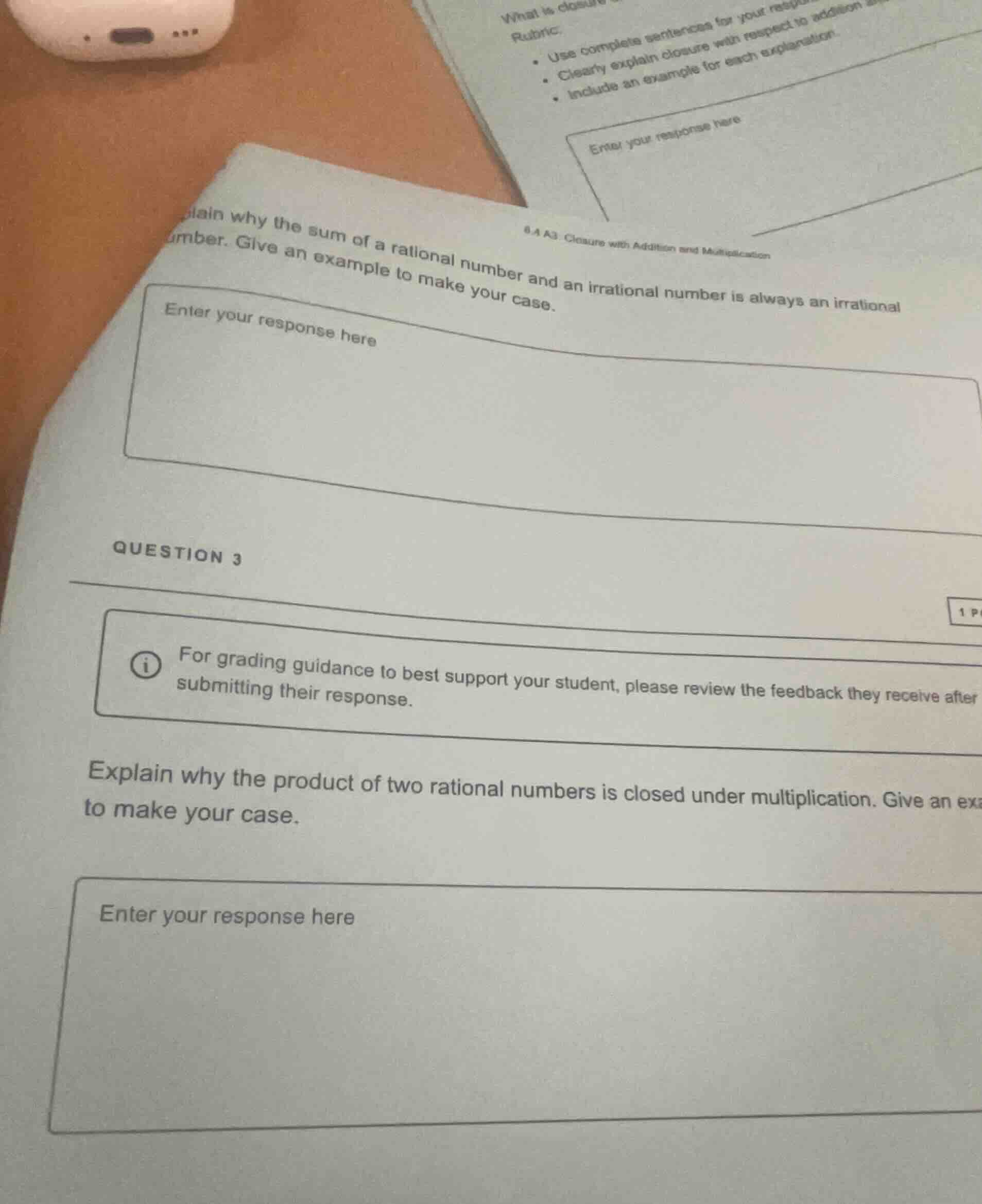
explain why the sum of a rational number and an irrational number is always an irrational number. give an example to make your case.
question 3
explain why the product of two rational numbers is closed under multiplication. give an example to make your case.
Define rational and irrational numbers
We use the Rational Numbers and Irrational Numbers concepts.
A rational number can be written as \(\frac{a}{b}\), where \(a, b\) are integers and \(b
eq 0\).
An irrational number cannot be written as a fraction of integers.
Prove sum is always irrational
We use proof by contradiction.
Let \(r\) be a rational number and \(i\) be an irrational number.
Assume their sum is a rational number \(s\):
Subtract \(r\) from both sides:
Since the difference of two rational numbers is always rational, \(s - r\) must be rational.
This contradicts the fact that \(i\) is irrational.
Thus, the sum \(r + i\) must be irrational.
Provide sum example
Let the rational number be \(r = 3\).
Let the irrational number be \(i = \sqrt{2}\).
Their sum is \(3 + \sqrt{2}\).
Since \(\sqrt{2} \approx 1.414213...\) is non-repeating and non-terminating, \(3 + \sqrt{2} \approx 4.414213...\) is also non-repeating and non-terminating, which is irrational.
Prove closure under multiplication
We use the Closure Property concept.
Let \(x\) and \(y\) be any two rational numbers:
where \(a, b, c, d\) are integers, and \(b, d
eq 0\).
Multiply the two numbers:
Since integers are closed under multiplication, \(a \cdot c\) and \(b \cdot d\) are integers.
Since \(b
eq 0\) and \(d
eq 0\), \(b \cdot d
eq 0\).
Therefore, the product is a ratio of integers, which is a rational number.
Provide product example
Let the rational numbers be \(\frac{2}{3}\) and \(\frac{5}{7}\).
Their product is:
Since \(10\) and \(21\) are integers and \(21
eq 0\), the product \(\frac{10}{21}\) is rational.

Snap & solve any problem in the app
Get step-by-step solutions on Sovi AI
Photo-based solutions with guided steps
Explore more problems and detailed explanations
Question 1
To explain why the sum of a rational number and an irrational number is always irrational, we can use a proof by contradiction:
- Proof: Let \(r\) be a rational number and \(i\) be an irrational number. Assume their sum is a rational number \(s\), so \(r + i = s\). Solving for \(i\) gives \(i = s - r\). Since the difference of two rational numbers is always rational, \(s - r\) must be rational. This contradicts our starting condition that \(i\) is irrational. Therefore, the sum \(r + i\) must be irrational.
- Example: Let the rational number be \(3\) and the irrational number be \(\sqrt{2}\). Their sum is \(3 + \sqrt{2}\). Since the decimal expansion of \(\sqrt{2}\) is non-terminating and non-repeating (\(1.414213...\)), adding \(3\) results in \(4.414213...\), which remains non-terminating and non-repeating, making it irrational.
Question 2
To explain why the product of two rational numbers is closed under multiplication:
- Proof: Let \(x\) and \(y\) be any two rational numbers, which can be written as \(x = \frac{a}{b}\) and \(y = \frac{c}{d}\) (where \(a, b, c, d\) are integers, and \(b, d
eq 0\)). Their product is:
Since integers are closed under multiplication, \(a \cdot c\) and \(b \cdot d\) are integers. Because \(b
eq 0\) and \(d
eq 0\), their product \(b \cdot d
eq 0\). Since the product can be written as a ratio of two integers with a non-zero denominator, it is by definition a rational number.
- Example: Let the two rational numbers be \(\frac{2}{3}\) and \(\frac{5}{7}\). Their product is:
Since \(10\) and \(21\) are integers and \(21
eq 0\), the product \(\frac{10}{21}\) is a rational number.