QUESTION IMAGE
Question
excerpt of \song of myself\
by walt whitman
the blab of the pave, tires of carts, sluff of boot-soles, talk of the promenaders,
the heavy omnibus, the driver with his interrogating thumb, the clank of the shod horses on the granite floor,
the snow-sleighs, clinking, shouted jokes, pelts of snow-balls,
the hurrahs for popular favorites, the fury of rousd mobs,
the flap of the curtaind litter, a sick man inside borne to the hospital,
the meeting of enemies, the sudden oath, the blows and fall,
the excited crowd, the policeman with his star quickly working his passage to the centre of the crowd,
the impassive stones that receive and return so many echoes,
what groans of over-fed or half-starvd who fall sunstruck or in fits,
what exclamations of women taken suddenly who hurry home and give birth to babes,
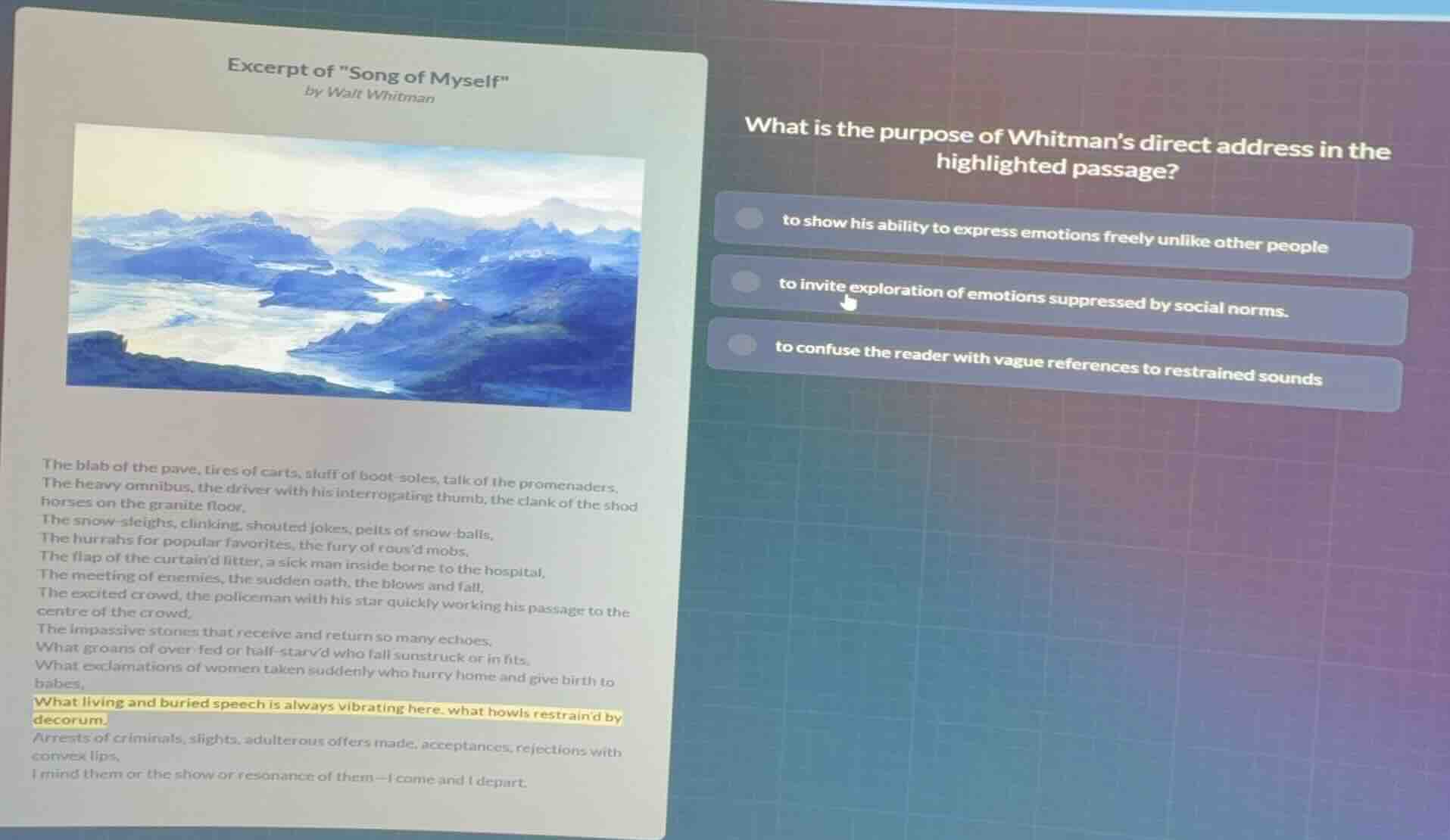
what living and buried speech is always vibrating here, what howls restraind by decorum,
arrests of criminals, slights, adulterous offers made, acceptances, rejections with convex lips,
i mind them or the show or resonance of them-i come and i depart.
what is the purpose of whitmans direct address in the highlighted passage?
to show his ability to express emotions freely unlike other people
to invite exploration of emotions suppressed by social norms.
to confuse the reader with vague references to restrained sounds
Analyze the highlighted passage
The highlighted passage in the excerpt from Walt Whitman's "Song of Myself" reads:
"What living and buried speech is always vibrating here, what howls restrain'd by decorum."
This passage uses Direct Address Analysis to prompt the reader to consider the unspoken, repressed thoughts and raw emotional expressions ("howls") that are kept hidden beneath the surface of polite society ("decorum").
Evaluate the purpose of the address
Whitman is drawing attention to the contrast between natural, raw human expression ("living and buried speech", "howls") and the restrictive expectations of society ("decorum"). By asking what these restrained howls are, he is not seeking to confuse the reader, nor is he merely boasting about his own unique abilities. Instead, he is inviting the reader to explore and acknowledge these deep, authentic emotions that social norms typically suppress.
Match with the correct option
- Option 1 ("to show his ability to express emotions freely unlike other people") focuses too much on self-aggrandizement rather than the universal human connection Whitman seeks.
- Option 2 ("to invite exploration of emotions suppressed by social norms") directly aligns with the thematic tension between "howls" (raw emotion) and "decorum" (social norms/propriety).
- Option 3 ("to confuse the reader...") misinterprets the literary purpose of Whitman's rhetorical inquiry.

Snap & solve any problem in the app
Get step-by-step solutions on Sovi AI
Photo-based solutions with guided steps
Explore more problems and detailed explanations
- to show his ability to express emotions freely unlike other people
- to invite exploration of emotions suppressed by social norms. (Correct answer)
- to confuse the reader with vague references to restrained sounds