QUESTION IMAGE
Question
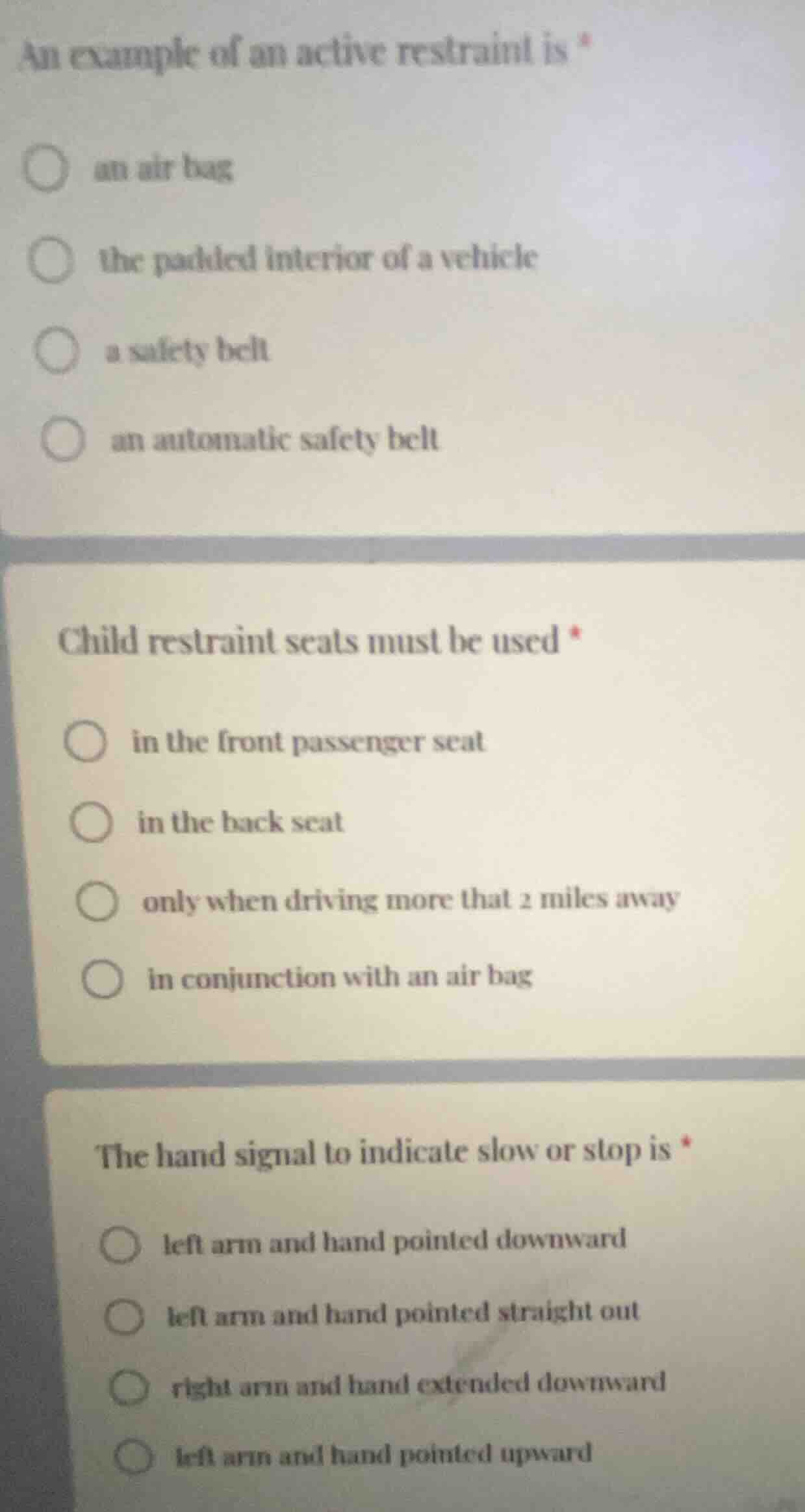
an example of an active restraint is *
an air bag
the padded interior of a vehicle
a safety belt
an automatic safety belt
child restraint seats must be used *
in the front passenger seat
in the back seat
only when driving more that 2 miles away
in conjunction with an air bag
the hand signal to indicate slow or stop is *
left arm and hand pointed downward
left arm and hand pointed straight out
right arm and hand extended downward
left arm and hand pointed upward
Analyze active versus passive restraint systems
Active restraints require action by the vehicle occupants to be effective. Applying our knowledge of Seat Belt Adjustment, a standard safety belt must be manually buckled by the passenger, making it an active restraint. Conversely, air bags, padded interiors, and automatic safety belts deploy or function without occupant intervention, classifying them as passive restraints.
Determine proper child restraint seat placement
Child safety seats must be installed in the back seat of a vehicle. Placing a child in the front passenger seat is highly dangerous due to the force of deploying passenger-side air bags. Restraints are required for all trips regardless of distance, and they do not rely on air bags for safety.
Identify standard driver hand signals
Standard hand signals are used when a vehicle's signaling lights are inoperable. To signal a slow or stop, the driver extends their left arm out of the window and points the arm and hand downward. Extending the arm straight out indicates a left turn, while pointing it upward indicates a right turn.

Snap & solve any problem in the app
Get step-by-step solutions on Sovi AI
Photo-based solutions with guided steps
Explore more problems and detailed explanations
Question 1
- (A) an air bag
- (B) the padded interior of a vehicle
- (C) a safety belt (Correct answer)
- (D) an automatic safety belt
Question 2
- (A) in the front passenger seat
- (B) in the back seat (Correct answer)
- (C) only when driving more that 2 miles away
- (D) in conjunction with an air bag
Question 3
- (A) left arm and hand pointed downward (Correct answer)
- (B) left arm and hand pointed straight out
- (C) right arm and hand extended downward
- (D) left arm and hand pointed upward