QUESTION IMAGE
Question
exam lesson name: the political process
exam number: 700111rr
exam guidelines
exam instructions
question 18 of 20 :
select the best answer for the question
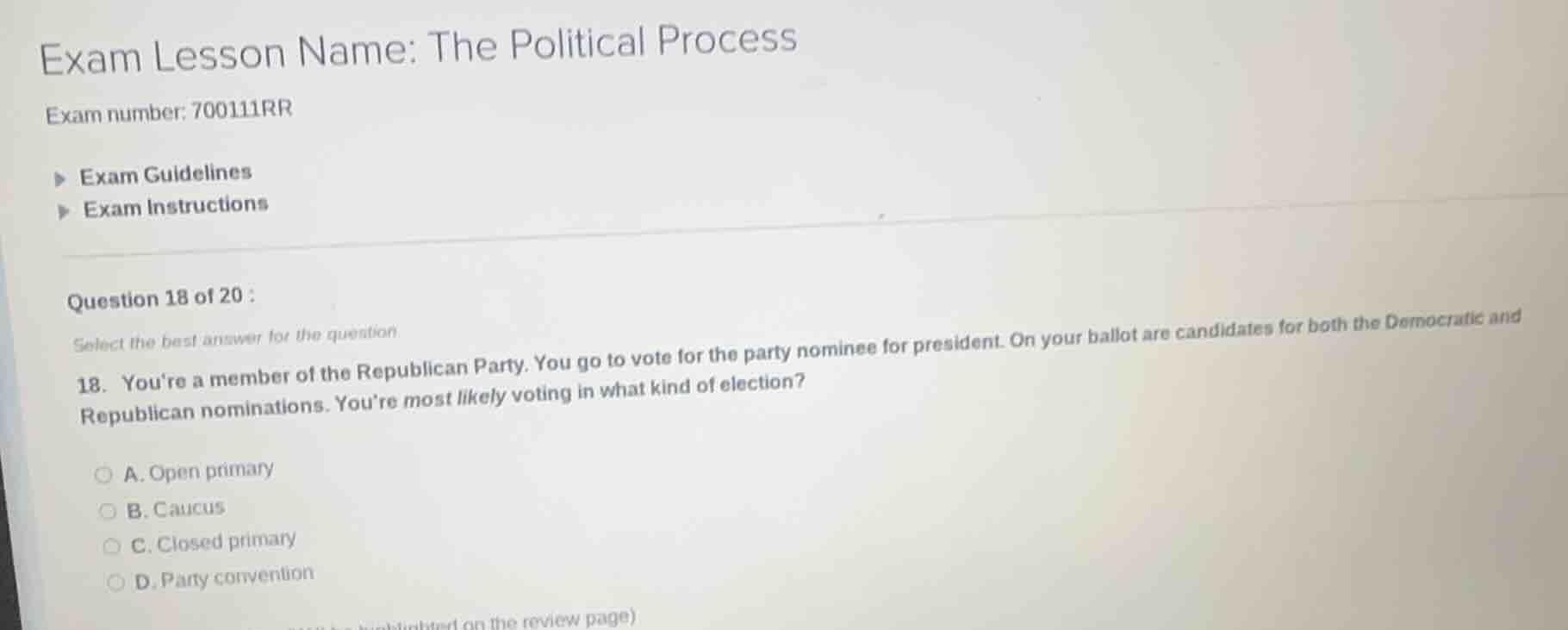
- youre a member of the republican party. you go to vote for the party nominee for president. on your ballot are candidates for both the democratic and republican nominations. youre most likely voting in what kind of election?
a. open primary
b. caucus
c. closed primary
d. party convention
Brief Explanations
To solve this, we analyze each option:
- Option A (Open primary): In an open primary, any registered voter (regardless of party) can choose which party's primary to vote in. But here, the voter is a Republican and the ballot has both Democratic and Republican nominees? No, wait—wait, the question says the voter is a Republican, going to vote for the party nominee, and the ballot has both Democratic and Republican nominations? Wait, no, maybe misread. Wait, the key: In an open primary, voters can choose any party's primary. But the question: the voter is a Republican, voting for party nominee, and ballot has both? No, maybe the question's scenario: Wait, no—let's recall definitions:
- Closed primary: Only registered members of the party can vote in that party's primary. But wait, the ballot here has both Democratic and Republican? No, maybe the question's wording: Wait, the question says "you're a member of the Republican Party. You go to vote for the party nominee for president. On your ballot are candidates for both the Democratic and Republican nominations." Wait, that would be an open primary? No, no—wait, no, maybe I misread. Wait, no: In an open primary, a voter (even non - party member) can choose which primary to vote in, and the ballot for that primary has only that party's candidates? Wait, no, maybe the question's error, or my misunderstanding. Wait, no—let's re - evaluate:
- Option A (Open primary): In an open primary, a voter can choose to vote in either party's primary, regardless of their own party affiliation. But the voter here is a Republican, and the ballot has both Democratic and Republican nominees. Wait, that would mean that in this election, voters can choose between the two parties' nominees in the primary, which is characteristic of an open primary? No, no—wait, no, the primary is to choose the party's nominee. Wait, maybe the question is phrased as: the voter is a Republican, going to vote for the party nominee, but the ballot has both Democratic and Republican nominations (i.e., the voter can choose to vote in either primary). Wait, that's an open primary. But wait, no—let's check the other options:
- Option B (Caucus): A caucus is a local meeting where party members gather to discuss and vote on candidates, it's not a ballot - based election with candidates from both parties on the ballot.
- Option C (Closed primary): In a closed primary, only registered members of the party can vote in that party's primary, and the ballot would only have that party's candidates. So if the voter is a Republican, in a closed primary, the ballot would only have Republican candidates. But the question says the ballot has both Democratic and Republican nominees, so closed primary is out.
- Option D (Party convention): A party convention is a meeting of party delegates to nominate candidates, not a primary election where individual voters cast ballots with candidates from both parties.
Wait, I think I made a mistake earlier. Let's re - define:
- Open primary: Voters (regardless of party) can choose which party's primary to vote in, and when they choose a party's primary, the ballot has that party's candidates. Wait, no—the question says "on your ballot are candidates for both the Democratic and Republican nominations". So the voter, a Republican, can vote for either Democratic or Republican nominees in the primary. That is the definition of an open primary: a primary election in which any registered voter can vote in any party's primary, and the ballot for that primary (if it's open…

Snap & solve any problem in the app
Get step-by-step solutions on Sovi AI
Photo-based solutions with guided steps
Explore more problems and detailed explanations
A. Open primary