QUESTION IMAGE
Question
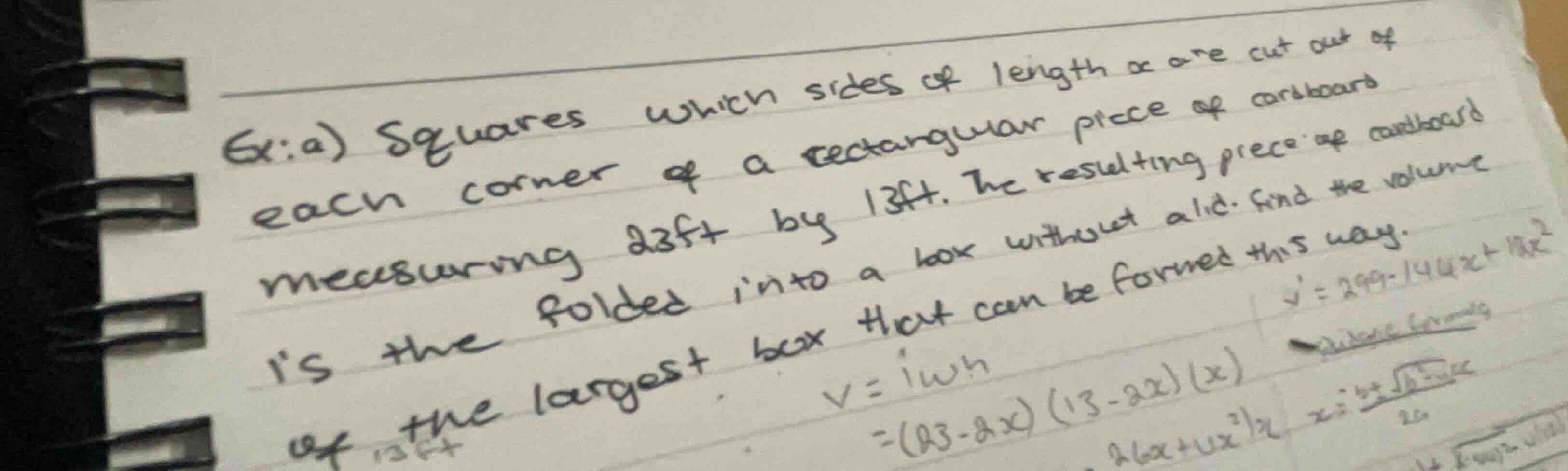
ex: a) squares which sides of length \\(x\\) are cut out of each corner of a rectangular piece of cardboard measuring \\(23\text{ft}\\) by \\(13\text{ft}\\). the resulting piece of cardboard is then folded into a box without a lid. find the volume of the largest box that can be formed this way.
<pre_analysis>
{
"quality": "clear",
"question_count": 1,
"skills_matched": [
"step_cot",
"explain_then_answer",
"tutor"
],
"needs_drawing": true,
"concepts_used": [],
"new_concepts": [
"Optimization Problems",
"Volume of a Box",
"Applied Derivatives"
],
"current_concepts": [
"Optimization Problems",
"Volume of a Box",
"Applied Derivatives"
]
}
</pre_analysis>
<reasoning>
Express the volume function
The dimensions of the cardboard are \(23\text{ ft}\) by \(13\text{ ft}\).
Cutting out squares of side length \(x\) from each corner yields:
- Length: \(l = 23 - 2x\)
- Width: \(w = 13 - 2x\)
- Height: \(h = x\)
The volume \(V(x)\) is:
\[
V(x) = x(23 - 2x)(13 - 2x) = 4x^3 - 72x^2 + 299x
\]
The physical domain is \(0 < x < 6.5\).
Find the derivative
Differentiate \(V(x)\) with respect to \(x\):
\[
V'(x) = 12x^2 - 144x + 299
\]
Solve for critical points
Set \(V'(x) = 0\):
\[
12x^2 - 144x + 299 = 0
\]
Using the quadratic formula:
\[
x = \frac{144 \pm \sqrt{(-144)^2 - 4(12)(299)}}{24}
\]
\[
x = \frac{144 \pm \sqrt{20736 - 14352}}{24} = \frac{144 \pm \sqrt{6384}}{24}
\]
\[
x = \frac{144 \pm 4\sqrt{399}}{24} = 6 \pm \frac{\sqrt{399}}{6}
\]
Evaluating the roots:
- \(x_1 = 6 + \frac{\sqrt{399}}{6} \approx 6 + 3.33 = 9.33\) (outside domain)
- \(x_2 = 6 - \frac{\sqrt{399}}{6} \approx 6 - 3.33 = 2.67\) (inside domain)
Verify the maximum
Using the second derivative test:
\[
V''(x) = 24x - 144
\]
At \(x \approx 2.67\):
\[
V''(2.67) = 24(2.67) - 144 \approx -79.92 < 0
\]
Thus, \(x = 6 - \frac{\sqrt{399}}{6}\) yields a local maximum.
Calculate maximum volume
Substitute \(x = 6 - \frac{\sqrt{399}}{6} \approx 2.671\) back into \(V(x)\):
\[
l \approx 23 - 2(2.671) = 17.658\text{ ft}
\]
\[
w \approx 13 - 2(2.671) = 7.658\text{ ft}
\]
\[
V \approx 17.658 \times 7.658 \times 2.671 \approx 361.2\text{ ft}^3
\]
</reasoning>
<answer>
The volume of the largest box that can be formed is approximately \(361.2\text{ ft}^3\) (occurring when \(x = 6 - \frac{\sqrt{399}}{6}\text{ ft} \approx 2.67\text{ ft}\)).
</answer>
<plot>
{
"elements": [
{
"type": "functiongraph",
"params": [
{
"js": "4xxx - 72xx + 299x",
"latex": "V(x) = 4x^3 - 72x^2 + 299x"
},
0,
6.5
],
"properties": {
"strokeColor": "#8C55F2",
"strokeWidth": 3,
"name": "V(x)"
}
},
{
"type": "point",
"params": [
[2.671, 361.2]
],
"properties": {
"name": "Max (2.67, 361.2)",
"color": "#F2557F",
"size": 5,
"withLabel": true
}
}
]
}
</plot>
<post_analysis>
{
"subject": "Mathematics",
"question_type": "Word Problem",
"knowledge_point": [
"Mathematics",
"Calculus",
"Optimization Problems"
]
}
</post_analysis>
Snap & solve any problem in the app
Get step-by-step solutions on Sovi AI
Photo-based solutions with guided steps
Explore more problems and detailed explanations
<pre_analysis>
{
"quality": "clear",
"question_count": 1,
"skills_matched": [
"step_cot",
"explain_then_answer",
"tutor"
],
"needs_drawing": true,
"concepts_used": [],
"new_concepts": [
"Optimization Problems",
"Volume of a Box",
"Applied Derivatives"
],
"current_concepts": [
"Optimization Problems",
"Volume of a Box",
"Applied Derivatives"
]
}
</pre_analysis>
<reasoning>
Express the volume function
The dimensions of the cardboard are \(23\text{ ft}\) by \(13\text{ ft}\).
Cutting out squares of side length \(x\) from each corner yields:
- Length: \(l = 23 - 2x\)
- Width: \(w = 13 - 2x\)
- Height: \(h = x\)
The volume \(V(x)\) is:
\[
V(x) = x(23 - 2x)(13 - 2x) = 4x^3 - 72x^2 + 299x
\]
The physical domain is \(0 < x < 6.5\).
Find the derivative
Differentiate \(V(x)\) with respect to \(x\):
\[
V'(x) = 12x^2 - 144x + 299
\]
Solve for critical points
Set \(V'(x) = 0\):
\[
12x^2 - 144x + 299 = 0
\]
Using the quadratic formula:
\[
x = \frac{144 \pm \sqrt{(-144)^2 - 4(12)(299)}}{24}
\]
\[
x = \frac{144 \pm \sqrt{20736 - 14352}}{24} = \frac{144 \pm \sqrt{6384}}{24}
\]
\[
x = \frac{144 \pm 4\sqrt{399}}{24} = 6 \pm \frac{\sqrt{399}}{6}
\]
Evaluating the roots:
- \(x_1 = 6 + \frac{\sqrt{399}}{6} \approx 6 + 3.33 = 9.33\) (outside domain)
- \(x_2 = 6 - \frac{\sqrt{399}}{6} \approx 6 - 3.33 = 2.67\) (inside domain)
Verify the maximum
Using the second derivative test:
\[
V''(x) = 24x - 144
\]
At \(x \approx 2.67\):
\[
V''(2.67) = 24(2.67) - 144 \approx -79.92 < 0
\]
Thus, \(x = 6 - \frac{\sqrt{399}}{6}\) yields a local maximum.
Calculate maximum volume
Substitute \(x = 6 - \frac{\sqrt{399}}{6} \approx 2.671\) back into \(V(x)\):
\[
l \approx 23 - 2(2.671) = 17.658\text{ ft}
\]
\[
w \approx 13 - 2(2.671) = 7.658\text{ ft}
\]
\[
V \approx 17.658 \times 7.658 \times 2.671 \approx 361.2\text{ ft}^3
\]
</reasoning>
<answer>
The volume of the largest box that can be formed is approximately \(361.2\text{ ft}^3\) (occurring when \(x = 6 - \frac{\sqrt{399}}{6}\text{ ft} \approx 2.67\text{ ft}\)).
</answer>
<plot>
{
"elements": [
{
"type": "functiongraph",
"params": [
{
"js": "4xxx - 72xx + 299x",
"latex": "V(x) = 4x^3 - 72x^2 + 299x"
},
0,
6.5
],
"properties": {
"strokeColor": "#8C55F2",
"strokeWidth": 3,
"name": "V(x)"
}
},
{
"type": "point",
"params": [
[2.671, 361.2]
],
"properties": {
"name": "Max (2.67, 361.2)",
"color": "#F2557F",
"size": 5,
"withLabel": true
}
}
]
}
</plot>
<post_analysis>
{
"subject": "Mathematics",
"question_type": "Word Problem",
"knowledge_point": [
"Mathematics",
"Calculus",
"Optimization Problems"
]
}
</post_analysis>