QUESTION IMAGE
Question
evaluating a rational function
\
\quad
\
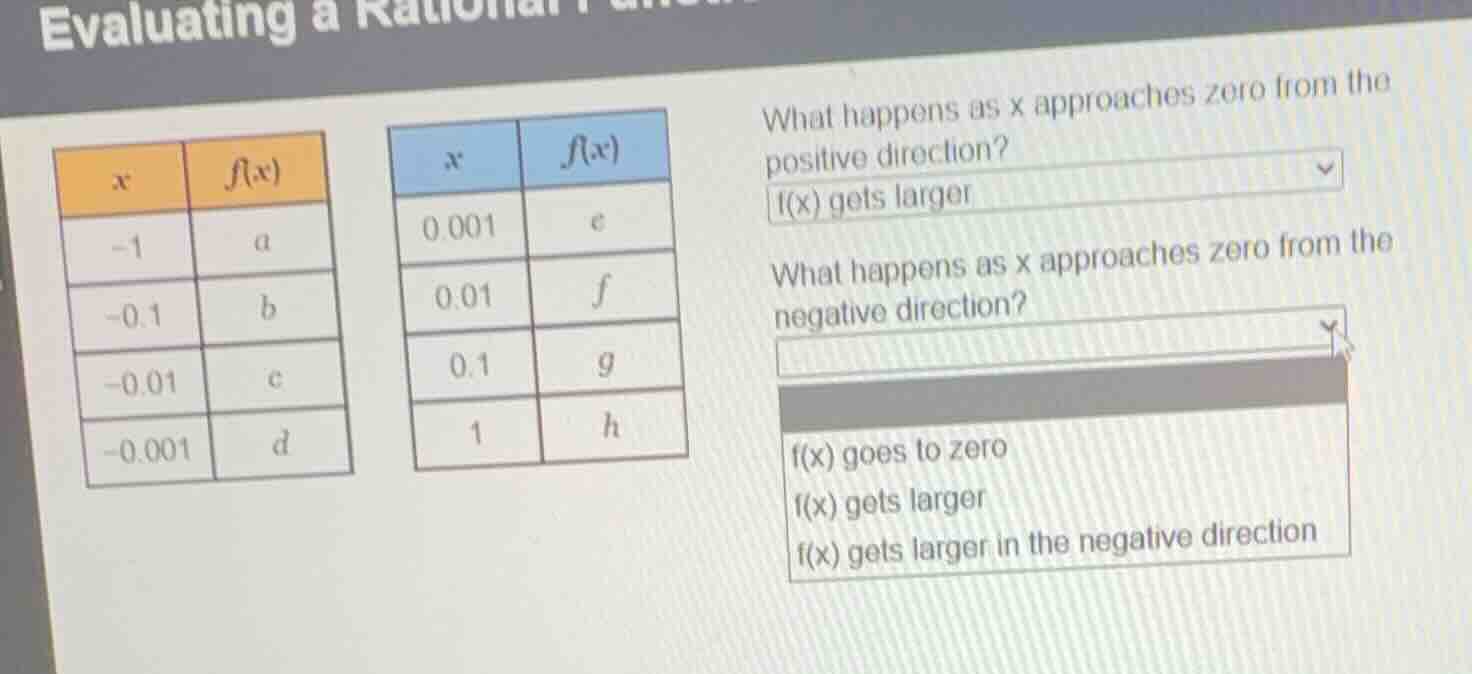
what happens as \\(x\\) approaches zero from the positive direction?
\\(f(x)\\) gets larger
what happens as \\(x\\) approaches zero from the negative direction?
options:
- \\(f(x)\\) goes to zero
- \\(f(x)\\) gets larger
- \\(f(x)\\) gets larger in the negative direction
Analyze the behavior from the positive direction
Using the Numerical Limits and One-Sided Limits knowledge points, we examine the table for positive values of \(x\) as they approach zero:
- For \(x = 1\), \(f(x) = h\)
- For \(x = 0.1\), \(f(x) = g\)
- For \(x = 0.01\), \(f(x) = f\)
- For \(x = 0.001\), \(f(x) = e\)
The first question asks: "What happens as \(x\) approaches zero from the positive direction?"
The selected answer in the image is: "f(x) gets larger". This indicates that as \(x\) decreases towards \(0\) from the right, the values of \(f(x)\) increase significantly (e.g., \(e > f > g > h\)).
Analyze the behavior from the negative direction
Now, we examine the table for negative values of \(x\) as they approach zero:
- For \(x = -1\), \(f(x) = a\)
- For \(x = -0.1\), \(f(x) = b\)
- For \(x = -0.01\), \(f(x) = c\)
- For \(x = -0.001\), \(f(x) = d\)
Since this is a rational function of the form \(f(x) = \frac{1}{x}\) or similar, as \(x\) approaches zero from the negative direction, the values of \(f(x)\) become extremely large in magnitude but negative in sign (e.g., \(-1, -10, -100, -1000\)).
Select the correct option
Looking at the dropdown options for the second question:
- "f(x) goes to zero"
- "f(x) gets larger"
- "f(x) gets larger in the negative direction"
As \(x\) approaches \(0\) from the left (negative direction), the values of \(f(x)\) decrease without bound, which is described as getting larger in the negative direction.

Snap & solve any problem in the app
Get step-by-step solutions on Sovi AI
Photo-based solutions with guided steps
Explore more problems and detailed explanations
- f(x) goes to zero
- f(x) gets larger
- f(x) gets larger in the negative direction (Correct answer)