QUESTION IMAGE
Question
2 - ethical marketing
learning objective: recognize the techniques used by businesses in an ethical environment.
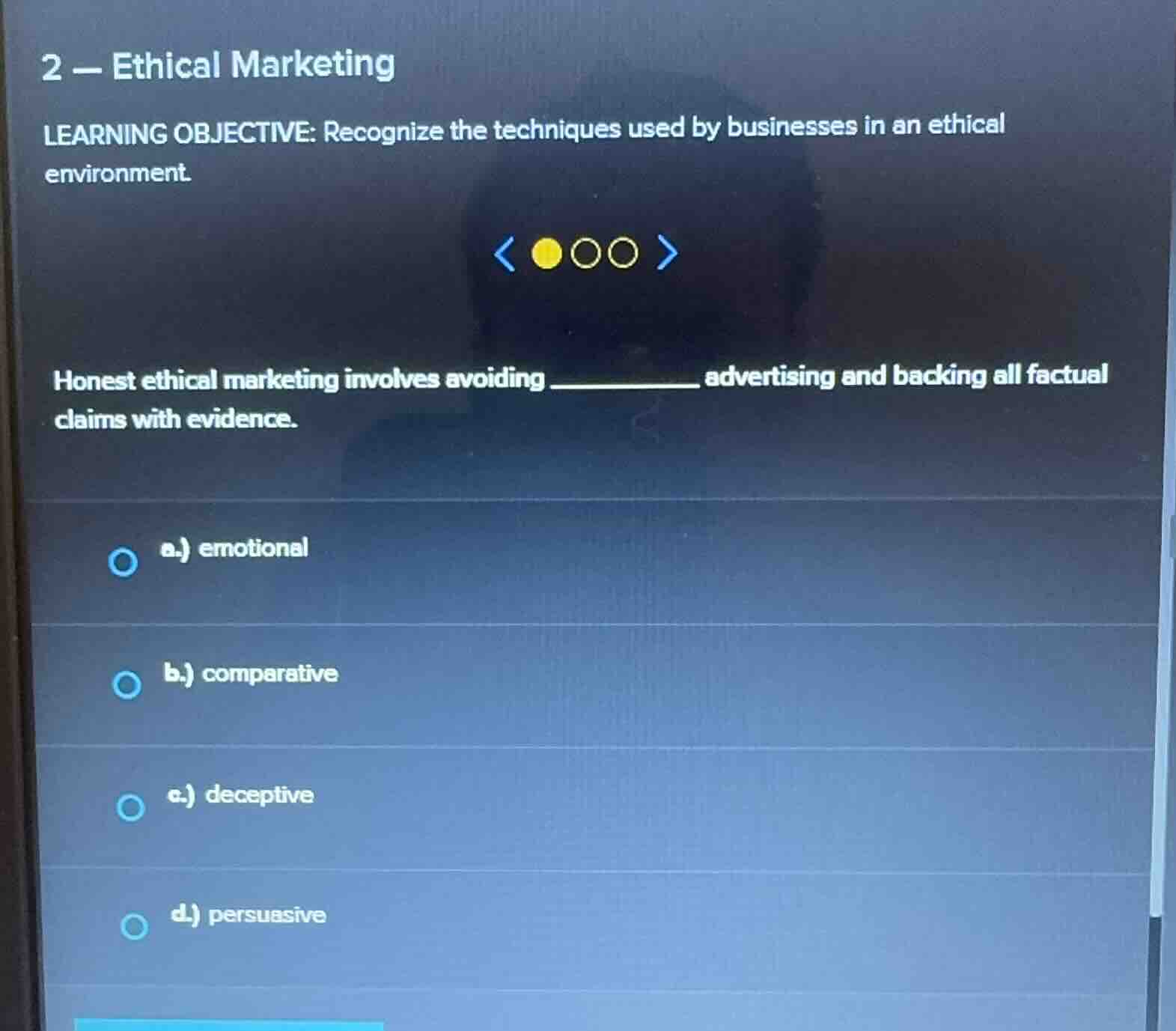
honest ethical marketing involves avoiding ________ advertising and backing all factual claims with evidence.
a.) emotional
b.) comparative
c.) deceptive
d.) persuasive
Analyze the core question
The question asks to fill in the blank: "Honest ethical marketing involves avoiding ________ advertising and backing all factual claims with evidence." We need to find the term that represents unethical advertising practice contrasted with backing claims with evidence.
Evaluate the options
- emotional: Emotional advertising appeals to feelings. While it can be manipulative, it is not inherently unethical or dishonest if it doesn't mislead.
- comparative: Comparative advertising compares one brand with another. This is a common and legal marketing strategy as long as the comparisons are true.
- deceptive: Deceptive advertising involves making false, misleading, or unproven claims. Avoiding this is the definition of honest, ethical marketing.
- persuasive: Persuasive advertising aims to convince consumers to buy. This is the fundamental goal of almost all marketing and is not unethical.
Connect to business ethics
Using Business Ethics, honest marketing requires truthfulness. Therefore, businesses must avoid deceptive practices and ensure all claims are supported by evidence.

Snap & solve any problem in the app
Get step-by-step solutions on Sovi AI
Photo-based solutions with guided steps
Explore more problems and detailed explanations
- a.) emotional
- b.) comparative
- c.) deceptive (Correct answer)
- d.) persuasive