QUESTION IMAGE
Question
erik eriksons stages of psychosocial development
a theory that people go through 8 stages across the lifespan, and each stage involves a key psychological conflict that influences personality and social development.
- trust vs. mistrust (infancy) - learning whether the world is safe and dependable.
- autonomy vs. shame/doubt (toddlerhood) - developing independence.
- initiative vs. guilt (early childhood) - learning to take action and make choices.
- industry vs. inferiority (school age) - building competence and confidence.
- identity vs. role confusion (adolescence) - figuring out \who am i?\
- intimacy vs. isolation (young adulthood) - forming close relationships.
- generativity vs. stagnation (middle adulthood) - contributing to society and future generations.
- integrity vs. despair (older adulthood) - reflecting on life with satisfaction or regret.
Identify the core topic
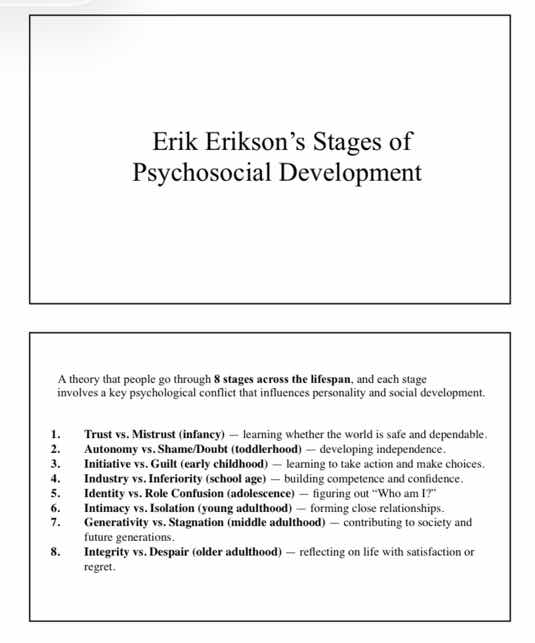
The provided image presents a summary of Erik Erikson's Stages of Psychosocial Development. It outlines a developmental theory consisting of eight distinct stages across the human lifespan.
Analyze the key components
Each of the eight stages is defined by a specific psychological conflict and associated age range:
- Trust vs. Mistrust (infancy): Focuses on learning if the world is safe and dependable.
- Autonomy vs. Shame/Doubt (toddlerhood): Focuses on developing personal independence.
- Initiative vs. Guilt (early childhood): Focuses on learning to take action and make choices.
- Industry vs. Inferiority (school age): Focuses on building competence and confidence.
- Identity vs. Role Confusion (adolescence): Focuses on figuring out personal identity ("Who am I?").
- Intimacy vs. Isolation (young adulthood): Focuses on forming close, loving relationships.
- Generativity vs. Stagnation (middle adulthood): Focuses on contributing to society and guiding future generations.
- Integrity vs. Despair (older adulthood): Focuses on reflecting on life with satisfaction or regret.
Summarize the theoretical framework
Erikson's theory suggests that personality and social development are shaped by how individuals navigate these sequential, age-specific conflicts throughout their lives. Successful resolution of each conflict leads to healthy psychological growth.

Snap & solve any problem in the app
Get step-by-step solutions on Sovi AI
Photo-based solutions with guided steps
Explore more problems and detailed explanations
The image outlines Erik Erikson's Theory of Psychosocial Development, which posits that individuals progress through eight distinct stages across their lifespan. Each stage is characterized by a central psychological conflict that must be resolved to support healthy personality and social development:
- Trust vs. Mistrust (Infancy): Establishing a sense of safety and trust in the world.
- Autonomy vs. Shame/Doubt (Toddlerhood): Developing a sense of personal independence and self-control.
- Initiative vs. Guilt (Early Childhood): Learning to take initiative, make choices, and carry out plans.
- Industry vs. Inferiority (School Age): Developing a sense of pride, competence, and confidence in skills.
- Identity vs. Role Confusion (Adolescence): Exploring and forming a stable personal identity ("Who am I?").
- Intimacy vs. Isolation (Young Adulthood): Forming deep, meaningful, and committed relationships with others.
- Generativity vs. Stagnation (Middle Adulthood): Contributing to the world through family, work, and community.
- Integrity vs. Despair (Older Adulthood): Reflecting on life with a sense of fulfillment and acceptance.