QUESTION IMAGE
Question
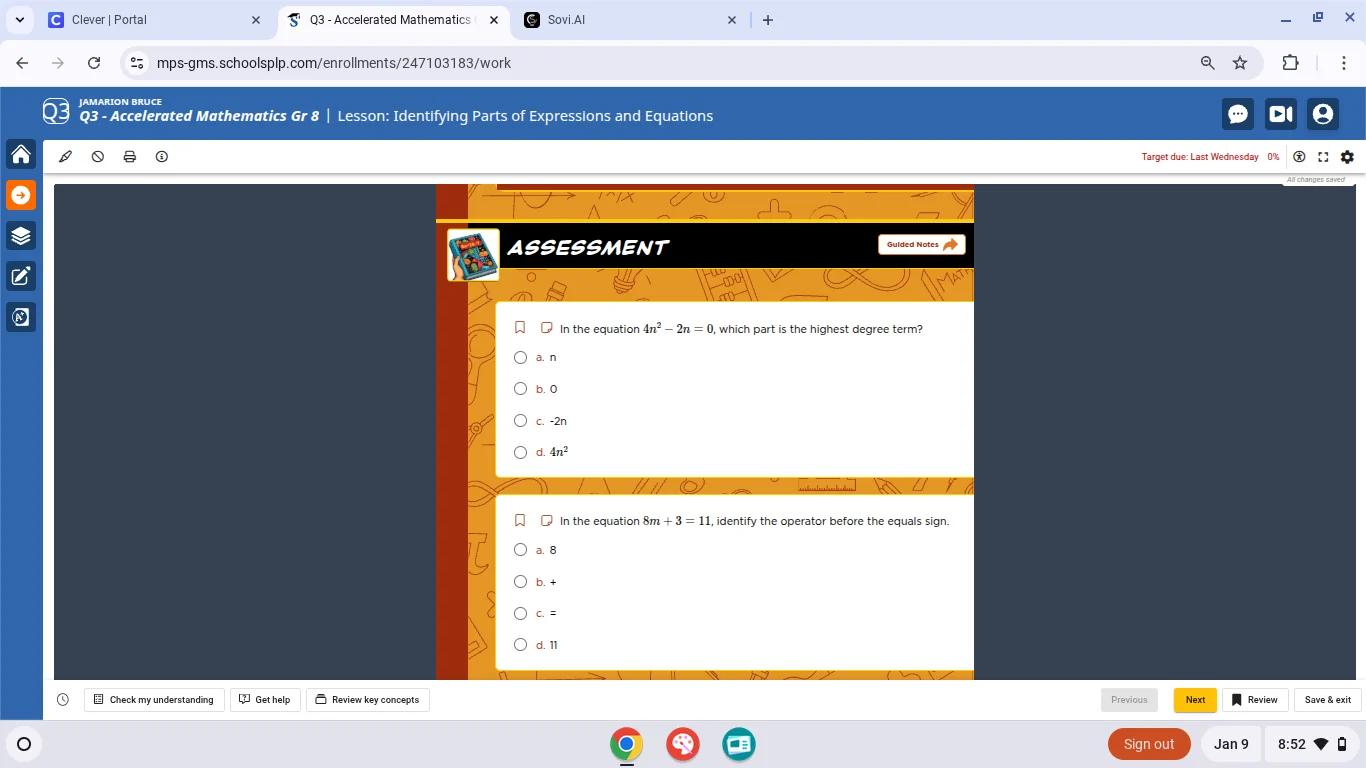
in the equation $4n^2 - 2n = 0$, which part is the highest degree term?
options:
a. n
b. 0
c. -2n
d. $4n^2$
in the equation $8m + 3 = 11$, identify the operator before the equals sign.
options:
a. 8
b. +
c. =
d. 11
First Question (About Highest Degree Term):
Step1: Recall Degree of a Term
The degree of a term with a variable is the exponent of the variable. For a term like \( an^k \), the degree is \( k \).
Step2: Analyze Each Option
- Option a: \( n \) has degree \( 1 \) (since \( n = n^1 \)).
- Option b: \( 0 \) is a constant, degree \( 0 \).
- Option c: \( -2n \) has degree \( 1 \) (exponent of \( n \) is \( 1 \)).
- Option d: \( 4n^2 \) has degree \( 2 \) (exponent of \( n \) is \( 2 \)).
Step3: Identify Highest Degree
Compare degrees: \( 2 > 1 > 0 \). So \( 4n^2 \) has the highest degree.
Step1: Recall Operators
Operators are symbols like \( +, -, \times, \div \), etc. The equals sign (\(=\)) is not an operator before itself. We look at the expression before \(=\) in \( 8m + 3 = 11 \), which is \( 8m + 3 \).
Step2: Identify Operator in \( 8m + 3 \)
In \( 8m + 3 \), the operator is \( + \) (addition). \( 8 \) is a coefficient, \( = \) is the equality symbol, \( 11 \) is a constant.

Snap & solve any problem in the app
Get step-by-step solutions on Sovi AI
Photo-based solutions with guided steps
Explore more problems and detailed explanations
d. \( 4n^2 \)