QUESTION IMAGE
Question
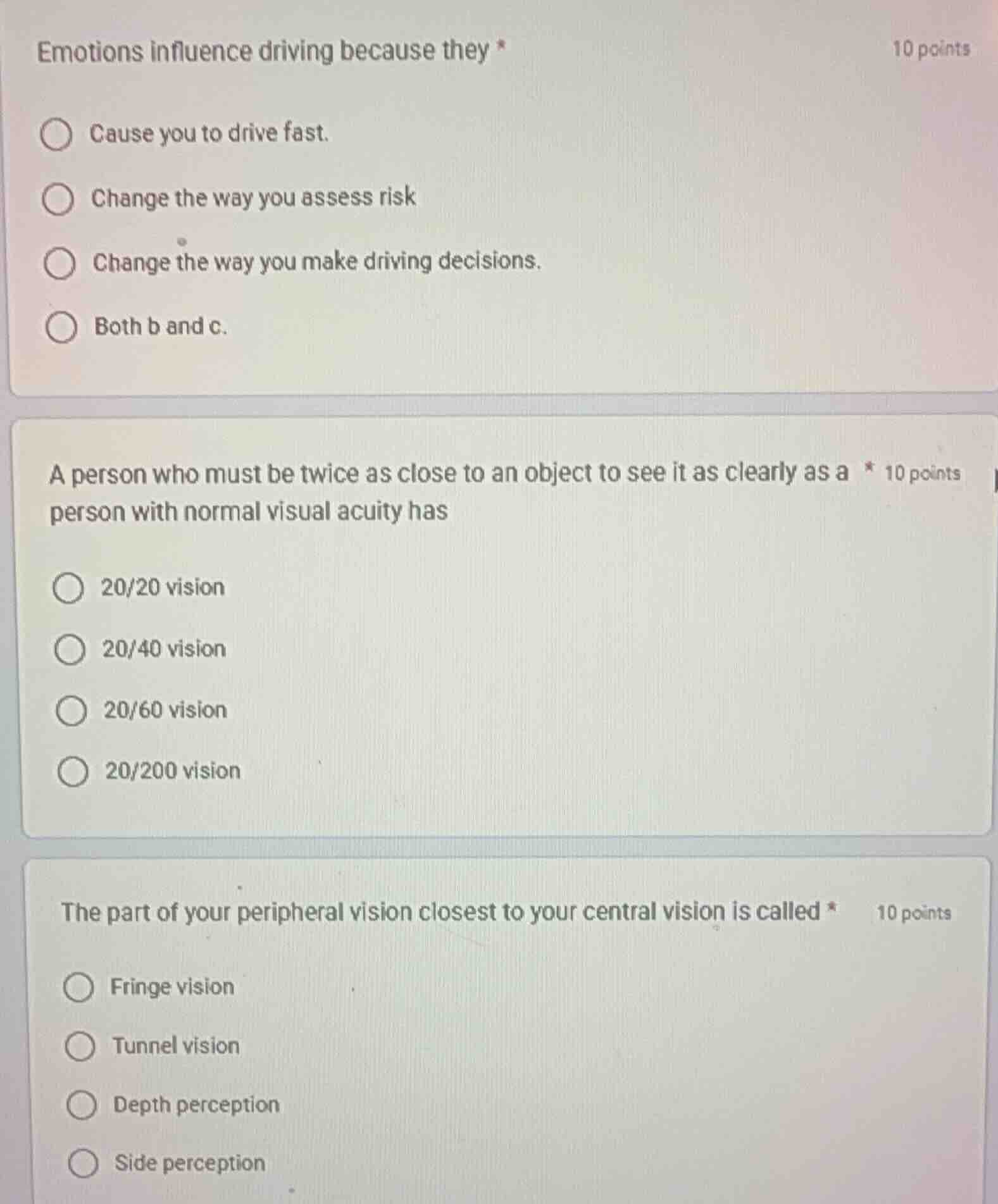
emotions influence driving because they *
- cause you to drive fast.
- change the way you assess risk
- change the way you make driving decisions.
- both b and c.
a person who must be twice as close to an object to see it as clearly as a * person with normal visual acuity has
- 20/20 vision
- 20/40 vision
- 20/60 vision
- 20/200 vision
the part of your peripheral vision closest to your central vision is called *
- fringe vision
- tunnel vision
- depth perception
- side perception
Analyze the influence of emotions on driving
Emotions affect cognitive processing, which alters how a driver evaluates potential hazards (risk assessment) and determines actions (decision making). Therefore, both options (b) and (c) are correct.
Determine visual acuity based on distance ratio
Normal visual acuity is represented as 20/20. If a person must be twice as close (10 feet instead of 20 feet) to see an object with the same clarity as a person with normal vision, their visual acuity is represented by doubling the denominator: 20/40 vision.
Identify the vision field closest to central vision
The visual field is divided into central vision, fringe (or focal) vision, and peripheral vision. Fringe vision is the part of the peripheral vision field that lies immediately adjacent to the central vision.

Snap & solve any problem in the app
Get step-by-step solutions on Sovi AI
Photo-based solutions with guided steps
Explore more problems and detailed explanations
Question 1
- Cause you to drive fast.
- Change the way you assess risk
- Change the way you make driving decisions.
- Both b and c. (Correct answer)
Question 2
- 20/20 vision
- 20/40 vision (Correct answer)
- 20/60 vision
- 20/200 vision
Question 3
- Fringe vision (Correct answer)
- Tunnel vision
- Depth perception
- Side perception