Sovi.AI - AI Math Tutor

Scan to solve math questions

QUESTION IMAGE

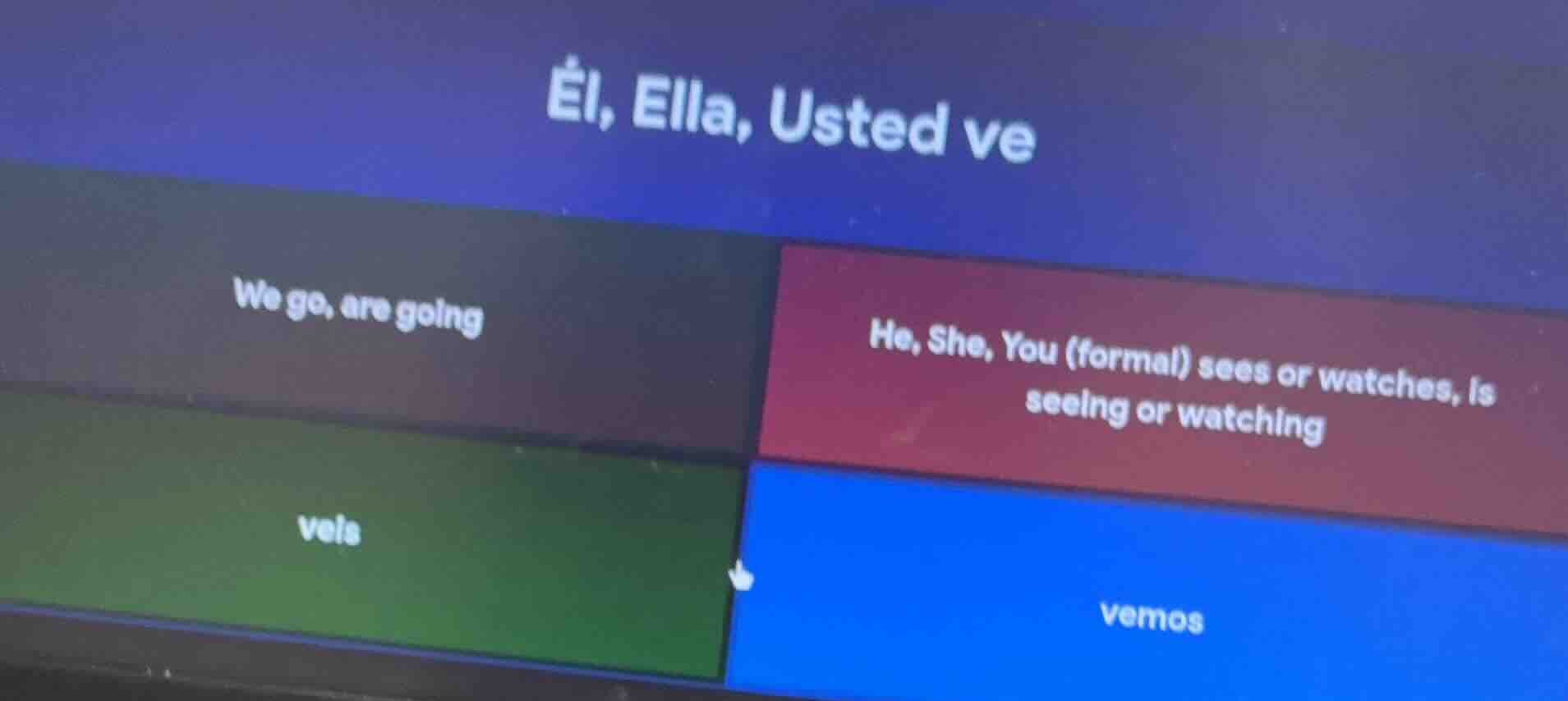
él, ella, usted ve we go, are going he, she, you (formal) sees or watch…

Question

él, ella, usted ve

we go, are going
he, she, you (formal) sees or watches, is seeing or watching
veis
vemos

Explanation:

Response

<pre_analysis>
{
"quality": "clear",
"question_count": 1,
"skills_matched": [
"direct_cot",
"multiple_choice_formatter",
"explain_then_answer",
"quick"
],
"needs_drawing": false,
"concepts_used": [],
"new_concepts": [
"Spanish Verb Conjugation",
"Spanish Present Tense"
],
"current_concepts": [
"Spanish Verb Conjugation",
"Spanish Present Tense"
]
}
</pre_analysis>

<reasoning>

Analyze the prompt

The prompt displays the Spanish phrase "Él, Ella, Usted ve".

Translate the components

  • "Él" means "He".
  • "Ella" means "She".
  • "Usted" means "You (formal)".
  • "ve" is the third-person singular present tense conjugation of the verb "ver" (to see/watch), meaning "sees", "watches", "is seeing", or "is watching".

Match with the options

  • "We go, are going" corresponds to "vamos".
  • "He, She, You (formal) sees or watches, is seeing or watching" matches "Él, Ella, Usted ve".
  • "veis" is the vosotros form of "ver".
  • "vemos" is the nosotros form of "ver".

</reasoning>

<answer>
<mcq-option>We go, are going</mcq-option>
<mcq-correct>He, She, You (formal) sees or watches, is seeing or watching</mcq-correct>
<mcq-option>veis</mcq-option>
<mcq-option>vemos</mcq-option>
</answer>

<post_analysis>
{
"subject": "Others",
"question_type": "Multiple Choice",
"knowledge_point": [
"Others",
"Linguistics",
"Spanish Verb Conjugation"
]
}
</post_analysis>

Answer:

<pre_analysis>
{
"quality": "clear",
"question_count": 1,
"skills_matched": [
"direct_cot",
"multiple_choice_formatter",
"explain_then_answer",
"quick"
],
"needs_drawing": false,
"concepts_used": [],
"new_concepts": [
"Spanish Verb Conjugation",
"Spanish Present Tense"
],
"current_concepts": [
"Spanish Verb Conjugation",
"Spanish Present Tense"
]
}
</pre_analysis>

<reasoning>

Analyze the prompt

The prompt displays the Spanish phrase "Él, Ella, Usted ve".

Translate the components

  • "Él" means "He".
  • "Ella" means "She".
  • "Usted" means "You (formal)".
  • "ve" is the third-person singular present tense conjugation of the verb "ver" (to see/watch), meaning "sees", "watches", "is seeing", or "is watching".

Match with the options

  • "We go, are going" corresponds to "vamos".
  • "He, She, You (formal) sees or watches, is seeing or watching" matches "Él, Ella, Usted ve".
  • "veis" is the vosotros form of "ver".
  • "vemos" is the nosotros form of "ver".

</reasoning>

<answer>
<mcq-option>We go, are going</mcq-option>
<mcq-correct>He, She, You (formal) sees or watches, is seeing or watching</mcq-correct>
<mcq-option>veis</mcq-option>
<mcq-option>vemos</mcq-option>
</answer>

<post_analysis>
{
"subject": "Others",
"question_type": "Multiple Choice",
"knowledge_point": [
"Others",
"Linguistics",
"Spanish Verb Conjugation"
]
}
</post_analysis>