Sovi.AI - AI Math Tutor

Scan to solve math questions

QUESTION IMAGE

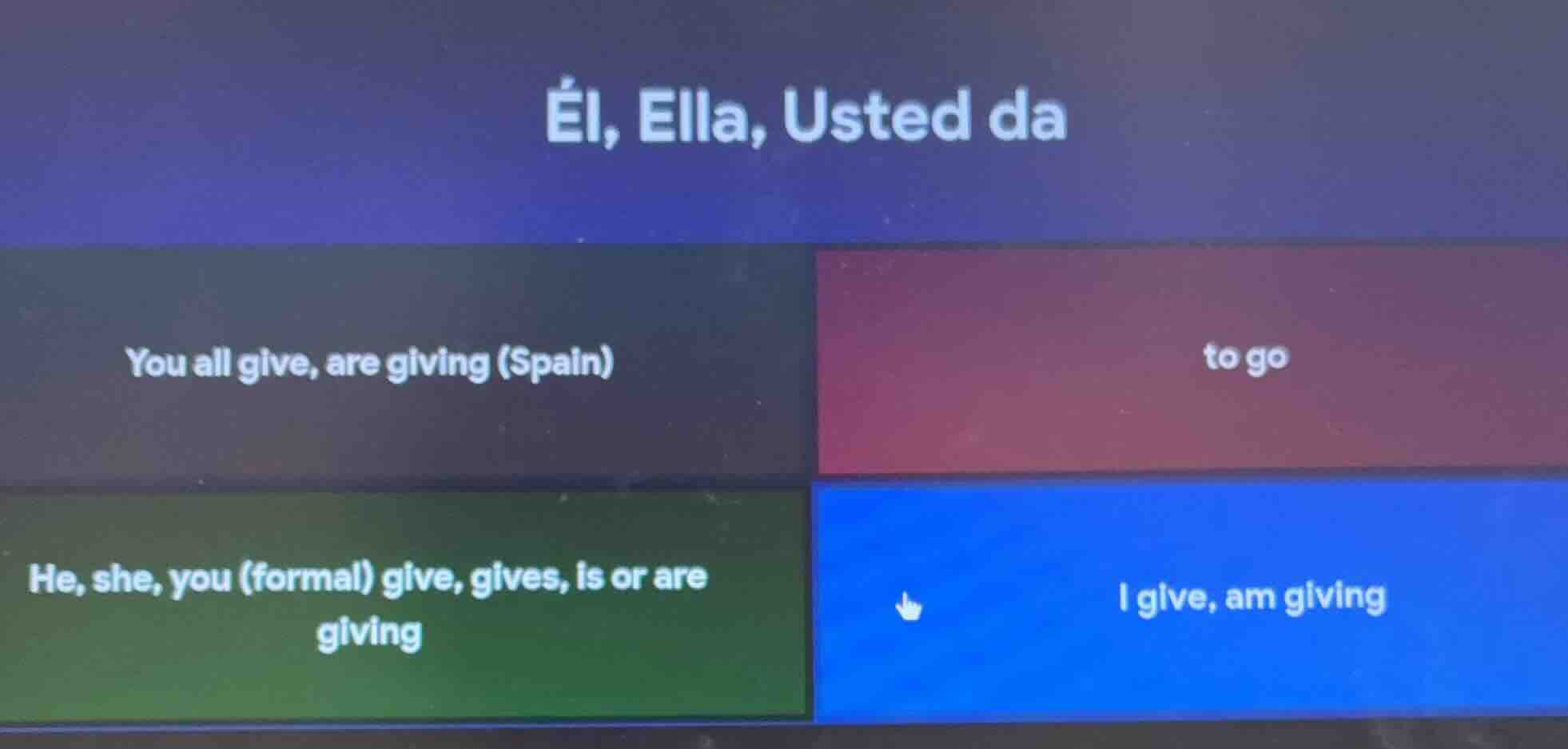
él, ella, usted da you all give, are giving (spain) to go he, she, you …

Question

él, ella, usted da

you all give, are giving (spain)
to go
he, she, you (formal) give, gives, is or are giving
i give, am giving

Explanation:

Response

<pre_analysis>
{
"quality": "clear",
"question_count": 1,
"skills_matched": [
"direct_cot",
"multiple_choice_formatter",
"explain_then_answer",
"quick"
],
"needs_drawing": false,
"concepts_used": [
"Spanish Verb Conjugation",
"Spanish Verb Translation"
],
"new_concepts": [],
"current_concepts": [
"Spanish Verb Conjugation",
"Spanish Verb Translation",
"Spanish Verbs"
]
}
</pre_analysis>

<reasoning>

Identify the subject and verb form

The prompt displays the Spanish subject pronouns "Él, Ella, Usted" paired with the conjugated verb form "da".

Translate the components

  • "Él" translates to "He".
  • "Ella" translates to "She".
  • "Usted" translates to "You (formal)".
  • "da" is the third-person singular present tense form of the verb "dar" (to give), which translates to "gives", "give", "is giving", or "are giving".

Match with the correct option

Combining these translations yields "He, she, you (formal) give, gives, is or are giving", which corresponds to the bottom-left green option.
</reasoning>

<answer>
<mcq-option>You all give, are giving (Spain)</mcq-option>
<mcq-option>to go</mcq-option>
<mcq-correct>He, she, you (formal) give, gives, is or are giving</mcq-correct>
<mcq-option>I give, am giving</mcq-option>
</answer>

<post_analysis>
{
"subject": "Others",
"question_type": "Multiple Choice",
"knowledge_point": [
"Others",
"Spanish",
"Spanish Verb Conjugation"
]
}
</post_analysis>

Answer:

<pre_analysis>
{
"quality": "clear",
"question_count": 1,
"skills_matched": [
"direct_cot",
"multiple_choice_formatter",
"explain_then_answer",
"quick"
],
"needs_drawing": false,
"concepts_used": [
"Spanish Verb Conjugation",
"Spanish Verb Translation"
],
"new_concepts": [],
"current_concepts": [
"Spanish Verb Conjugation",
"Spanish Verb Translation",
"Spanish Verbs"
]
}
</pre_analysis>

<reasoning>

Identify the subject and verb form

The prompt displays the Spanish subject pronouns "Él, Ella, Usted" paired with the conjugated verb form "da".

Translate the components

  • "Él" translates to "He".
  • "Ella" translates to "She".
  • "Usted" translates to "You (formal)".
  • "da" is the third-person singular present tense form of the verb "dar" (to give), which translates to "gives", "give", "is giving", or "are giving".

Match with the correct option

Combining these translations yields "He, she, you (formal) give, gives, is or are giving", which corresponds to the bottom-left green option.
</reasoning>

<answer>
<mcq-option>You all give, are giving (Spain)</mcq-option>
<mcq-option>to go</mcq-option>
<mcq-correct>He, she, you (formal) give, gives, is or are giving</mcq-correct>
<mcq-option>I give, am giving</mcq-option>
</answer>

<post_analysis>
{
"subject": "Others",
"question_type": "Multiple Choice",
"knowledge_point": [
"Others",
"Spanish",
"Spanish Verb Conjugation"
]
}
</post_analysis>