QUESTION IMAGE
Question
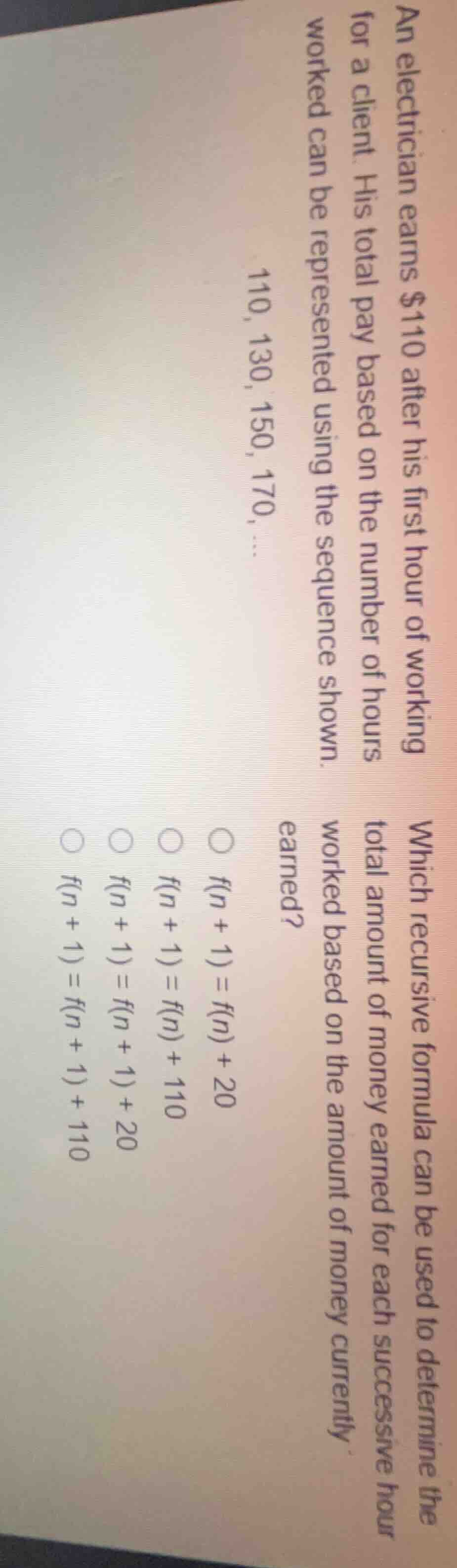
an electrician earns \\$110 after his first hour of working for a client. his total pay based on the number of hours worked can be represented using the sequence shown.
\\110, 130, 150, 170, \dots\\
which recursive formula can be used to determine the total amount of money earned for each successive hour worked based on the amount of money currently earned?
\\(f(n + 1) = f(n) + 20\\)
\\(f(n + 1) = f(n) + 110\\)
\\(f(n + 1) = f(n + 1) + 20\\)
\\(f(n + 1) = f(n + 1) + 110\\)
Identify the sequence terms
$$
LATEXBLOCK0
$$
Determine the common difference
$$
LATEXBLOCK1
$$
Formulate the recursive equation
$$
f(n+1) = f(n) + 20
$$

Snap & solve any problem in the app
Get step-by-step solutions on Sovi AI
Photo-based solutions with guided steps
Explore more problems and detailed explanations
- (A) \(f(n + 1) = f(n) + 20\) (Correct answer)
- (B) \(f(n + 1) = f(n) + 110\)
- (C) \(f(n + 1) = f(n + 1) + 20\)
- (D) \(f(n + 1) = f(n + 1) + 110\)