QUESTION IMAGE
Question
electric field strength
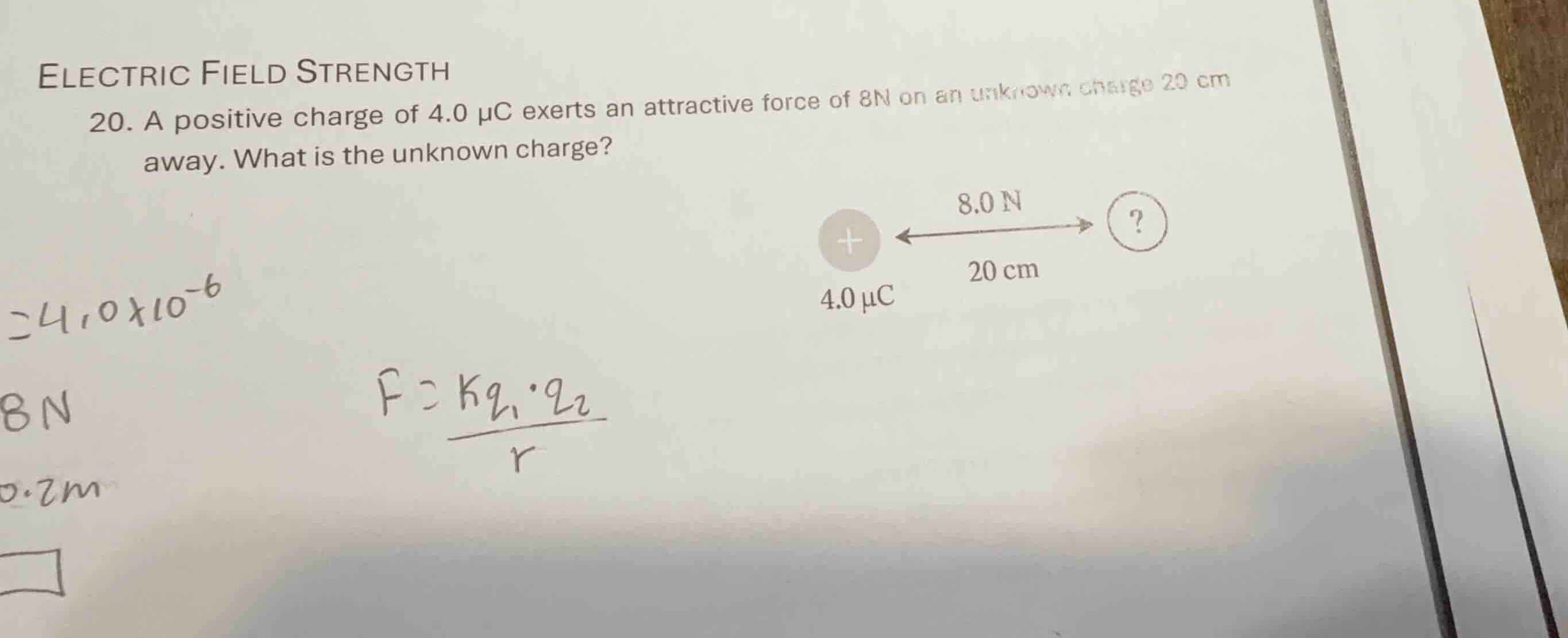
- a positive charge of 4.0 \\(\mu\text{c}\\) exerts an attractive force of 8n on an unknown charge 20 cm away. what is the unknown charge?
Identify the given parameters
We extract the physical quantities from the problem statement:
- Known charge: \(q_1 = +4.0\ \mu\text{C} = +4.0 \times 10^{-6}\ \text{C}\)
- Electrostatic force: \(F = 8.0\ \text{N}\) (attractive)
- Distance between charges: \(r = 20\ \text{cm} = 0.20\ \text{m}\)
- Coulomb's constant: \(k \approx 8.99 \times 10^9\ \text{N}\cdot\text{m}^2/\text{C}^2\)
Determine the sign of the unknown charge
The problem states that the force between the two charges is attractive. By the fundamental rules of electrostatics, opposite charges attract each other, while like charges repel. Since the known charge \(q_1\) is positive, the unknown charge \(q_2\) must be negative.
Apply Coulomb's Law formula
Coulomb's Law relates the electrostatic force between two point charges to their magnitudes and the distance separating them:
Solve for the magnitude of the unknown charge
We rearrange Coulomb's Law to isolate the magnitude of the unknown charge \(|q_2|\):
Substituting the known values into this rearranged equation:
Combine magnitude and sign for the final answer
Since the force is attractive and the known charge is positive, the unknown charge must be negative. Therefore, we assign a negative sign to the calculated magnitude:

Snap & solve any problem in the app
Get step-by-step solutions on Sovi AI
Photo-based solutions with guided steps
Explore more problems and detailed explanations
\(-8.9\ \mu\text{C}\) (or \(-8.9 \times 10^{-6}\ \text{C}\))