QUESTION IMAGE
Question
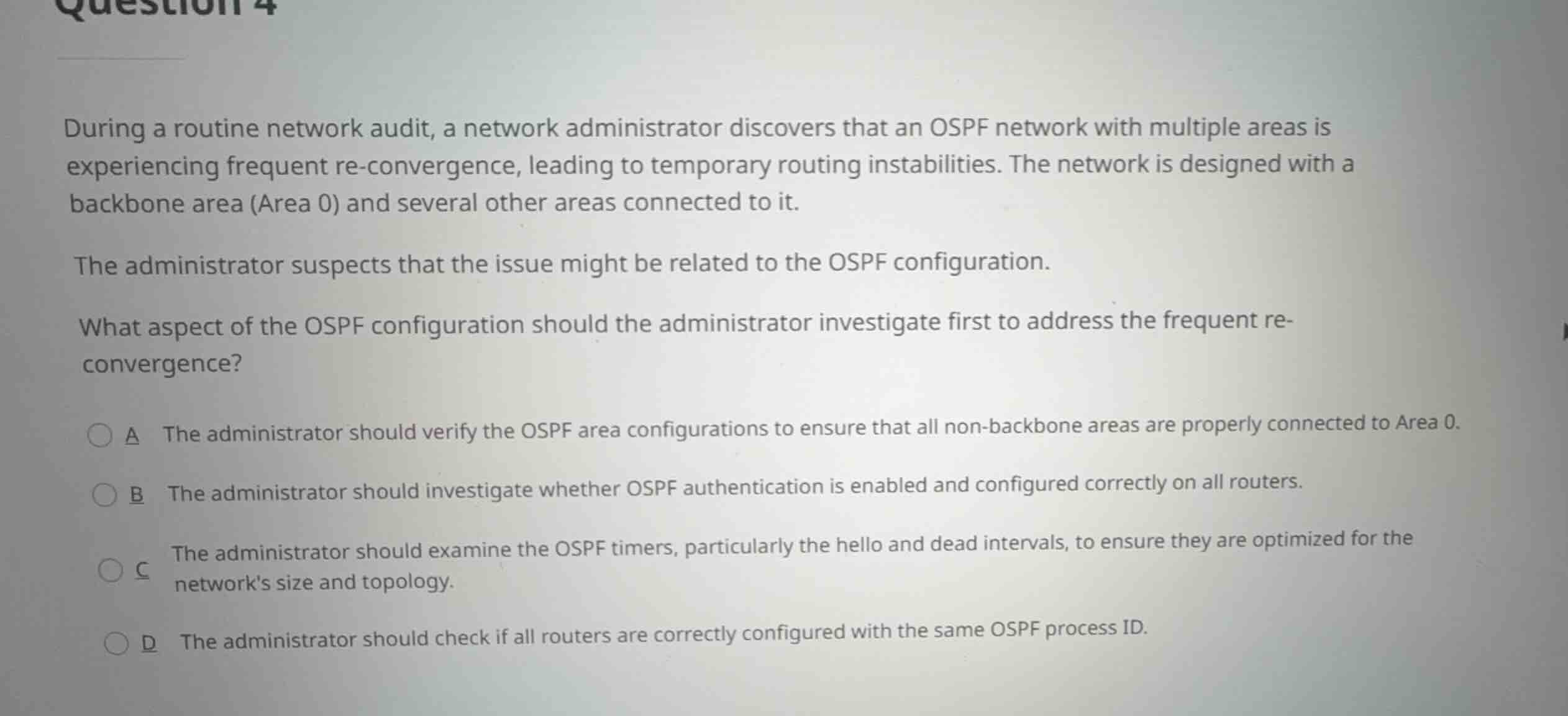
during a routine network audit, a network administrator discovers that an ospf network with multiple areas is experiencing frequent re-convergence, leading to temporary routing instabilities. the network is designed with a backbone area (area 0) and several other areas connected to it.
the administrator suspects that the issue might be related to the ospf configuration.
what aspect of the ospf configuration should the administrator investigate first to address the frequent re-convergence?
a the administrator should verify the ospf area configurations to ensure that all non-backbone areas are properly connected to area 0.
b the administrator should investigate whether ospf authentication is enabled and configured correctly on all routers.
c the administrator should examine the ospf timers, particularly the hello and dead intervals, to ensure they are optimized for the networks size and topology.
d the administrator should check if all routers are correctly configured with the same ospf process id.
Analyze the network instability symptom
The network is experiencing frequent re-convergence and temporary routing instabilities. In OSPF, frequent re-convergence is typically caused by flapping links or mismatched/unoptimized timers that cause neighbor relationships to repeatedly drop and re-establish.
Evaluate the role of OSPF timers
Using the Network Routing and Autonomous System knowledge points, we analyze how OSPF maintains adjacency. OSPF relies on Hello packets sent at regular intervals to maintain neighbor relationships. If a router does not receive a Hello packet within the Dead interval, it declares the neighbor down, leading to SPF recalculation and re-convergence. If these timers are unoptimized or mismatched, slight network delays can trigger false downs, causing frequent, unnecessary re-convergence.
Assess alternative configuration options
- Option A: Mismatched area configurations would prevent adjacency from forming entirely, rather than causing frequent re-convergence.
- Option B: Authentication issues prevent adjacency from establishing in the first place.
- Option D: OSPF process IDs are locally significant and do not need to match across routers to establish adjacency or maintain stability.
Determine the primary investigation target
Therefore, the administrator should first investigate the OSPF timers (Hello and Dead intervals) to ensure they are optimized for the network's size, media types, and topology to prevent instability.

Snap & solve any problem in the app
Get step-by-step solutions on Sovi AI
Photo-based solutions with guided steps
Explore more problems and detailed explanations
- (A) The administrator should verify the OSPF area configurations to ensure that all non-backbone areas are properly connected to Area 0.
- (B) The administrator should investigate whether OSPF authentication is enabled and configured correctly on all routers.
- (C) The administrator should examine the OSPF timers, particularly the hello and dead intervals, to ensure they are optimized for the network's size and topology. (Correct answer)
- (D) The administrator should check if all routers are correctly configured with the same OSPF process ID.