QUESTION IMAGE
Question
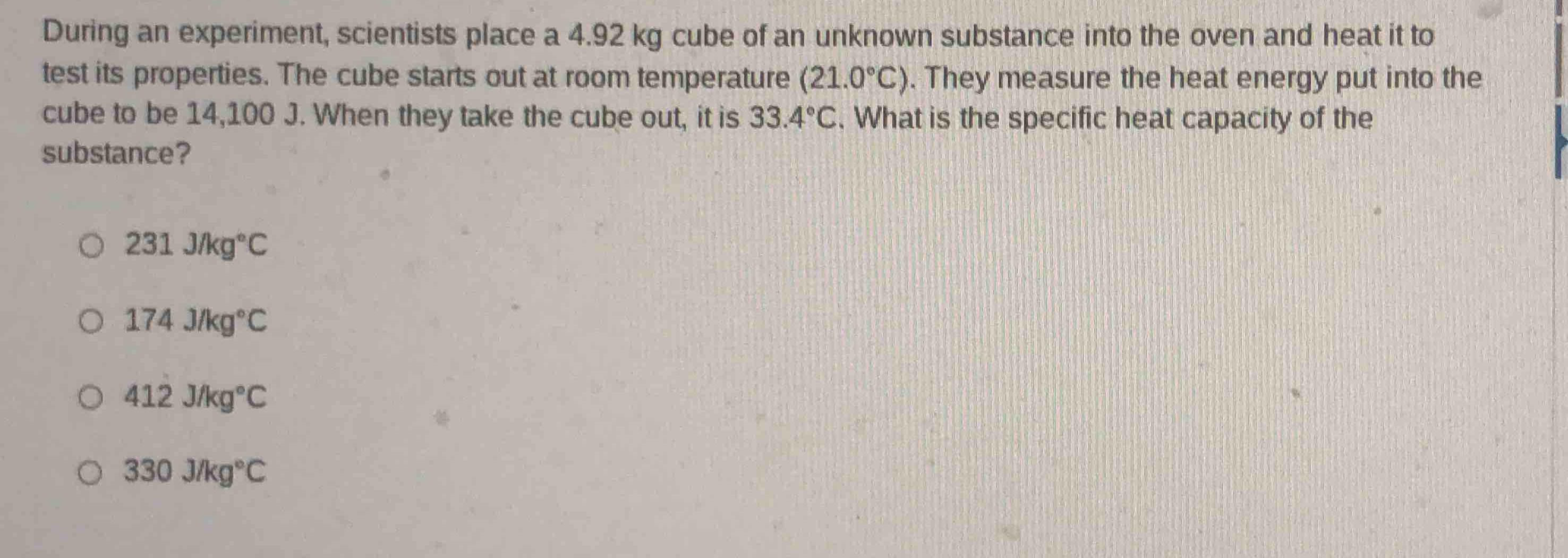
during an experiment, scientists place a 4.92 kg cube of an unknown substance into the oven and heat it to test its properties. the cube starts out at room temperature (21.0°c). they measure the heat energy put into the cube to be 14,100 j. when they take the cube out, it is 33.4°c. what is the specific heat capacity of the substance?
231 j/kg°c
174 j/kg°c
412 j/kg°c
330 j/kg°c
Identify the given values
We extract the physical quantities from the problem statement:
- Mass of the cube, \(m = 4.92\text{ kg}\)
- Initial temperature, \(T_i = 21.0^\circ\text{C}\)
- Final temperature, \(T_f = 33.4^\circ\text{C}\)
- Heat energy added, \(Q = 14,100\text{ J}\)
Calculate the temperature change
We find the change in temperature \(\Delta T\) by subtracting the initial temperature from the final temperature:
State the heat transfer formula
The relationship between heat energy, mass, specific heat capacity, and temperature change is given by:
where \(c\) is the specific heat capacity of the substance.
Solve for specific heat capacity
We rearrange the formula to solve for \(c\):
Substitute the known values into the equation:
Match with the options
The calculated value of approximately \(231\text{ J/(kg}\cdot^\circ\text{C)}\) matches the first option.

Snap & solve any problem in the app
Get step-by-step solutions on Sovi AI
Photo-based solutions with guided steps
Explore more problems and detailed explanations
- (A) 231 J/kg°C (Correct answer)
- (B) 174 J/kg°C
- (C) 412 J/kg°C
- (D) 330 J/kg°C