QUESTION IMAGE
Question
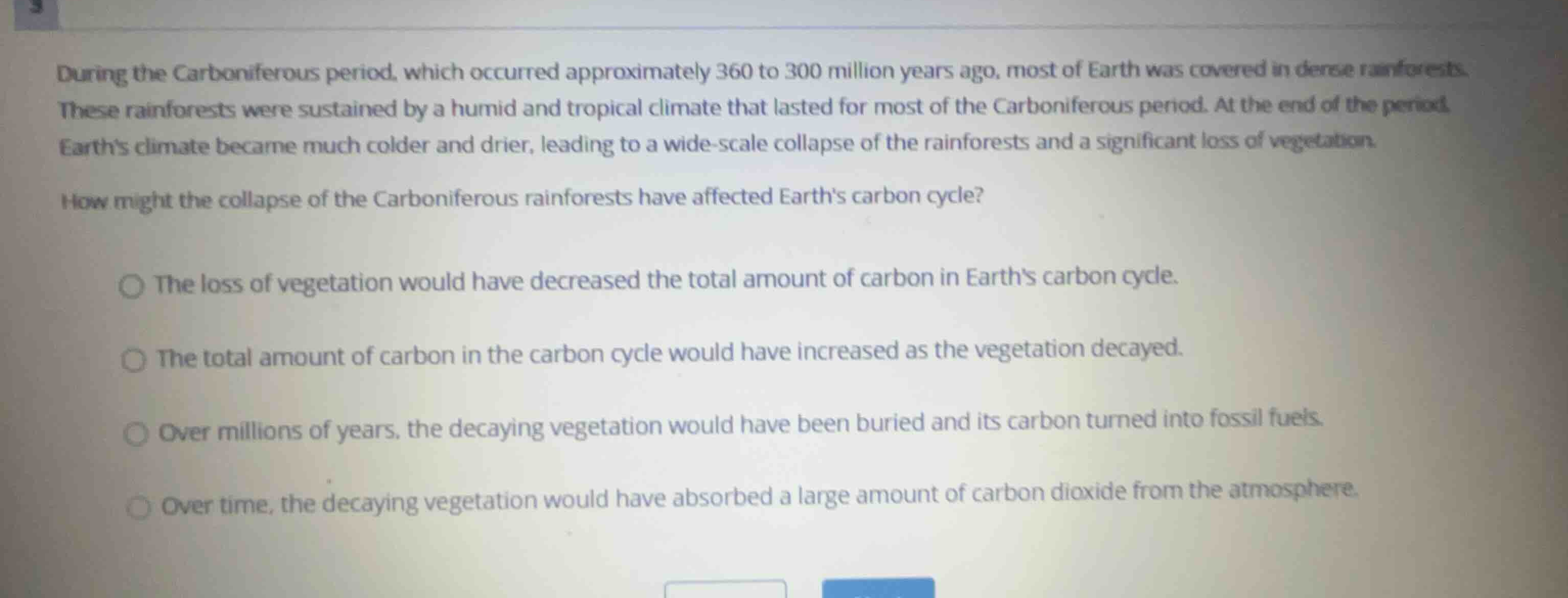
during the carboniferous period, which occurred approximately 360 to 300 million years ago, most of earth was covered in dense rainforests. these rainforests were sustained by a humid and tropical climate that lasted for most of the carboniferous period. at the end of the period, earths climate became much colder and drier, leading to a wide-scale collapse of the rainforests and a significant loss of vegetation.
how might the collapse of the carboniferous rainforests have affected earths carbon cycle?
- the loss of vegetation would have decreased the total amount of carbon in earths carbon cycle.
- the total amount of carbon in the carbon cycle would have increased as the vegetation decayed.
- over millions of years, the decaying vegetation would have been buried and its carbon turned into fossil fuels.
- over time, the decaying vegetation would have absorbed a large amount of carbon dioxide from the atmosphere.
Analyze the historical context
During the Carboniferous period, vast, dense rainforests covered much of the Earth. When these massive amounts of vegetation collapsed and died due to climate cooling and drying, the plant matter did not fully decompose in the swampy, oxygen-poor environments of the time.
Evaluate the carbon cycle dynamics
The law of conservation of mass dictates that the total amount of carbon on Earth remains constant; it merely shifts between different reservoirs (atmosphere, biosphere, geosphere, and oceans). Therefore, options suggesting a change in the total amount of carbon in the entire cycle are scientifically incorrect.
Determine the fate of the organic matter
Over millions of years, the massive accumulation of dead, decaying vegetation was buried under layers of sediment. Under high pressure and temperature, this trapped organic carbon was chemically transformed into coal and other fossil fuels, storing carbon deep within the Earth's crust.
Assess the given options
- Option 1: Incorrect. The total amount of carbon in the global cycle remains constant.
- Option 2: Incorrect. The total amount of carbon in the global cycle does not increase.
- Option 3: Correct. The buried organic matter became fossil fuels (coal) over millions of years.
- Option 4: Incorrect. Decaying vegetation releases carbon dioxide or stores it in the ground; it does not actively absorb carbon dioxide from the atmosphere (only living, photosynthesizing plants do that).

Snap & solve any problem in the app
Get step-by-step solutions on Sovi AI
Photo-based solutions with guided steps
Explore more problems and detailed explanations
- The loss of vegetation would have decreased the total amount of carbon in Earth's carbon cycle.
- The total amount of carbon in the carbon cycle would have increased as the vegetation decayed.
- Over millions of years, the decaying vegetation would have been buried and its carbon turned into fossil fuels. (Correct answer)
- Over time, the decaying vegetation would have absorbed a large amount of carbon dioxide from the atmosphere.