QUESTION IMAGE
Question
drawing a conclusion
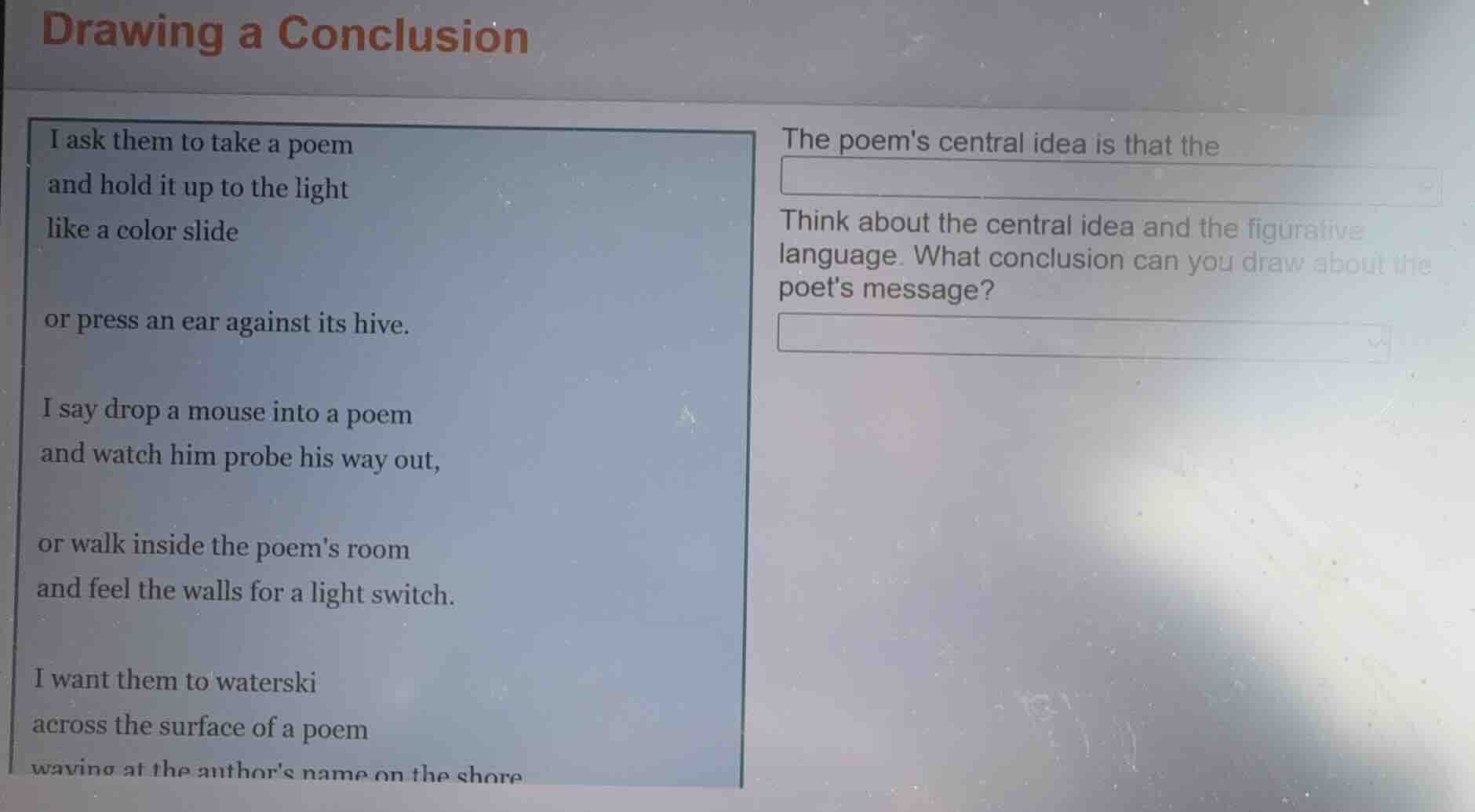
i ask them to take a poem
and hold it up to the light
like a color slide
or press an ear against its hive.
i say drop a mouse into a poem
and watch him probe his way out,
or walk inside the poems room
and feel the walls for a light switch.
i want them to waterski
across the surface of a poem
waving at the authors name on the shore.
the poems central idea is that the
think about the central idea and the figurative language. what conclusion can you draw about the poets message?
Identify the central idea of the poem
The poem shown is Billy Collins's "Introduction to Poetry." The speaker uses metaphors (holding a poem to the light like a color slide, pressing an ear against its hive, dropping a mouse in, walking inside its room, waterskiing across the surface) to show that readers should explore, experience, and enjoy poetry rather than trying to force a single, rigid meaning out of it.
Analyze the figurative language and draw a conclusion
The figurative language (metaphors of exploration and play) suggests that reading poetry should be an active, sensory, and open-minded journey of discovery. The conclusion we can draw about the poet's message is that readers should experience and enjoy a poem's imagery and feelings instead of over-analyzing it or trying to force a single, correct interpretation.

Snap & solve any problem in the app
Get step-by-step solutions on Sovi AI
Photo-based solutions with guided steps
Explore more problems and detailed explanations
Question 1
The poem's central idea is that the <blank>reader should explore and experience a poem rather than force a single meaning from it</blank>.
Question 2
Think about the central idea and the figurative language. What conclusion can you draw about the poet's message?
<blank>Poetry is meant to be enjoyed and explored through sensory experience and curiosity, not over-analyzed or tortured for a single correct interpretation.</blank>