QUESTION IMAGE
Question
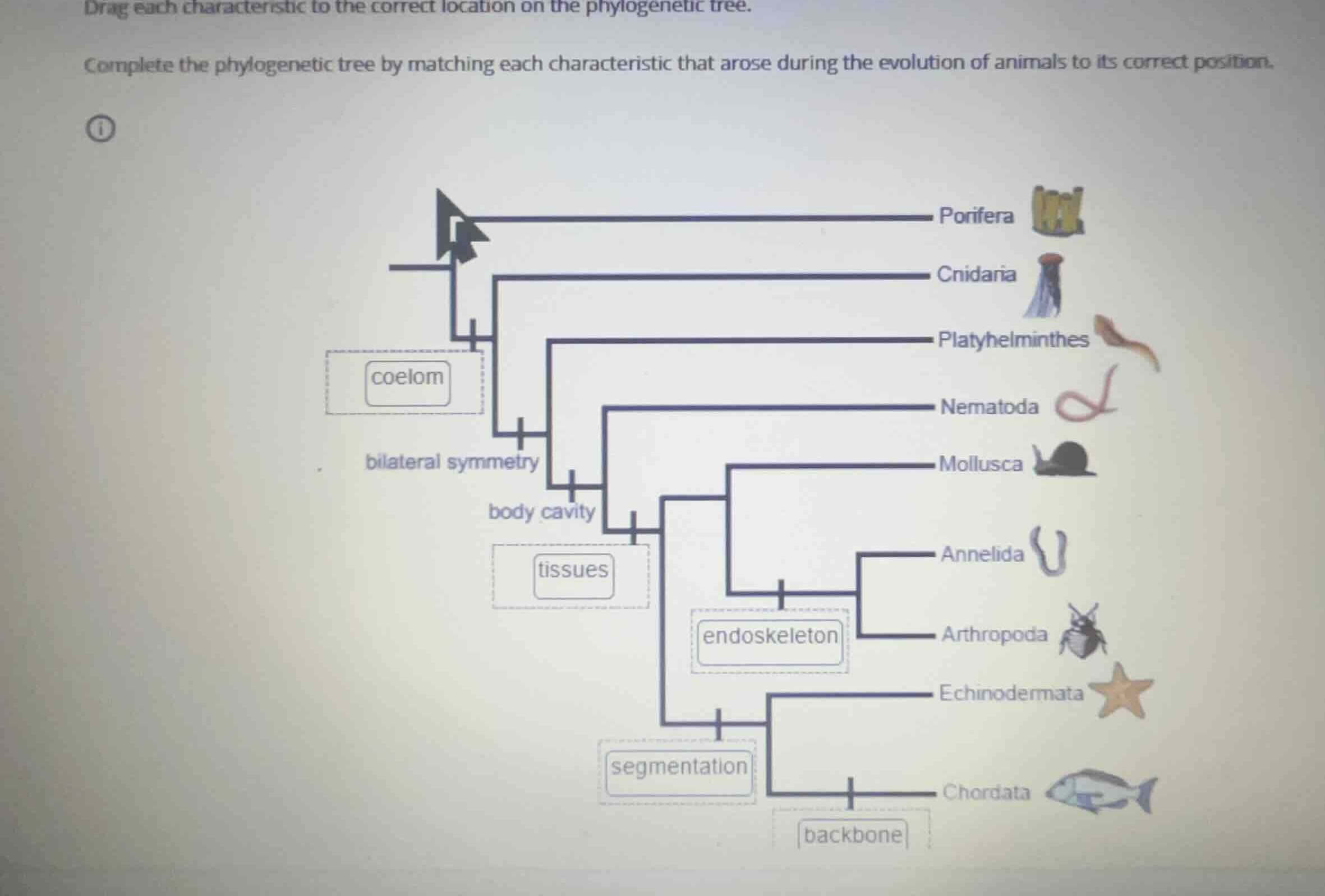
drag each characteristic to the correct location on the phylogenetic tree.
complete the phylogenetic tree by matching each characteristic that arose during the evolution of animals to its correct position.
porifera
cnidaria
platyhelminthes
nematoda
mollusca
annelida
arthropoda
echinodermata
chordata
coelom
bilateral symmetry
body cavity
tissues
endoskeleton
segmentation
backbone
Identify early evolutionary milestones
Using the Body Cavity Types knowledge point
The earliest animal divergence shown is Porifera (sponges), which lack true tissues. The branch leading to all other animals (Eumetazoa) must be defined by the development of true tissues. Therefore, the first evolutionary marker on the main stem before Cnidaria branches off is tissues.
Determine symmetry and body cavity development
Using the Body Cavity Types knowledge point
Cnidaria exhibit radial symmetry, whereas the remaining groups have bilateral symmetry. After bilateral symmetry arises, Platyhelminthes (flatworms) branch off; they are acoelomates (lacking a body cavity). The next major evolutionary step leading to Nematoda, Mollusca, and subsequent phyla is the development of a body cavity (pseudocoelom in Nematoda, true coelom in others). The marker on the branch leading to Mollusca, Annelida, Arthropoda, Echinodermata, and Chordata represents a true coelom.
Analyze protostome and deuterostome branches
Using the Echinoderm Endoskeleton knowledge point
The lineage splits into protostomes (Mollusca, Annelida, Arthropoda) and deuterostomes (Echinodermata, Chordata).
- Within the protostome group, Annelida and Arthropoda share segmentation, which distinguishes them from Mollusca.
- Within the deuterostome group, Echinodermata (starfish) and Chordata share deuterostome development. Echinoderms are characterized by a unique calcareous endoskeleton.
- Chordates are uniquely characterized by a backbone (vertebral column) in vertebrates.
Map characteristics to the tree locations
By matching the evolutionary milestones to the dashed boxes on the diagram:
- The box on the main stem before Cnidaria must be tissues.
- The box on the branch leading to Bilateria (after Cnidaria) must be bilateral symmetry (already placed in the image as a label, but let's look at the draggable boxes).
- Let's re-examine the draggable boxes (dashed borders):
- Top-left box (on the branch leading to Platyhelminthes, Nematoda, etc.): This is before the split of Platyhelminthes. Platyhelminthes lack a body cavity, but Cnidarians lack bilateral symmetry. The label "bilateral symmetry" is already placed. The box above it on the branch leading to Cnidaria/others is actually tissues (since Porifera lacks tissues). Let's trace the lines:
- The main stem has a branch going to Porifera.
- The next node has a branch going to Cnidaria. The marker before this node must be tissues.
- The next node has a branch going to Platyhelminthes. The marker before this is bilateral symmetry.
- The marker after Platyhelminthes but before Nematoda/Mollusca is body cavity.
- The marker leading to Mollusca/Annelida/Arthropoda/Echinodermata/Chordata is coelom.
- The marker on the branch leading to Annelida and Arthropoda is segmentation.
- The marker on the branch leading to Echinodermata is endoskeleton.
- The marker on the branch leading to Chordata is **…

Snap & solve any problem in the app
Get step-by-step solutions on Sovi AI
Photo-based solutions with guided steps
Explore more problems and detailed explanations
To complete the phylogenetic tree correctly, the characteristics should be placed in the following locations from the base of the tree to the terminal branches:
- First box (at the base, before Cnidaria branches off):
tissues - Second box (on the branch leading to Platyhelminthes and subsequent phyla):
coelom - Third box (on the branch shared by Annelida and Arthropoda):
segmentation - Fourth box (on the branch leading to Echinodermata):
endoskeleton - Fifth box (on the branch leading to Chordata):
backbone