QUESTION IMAGE
Question
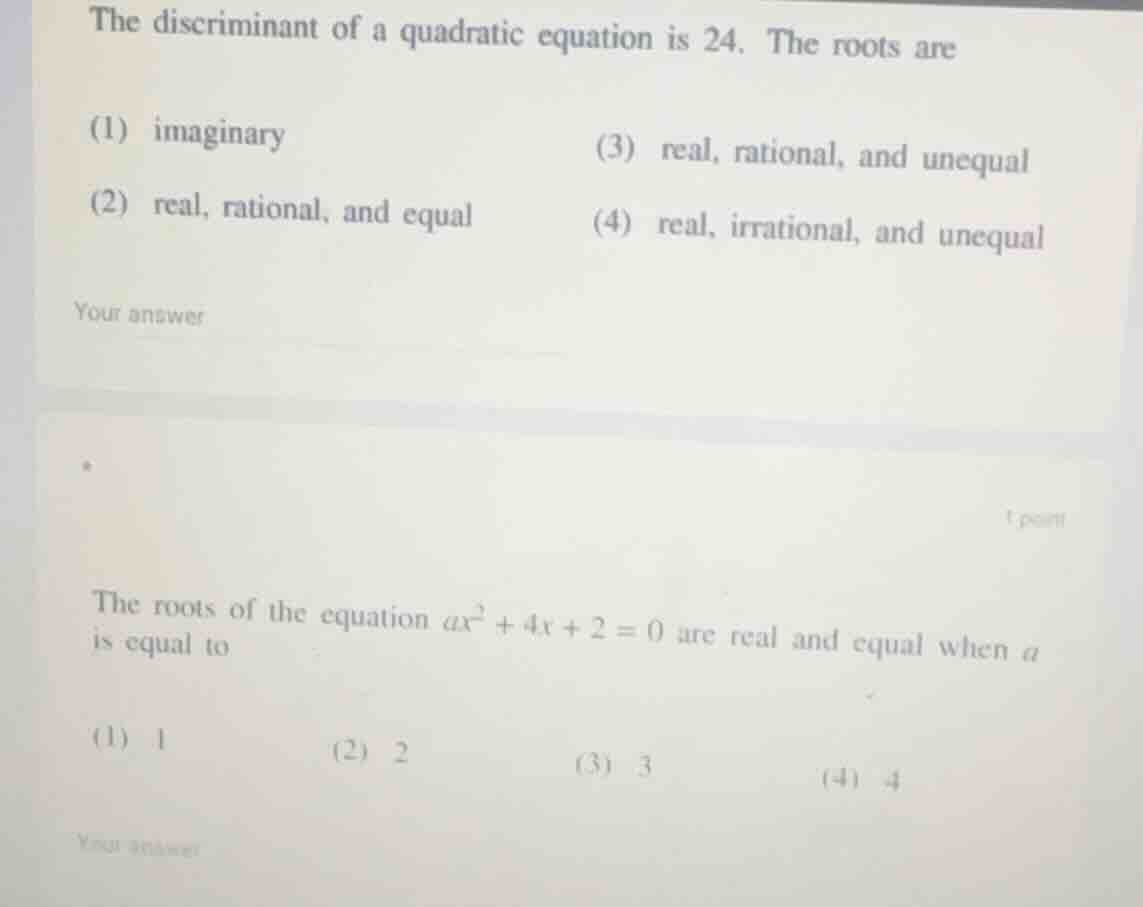
the discriminant of a quadratic equation is 24. the roots are
(1) imaginary (3) real, rational, and unequal
(2) real, rational, and equal (4) real, irrational, and unequal
your answer
the roots of the equation $ax^2 + 4x + 2 = 0$ are real and equal when $a$ is equal to
(1) 1 (2) 2 (3) 3 (4) 4
your answer
Step1: Analyze discriminant rule (Q1)
For quadratic $ax^2+bx+c=0$, discriminant $D=b^2-4ac$:
- $D>0$: real, unequal roots
- $D$ perfect square: rational roots; else irrational
Given $D=24>0$, 24 is not a perfect square.
Step2: Match to root type (Q1)
Roots are real, irrational, unequal.
Step3: Set discriminant to 0 (Q2)
For real equal roots, $D=0$.
Here $b=4$, $a=a$, $c=2$, so:
$$4^2 - 4(a)(2) = 0$$
Step4: Solve for $a$ (Q2)
$$16 - 8a = 0$$
$$8a=16$$
$$a=\frac{16}{8}=2$$

Snap & solve any problem in the app
Get step-by-step solutions on Sovi AI
Photo-based solutions with guided steps
Explore more problems and detailed explanations
- (4) real, irrational, and unequal
- (2) 2