Sovi.AI - AI Math Tutor

Scan to solve math questions

QUESTION IMAGE

dimitri and rita eat some donuts for breakfast and then spend the morni…

Question

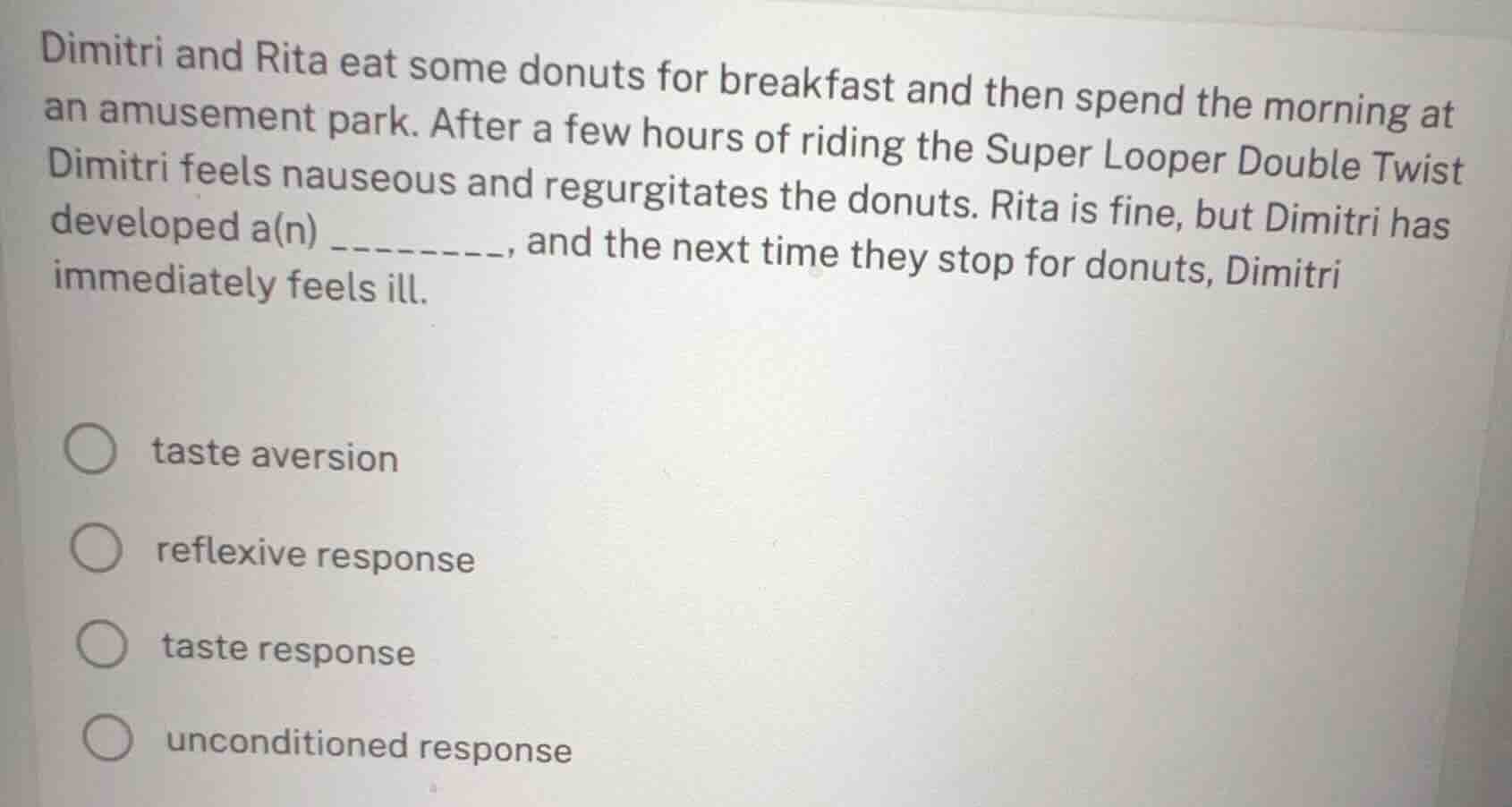
dimitri and rita eat some donuts for breakfast and then spend the morning at an amusement park. after a few hours of riding the super looper double twist dimitri feels nauseous and regurgitates the donuts. rita is fine, but dimitri has developed a(n) ________, and the next time they stop for donuts, dimitri immediately feels ill.

taste aversion
reflexive response
taste response
unconditioned response

Explanation:

Response

<pre_analysis>
{
"quality": "clear",
"question_count": 1,
"skills_matched": [
"direct_cot",
"multiple_choice_formatter",
"explain_then_answer",
"tutor",
"mastery_adaptive_brevity"
],
"needs_drawing": false,
"concepts_used": [
"Classical Conditioning"
],
"new_concepts": [
"Taste Aversion",
"Garcia Effect"
],
"current_concepts": [
"Classical Conditioning",
"Taste Aversion",
"Garcia Effect"
]
}
</pre_analysis>

<reasoning>

Analyze the scenario

Using the Classical Conditioning knowledge point

Dimitri eats donuts (neutral stimulus) and then rides a roller coaster, which causes motion sickness and nausea (unconditioned stimulus and response). Because the nausea is paired with the taste/smell of the donuts, Dimitri's brain associates the food with the illness.

Identify the psychological phenomenon

The next time Dimitri encounters donuts, he immediately feels ill. This rapid, highly specific association between a food flavor and subsequent illness is a classic example of a conditioned taste aversion (often called the Garcia Effect).

Evaluate the options

  • taste aversion: This matches the scenario perfectly, where a learned avoidance of a specific food occurs after it is paired with nausea.
  • reflexive response: This is an unlearned, automatic reaction to a stimulus, not a newly learned association with a food cue.
  • taste response: This is a general term for tasting food, not the learned association of illness with a flavor.
  • unconditioned response: This is the natural, unlearned reaction (nausea) to the roller coaster ride, not the newly learned reaction to the donuts.

</reasoning>

<answer>
<mcq-correct>taste aversion</mcq-correct>
<mcq-option>reflexive response</mcq-option>
<mcq-option>taste response</mcq-option>
<mcq-option>unconditioned response</mcq-option>
</answer>

<post_analysis>
{
"subject": "Social Science",
"question_type": "Multiple Choice",
"knowledge_point": [
"Social Science",
"Psychology",
"Classical Conditioning"
]
}
</post_analysis>

Answer:

<pre_analysis>
{
"quality": "clear",
"question_count": 1,
"skills_matched": [
"direct_cot",
"multiple_choice_formatter",
"explain_then_answer",
"tutor",
"mastery_adaptive_brevity"
],
"needs_drawing": false,
"concepts_used": [
"Classical Conditioning"
],
"new_concepts": [
"Taste Aversion",
"Garcia Effect"
],
"current_concepts": [
"Classical Conditioning",
"Taste Aversion",
"Garcia Effect"
]
}
</pre_analysis>

<reasoning>

Analyze the scenario

Using the Classical Conditioning knowledge point

Dimitri eats donuts (neutral stimulus) and then rides a roller coaster, which causes motion sickness and nausea (unconditioned stimulus and response). Because the nausea is paired with the taste/smell of the donuts, Dimitri's brain associates the food with the illness.

Identify the psychological phenomenon

The next time Dimitri encounters donuts, he immediately feels ill. This rapid, highly specific association between a food flavor and subsequent illness is a classic example of a conditioned taste aversion (often called the Garcia Effect).

Evaluate the options

  • taste aversion: This matches the scenario perfectly, where a learned avoidance of a specific food occurs after it is paired with nausea.
  • reflexive response: This is an unlearned, automatic reaction to a stimulus, not a newly learned association with a food cue.
  • taste response: This is a general term for tasting food, not the learned association of illness with a flavor.
  • unconditioned response: This is the natural, unlearned reaction (nausea) to the roller coaster ride, not the newly learned reaction to the donuts.

</reasoning>

<answer>
<mcq-correct>taste aversion</mcq-correct>
<mcq-option>reflexive response</mcq-option>
<mcq-option>taste response</mcq-option>
<mcq-option>unconditioned response</mcq-option>
</answer>

<post_analysis>
{
"subject": "Social Science",
"question_type": "Multiple Choice",
"knowledge_point": [
"Social Science",
"Psychology",
"Classical Conditioning"
]
}
</post_analysis>