QUESTION IMAGE
Question
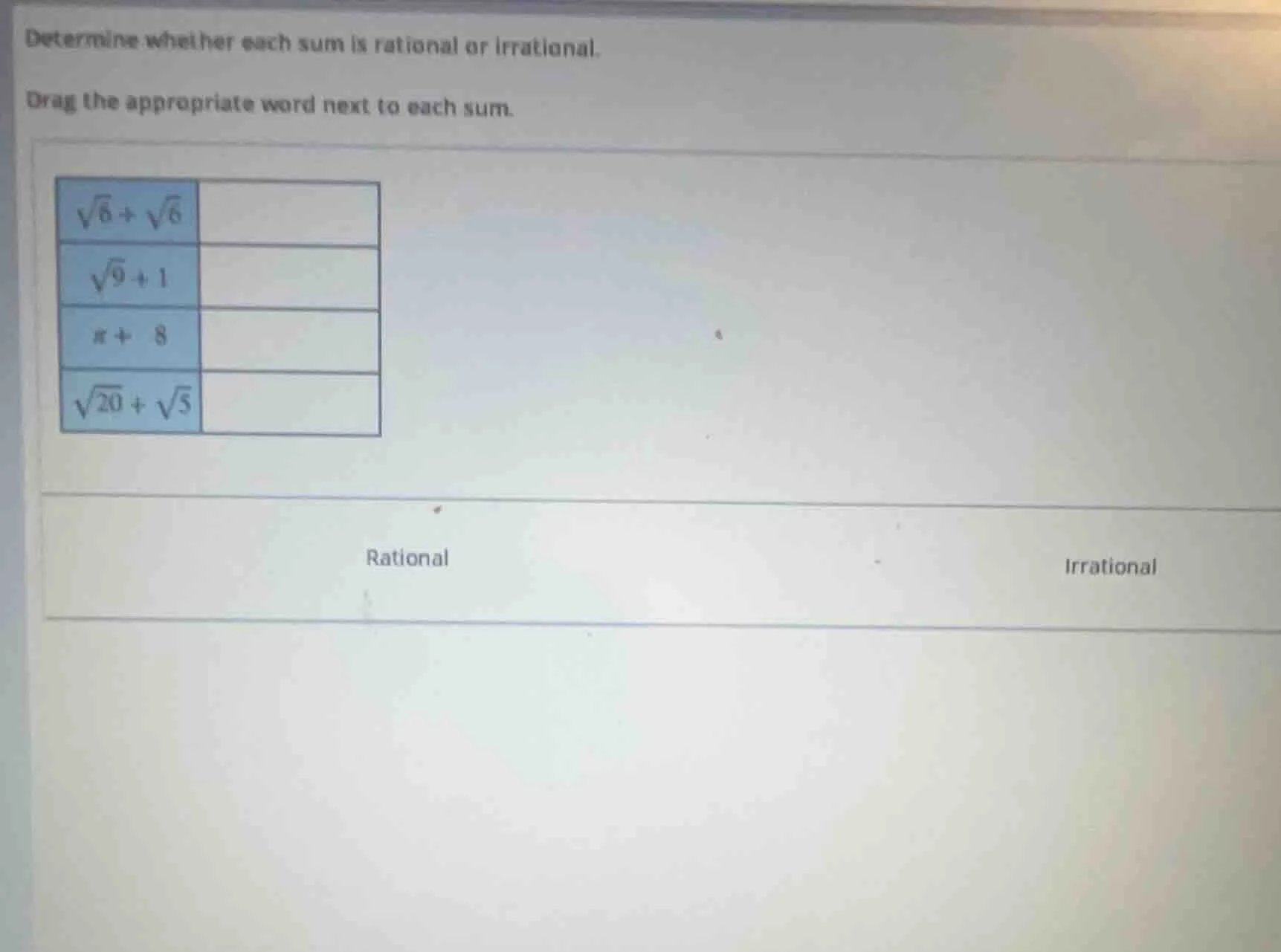
determine whether each sum is rational or irrational.
drag the appropriate word next to each sum.
\\(\sqrt{6}+\sqrt{6}\\)
\\(\sqrt{9}+1\\)
\\(\pi + 8\\)
\\(\sqrt{20}+\sqrt{5}\\)
rational
irrational
For \(\boldsymbol{\sqrt{6}+\sqrt{6}}\):
Step1: Simplify the sum
\(\sqrt{6}+\sqrt{6} = 2\sqrt{6}\)
Step2: Determine rationality
\(\sqrt{6}\) is irrational, and multiplying an irrational number by a non - zero rational number (2) still gives an irrational number. So \(2\sqrt{6}\) is irrational.
For \(\boldsymbol{\sqrt{9}+1}\):
Step1: Simplify \(\sqrt{9}\)
\(\sqrt{9}=3\) (since \(3\times3 = 9\))
Step2: Calculate the sum
\(3 + 1=4\), and 4 is a rational number (it can be written as \(\frac{4}{1}\)).
For \(\boldsymbol{\pi + 8}\):
Step1: Recall the nature of \(\pi\)
\(\pi\) is an irrational number (it has a non - repeating, non - terminating decimal expansion).
Step2: Determine the sum's nature
The sum of an irrational number (\(\pi\)) and a rational number (8) is irrational.
For \(\boldsymbol{\sqrt{20}+\sqrt{5}}\):

Snap & solve any problem in the app
Get step-by-step solutions on Sovi AI
Photo-based solutions with guided steps
Explore more problems and detailed explanations
- \(\sqrt{6}+\sqrt{6}\): Irrational
- \(\sqrt{9}+1\): Rational
- \(\pi + 8\): Irrational
- \(\sqrt{20}+\sqrt{5}\): Irrational