QUESTION IMAGE
Question
- describe how electricity flows through a conductor:
🆕 New Concept Discovered: Electric Current in Conductors
How free electrons move to carry charge
Step 1: Identify the charge carriers in a conductor
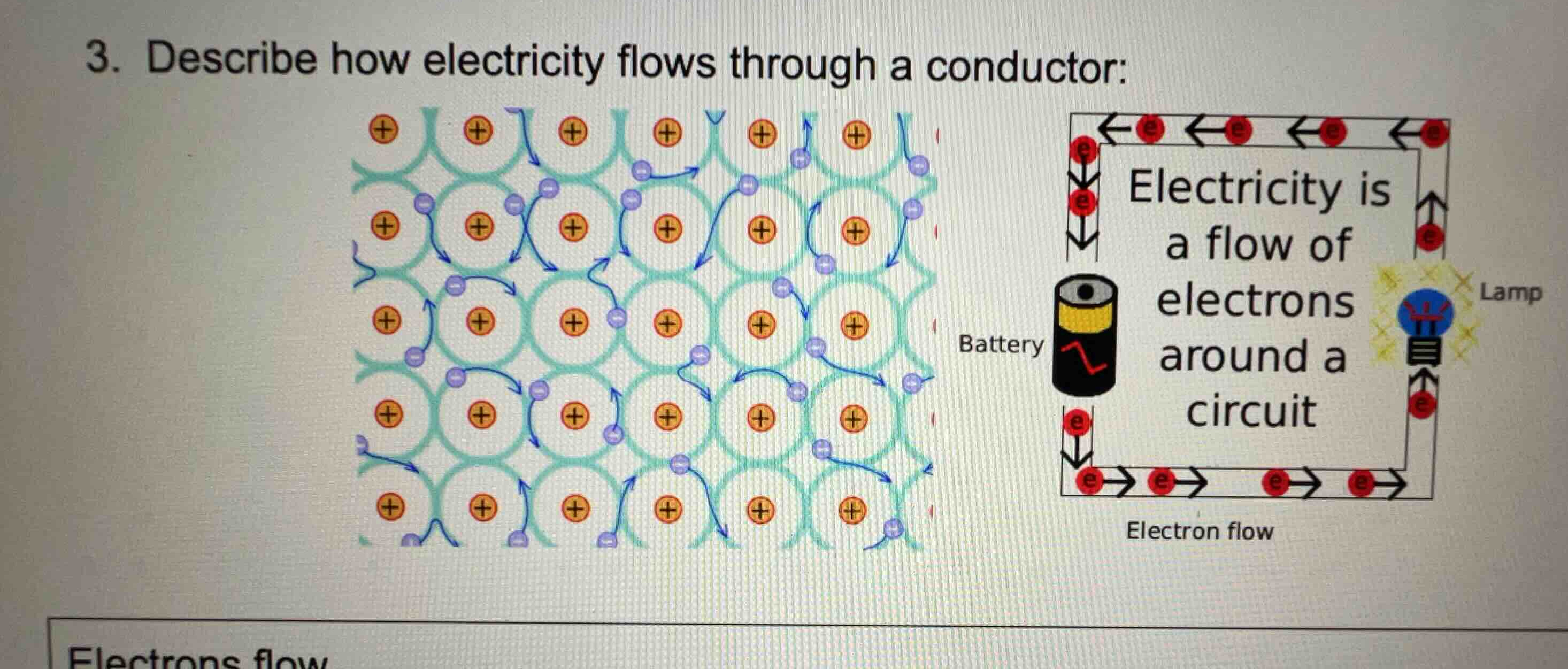
In a metallic conductor, the atoms are arranged in a fixed lattice structure. The outer electrons of these atoms are loosely bound and detach easily, becoming "free electrons." These free electrons form a "sea of electrons" that can move throughout the material, while the positive metal ions remain fixed in place.
Step 2: Describe the movement without a voltage source
When no battery or voltage source is connected, the free electrons move randomly in all directions due to thermal energy. Because this movement is completely random, there is no net flow of charge in any specific direction, meaning no electric current flows.
Step 3: Describe the movement with a voltage source (electric circuit)
When a voltage source (like a battery) is connected across the conductor:
- An electric field is established throughout the circuit.
- Since electrons carry a negative charge (\(e^-\)), they are repelled by the negative terminal of the battery and attracted toward the positive terminal.
- This causes the free electrons to drift in a coordinated direction—from the negative terminal, through the conductor, and toward the positive terminal. This continuous flow of electrons constitutes an electric current.

Snap & solve any problem in the app
Get step-by-step solutions on Sovi AI
Photo-based solutions with guided steps
Explore more problems and detailed explanations
Electricity flows through a conductor via the movement of free electrons.
- Structure of a Conductor: Metals contain a lattice of fixed positive ions surrounded by a "sea" of mobile, free electrons.
- Applying a Voltage: When a battery is connected, it creates an electrical push (voltage).
- Direction of Flow: Because electrons are negatively charged, they are repelled by the negative terminal of the battery and attracted to the positive terminal, drifting through the conductor to create a continuous electric current.