QUESTION IMAGE
Question
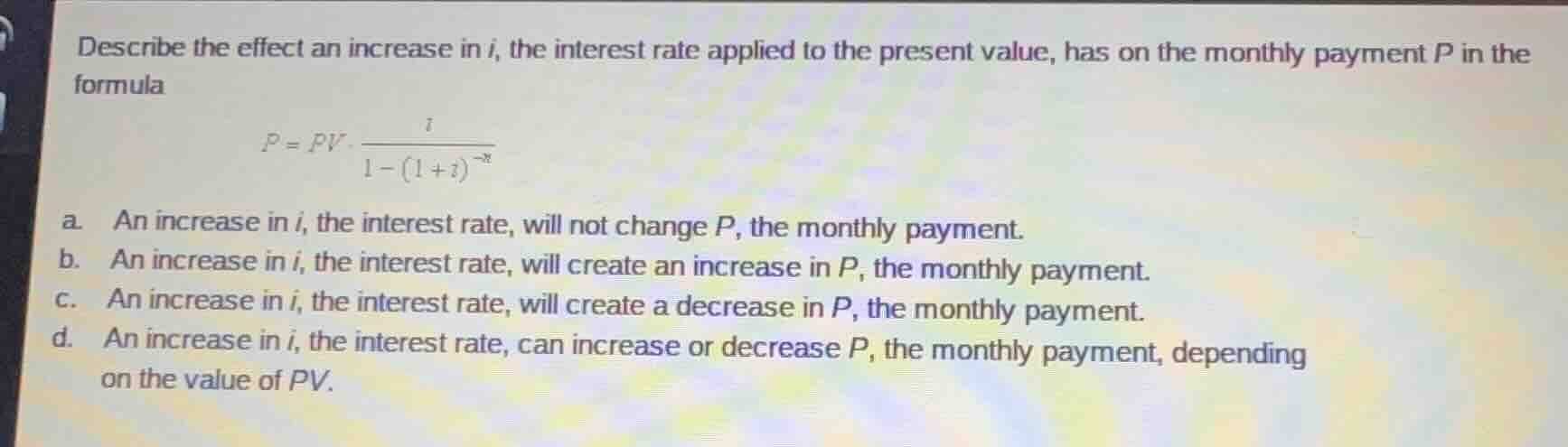
describe the effect an increase in \\(i\\), the interest rate applied to the present value, has on the monthly payment \\(p\\) in the formula
\\p = pv \cdot \frac{i}{1 - (1 + i)^{-n}}\\
a. an increase in \\(i\\), the interest rate, will not change \\(p\\), the monthly payment.
b. an increase in \\(i\\), the interest rate, will create an increase in \\(p\\), the monthly payment.
c. an increase in \\(i\\), the interest rate, will create a decrease in \\(p\\), the monthly payment.
d. an increase in \\(i\\), the interest rate, can increase or decrease \\(p\\), the monthly payment, depending on the value of \\(pv\\).
Analyze the given formula
Using the Amortization Formula Analysis and Loan Monthly Payment knowledge points
where \(P\) is the monthly payment, \(PV\) is the present value (loan principal), \(i\) is the interest rate per period, and \(n\) is the total number of payments.
Determine the effect of increasing \(i\)
Using the Amortization Formula Analysis knowledge point
An increase in the interest rate \(i\) increases the cost of borrowing. Mathematically, as \(i\) increases, the numerator \(i\) increases, and the denominator \(1 - (1+i)^{-n}\) decreases because \((1+i)^{-n}\) becomes smaller. A larger numerator divided by a smaller positive denominator results in a larger overall fraction. Therefore, \(P\) must increase.

Snap & solve any problem in the app
Get step-by-step solutions on Sovi AI
Photo-based solutions with guided steps
Explore more problems and detailed explanations
- a. An increase in i, the interest rate, will not change P, the monthly payment.
- b. An increase in i, the interest rate, will create an increase in P, the monthly payment. (Correct answer)
- c. An increase in i, the interest rate, will create a decrease in P, the monthly payment.
- d. An increase in i, the interest rate, can increase or decrease P, the monthly payment, depending on the value of PV.