QUESTION IMAGE
Question
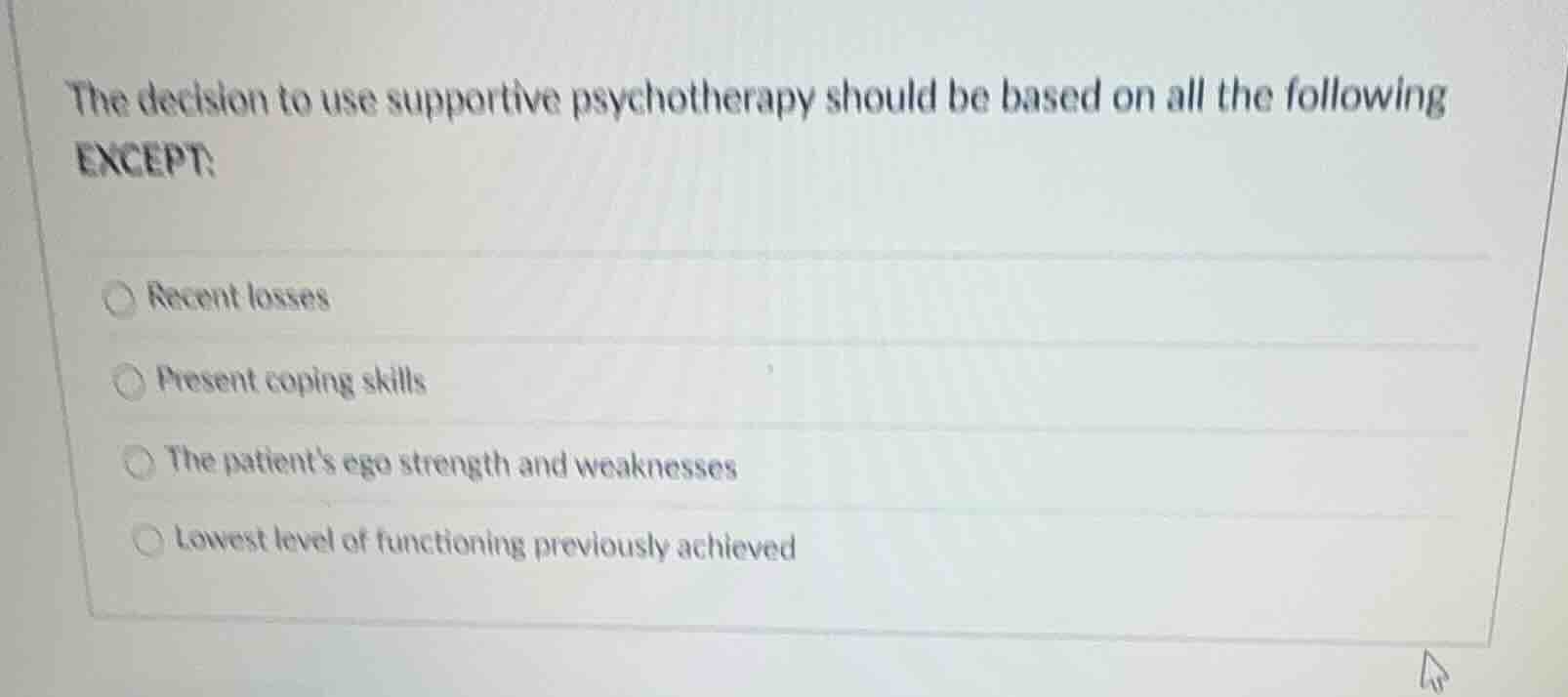
the decision to use supportive psychotherapy should be based on all the following except:
- recent losses
- present coping skills
- the patients ego strength and weaknesses
- lowest level of functioning previously achieved
🆕 New Concept Discovered: Supportive Psychotherapy Indications
Determining when to use supportive versus expressive therapy.
Step 1: Understand Supportive Psychotherapy
Supportive psychotherapy is a treatment approach designed to reinforce a patient's healthy defenses, promote adaptive coping mechanisms, and restore their optimal level of functioning. Unlike expressive or psychoanalytic therapies, it does not aim to restructure personality or uncover deep-seated unconscious conflicts. Instead, it helps patients manage current stressors, crises, or chronic psychological deficits.
Step 2: Evaluate the Indications
To decide if supportive psychotherapy is appropriate, a clinician evaluates several key clinical factors:
- Recent losses / acute stressors: Acute life crises or recent losses are primary indications for supportive therapy to help the patient stabilize.
- Present coping skills: Assessing current coping mechanisms helps the clinician determine how much external support and structure the patient needs.
- Ego strength and weaknesses: Patients with fragile ego strength (e.g., those prone to psychosis or severe regression) are prime candidates for supportive therapy because expressive therapy might destabilize them.
Step 3: Identify the Exception
When assessing a patient's baseline and potential to return to a healthy state, clinicians look at their highest level of functioning previously achieved (pre-morbid functioning), not their lowest. The highest previous level of functioning serves as the target goal for restoration in supportive therapy. The "lowest level of functioning previously achieved" is not a standard metric used to justify or guide the decision to initiate supportive psychotherapy.

Snap & solve any problem in the app
Get step-by-step solutions on Sovi AI
Photo-based solutions with guided steps
Explore more problems and detailed explanations
Lowest level of functioning previously achieved