QUESTION IMAGE
Question
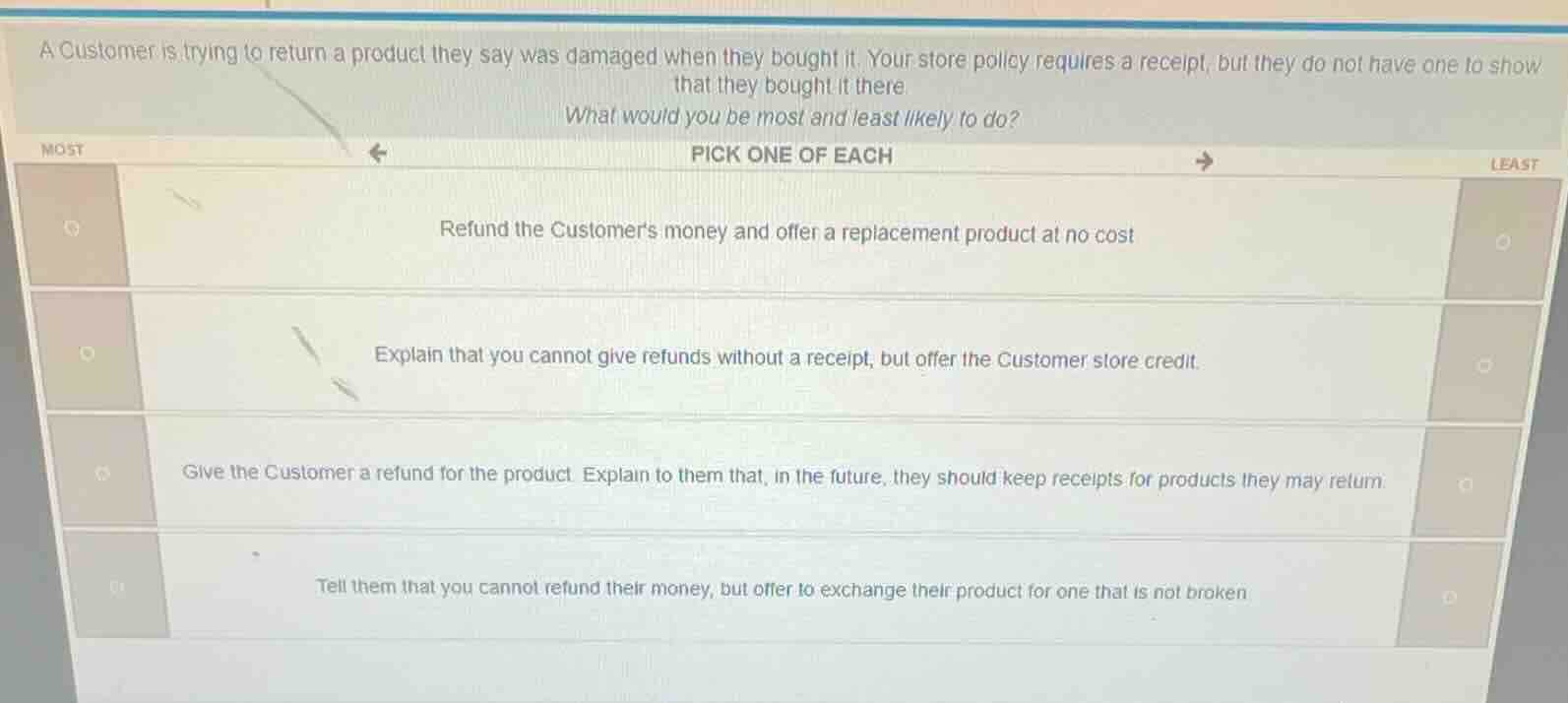
a customer is trying to return a product they say was damaged when they bought it. your store policy requires a receipt, but they do not have one to show that they bought it there.
what would you be most and least likely to do?
pick one of each
refund the customers money and offer a replacement product at no cost
explain that you cannot give refunds without a receipt, but offer the customer store credit.
give the customer a refund for the product. explain to them that, in the future, they should keep receipts for products they may return.
tell them that you cannot refund their money, but offer to exchange their product for one that is not broken.
Analyze the scenario constraints
The scenario presents a classic customer service dilemma:
- Customer's issue: Trying to return a product claimed to be damaged upon purchase.
- Store policy: Requires a receipt to prove the item was purchased at this store.
- Complication: The customer does not have a receipt.
We must evaluate the four options to find the Most Likely (best balanced, policy-respecting yet customer-oriented) and Least Likely (worst, either overly permissive/violating policy completely or unhelpful) actions using Situational Judgment Test principles.
Evaluate Option 1
Option 1: "Refund the Customer's money and offer a replacement product at no cost"
- Analysis: This option gives the customer both their money back and a free replacement. This is a double-recovery that violates store policy (refunding without a receipt) and causes unnecessary financial loss to the store. It is highly unrealistic and represents poor Customer Service Excellence because it lacks commercial balance.
Evaluate Option 2
Option 2: "Explain that you cannot give refunds without a receipt, but offer the Customer store credit."
- Analysis: This option respects the store policy (no cash/original payment refund without a receipt) while offering a reasonable compromise (store credit) to resolve the issue. This demonstrates strong Conflict Resolution and adheres to standard retail practices.
Evaluate Option 3
Option 3: "Give the Customer a refund for the product. Explain to them that, in the future, they should keep receipts for products they may return."
- Analysis: This option directly violates the store policy by giving a refund without a receipt. Simply lecturing the customer about keeping receipts in the future does not justify breaking the policy.
Evaluate Option 4
Option 4: "Tell them that you cannot refund their money, but offer to exchange their product for one that is not broken"
- Analysis: This is the most balanced action. Since the customer claims the product was damaged when bought, offering a direct exchange for an identical, undamaged item solves their core problem (getting a working product) without giving away cash/credit without proof of purchase. This perfectly balances policy adherence with Customer Service Excellence.
Determine Most and Least Likely
- Most Likely: Option 4. It directly addresses the customer's issue (damaged product) by replacing it, while upholding the store's refund policy.
- Least Likely: Option 1. It gives a full refund and a free replacement, which is an excessive, unauthorized double-benefit that violates policy and hurts the business.

Snap & solve any problem in the app
Get step-by-step solutions on Sovi AI
Photo-based solutions with guided steps
Explore more problems and detailed explanations
Question 1
- MOST: Tell them that you cannot refund their money, but offer to exchange their product for one that is not broken
- LEAST: Refund the Customer's money and offer a replacement product at no cost (Correct answer)
- Explain that you cannot give refunds without a receipt, but offer the Customer store credit.
- Give the Customer a refund for the product. Explain to them that, in the future, they should keep receipts for products they may return.