Sovi.AI - AI Math Tutor

Scan to solve math questions

QUESTION IMAGE

coronary artery disease is caused by the ______ build up in the wall of…

Question

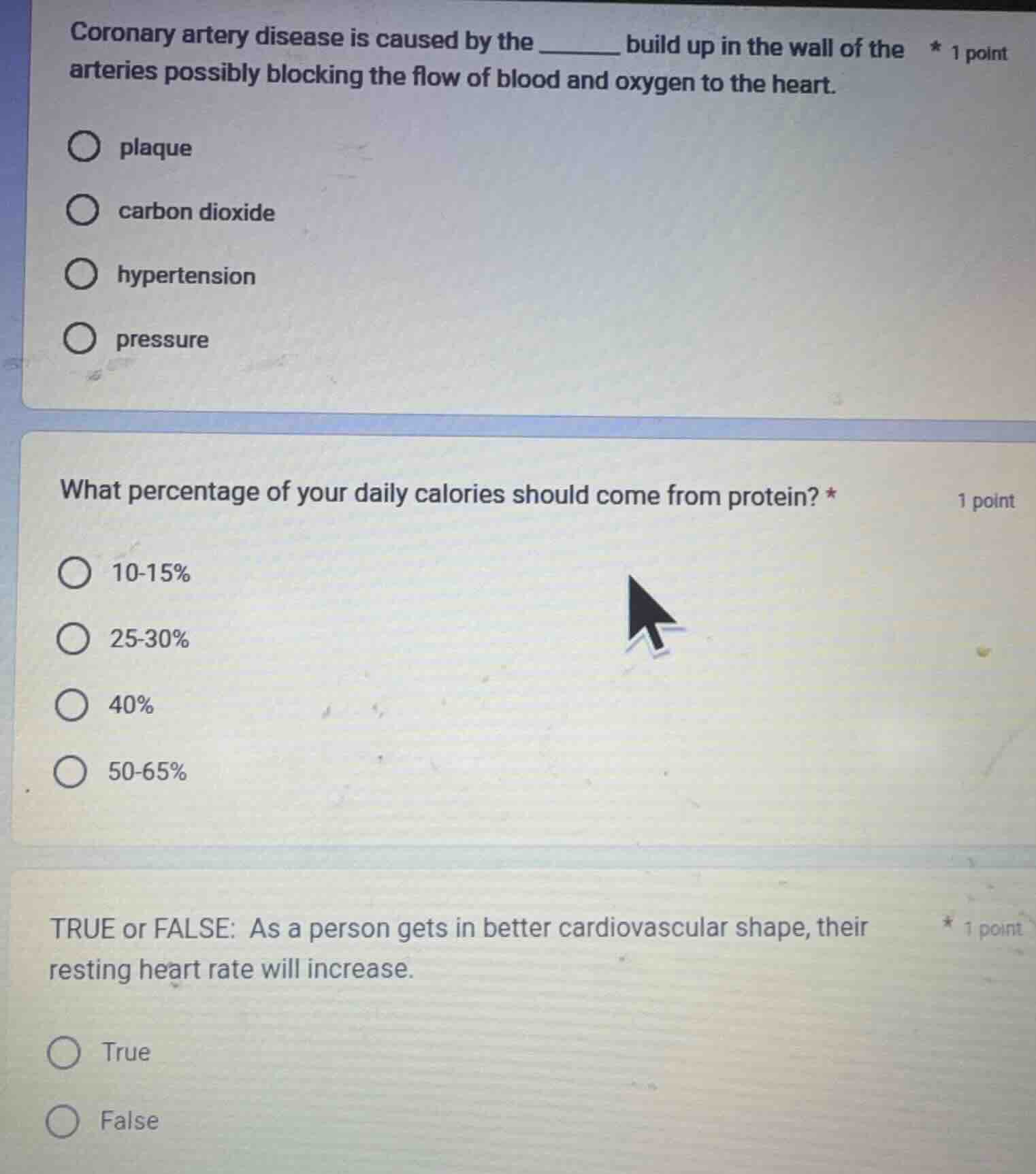
coronary artery disease is caused by the ______ build up in the wall of the arteries possibly blocking the flow of blood and oxygen to the heart.

  • plaque
  • carbon dioxide
  • hypertension
  • pressure

what percentage of your daily calories should come from protein?

  • 10-15%
  • 25-30%
  • 40%
  • 50-65%

true or false: as a person gets in better cardiovascular shape, their resting heart rate will increase.

  • true
  • false

Explanation:

Response

<pre_analysis>
{
"quality": "clear",
"question_count": 3,
"skills_matched": [
"direct_cot",
"multiple_choice_formatter",
"explain_then_answer",
"tutor"
],
"needs_drawing": false,
"concepts_used": [
"Cardiovascular Disease Risk Factors",
"Macronutrient Functions",
"Cardiovascular Adaptations"
],
"new_concepts": [
"Coronary Artery Disease Pathophysiology",
"Macronutrient Distribution Ranges"
],
"current_concepts": [
"Cardiovascular Disease Risk Factors",
"Macronutrient Functions",
"Cardiovascular Adaptations",
"Coronary Artery Disease Pathophysiology",
"Macronutrient Distribution Ranges"
]
}
</pre_analysis>

<reasoning>

Analyze coronary artery disease causes

Using the Cardiovascular Disease Risk Factors knowledge point, coronary artery disease (CAD) is characterized by the narrowing of the coronary arteries. This narrowing is caused by the accumulation of fatty deposits, cholesterol, and other cellular waste products, collectively known as plaque, along the inner walls of the arteries. This buildup restricts blood flow and oxygen delivery to the heart muscle.

Determine daily protein calorie percentage

Using the Macronutrient Functions knowledge point, the Acceptable Macronutrient Distribution Range (AMDR) established by nutritional guidelines recommends that adults consume 10–35% of their daily calories from protein. Among the given options, the range 10–15% represents a standard healthy minimum proportion of daily caloric intake dedicated to protein.

Evaluate cardiovascular fitness and resting heart rate

Using the Cardiovascular Adaptations knowledge point, regular aerobic exercise strengthens the heart muscle, allowing it to pump a greater volume of blood with each beat (increased stroke volume). Because the heart becomes more efficient, it does not need to beat as frequently to maintain adequate circulation at rest. Therefore, as cardiovascular fitness improves, resting heart rate decreases rather than increases, making the statement false.
</reasoning>

<answer>

Question 1

<mcq-correct>plaque</mcq-correct>
<mcq-option>carbon dioxide</mcq-option>
<mcq-option>hypertension</mcq-option>
<mcq-option>pressure</mcq-option>

Question 2

<mcq-correct>10-15%</mcq-correct>
<mcq-option>25-30%</mcq-option>
<mcq-option>40%</mcq-option>
<mcq-option>50-65%</mcq-option>

Question 3

<mcq-option>True</mcq-option>
<mcq-correct>False</mcq-correct>
</answer>

<post_analysis>
{
"subject": "Natural Science",
"question_type": "Multiple Choice",
"knowledge_point": [
"Natural Science",
"Medicine and Health",
"Cardiovascular Health and Nutrition"
]
}
</post_analysis>

Answer:

<pre_analysis>
{
"quality": "clear",
"question_count": 3,
"skills_matched": [
"direct_cot",
"multiple_choice_formatter",
"explain_then_answer",
"tutor"
],
"needs_drawing": false,
"concepts_used": [
"Cardiovascular Disease Risk Factors",
"Macronutrient Functions",
"Cardiovascular Adaptations"
],
"new_concepts": [
"Coronary Artery Disease Pathophysiology",
"Macronutrient Distribution Ranges"
],
"current_concepts": [
"Cardiovascular Disease Risk Factors",
"Macronutrient Functions",
"Cardiovascular Adaptations",
"Coronary Artery Disease Pathophysiology",
"Macronutrient Distribution Ranges"
]
}
</pre_analysis>

<reasoning>

Analyze coronary artery disease causes

Using the Cardiovascular Disease Risk Factors knowledge point, coronary artery disease (CAD) is characterized by the narrowing of the coronary arteries. This narrowing is caused by the accumulation of fatty deposits, cholesterol, and other cellular waste products, collectively known as plaque, along the inner walls of the arteries. This buildup restricts blood flow and oxygen delivery to the heart muscle.

Determine daily protein calorie percentage

Using the Macronutrient Functions knowledge point, the Acceptable Macronutrient Distribution Range (AMDR) established by nutritional guidelines recommends that adults consume 10–35% of their daily calories from protein. Among the given options, the range 10–15% represents a standard healthy minimum proportion of daily caloric intake dedicated to protein.

Evaluate cardiovascular fitness and resting heart rate

Using the Cardiovascular Adaptations knowledge point, regular aerobic exercise strengthens the heart muscle, allowing it to pump a greater volume of blood with each beat (increased stroke volume). Because the heart becomes more efficient, it does not need to beat as frequently to maintain adequate circulation at rest. Therefore, as cardiovascular fitness improves, resting heart rate decreases rather than increases, making the statement false.
</reasoning>

<answer>

Question 1

<mcq-correct>plaque</mcq-correct>
<mcq-option>carbon dioxide</mcq-option>
<mcq-option>hypertension</mcq-option>
<mcq-option>pressure</mcq-option>

Question 2

<mcq-correct>10-15%</mcq-correct>
<mcq-option>25-30%</mcq-option>
<mcq-option>40%</mcq-option>
<mcq-option>50-65%</mcq-option>

Question 3

<mcq-option>True</mcq-option>
<mcq-correct>False</mcq-correct>
</answer>

<post_analysis>
{
"subject": "Natural Science",
"question_type": "Multiple Choice",
"knowledge_point": [
"Natural Science",
"Medicine and Health",
"Cardiovascular Health and Nutrition"
]
}
</post_analysis>