QUESTION IMAGE
Question
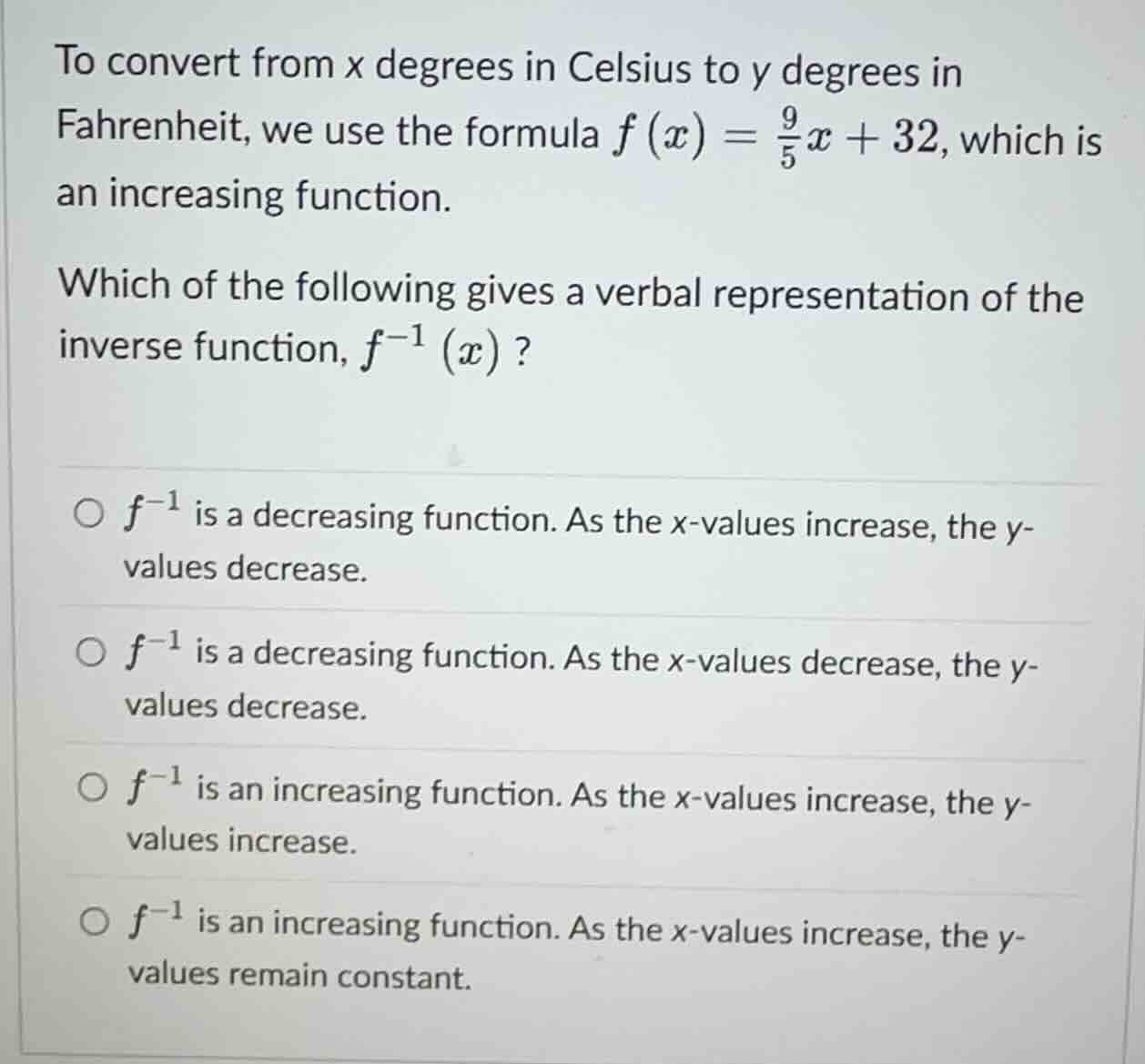
to convert from (x) degrees in celsius to (y) degrees in fahrenheit, we use the formula (f(x) = \frac{9}{5}x + 32), which is an increasing function.
which of the following gives a verbal representation of the inverse function, (f^{-1}(x))?
- (f^{-1}) is a decreasing function. as the (x)-values increase, the (y)-values decrease.
- (f^{-1}) is a decreasing function. as the (x)-values decrease, the (y)-values decrease.
- (f^{-1}) is an increasing function. as the (x)-values increase, the (y)-values increase.
- (f^{-1}) is an increasing function. as the (x)-values increase, the (y)-values remain constant.
⚡ Using what you learned: inverse functions: definition and notation
Step 1: Analyze the behavior of the original function
The original function is:
We are given that \( f(x) \) is an increasing function. This means as the input \( x \) increases, the output \( y \) also increases.
Step 2: Determine the behavior of the inverse function
An inverse function \( f^{-1}(x) \) reverses the inputs and outputs of the original function, but it preserves the direction of the relationship (monotonicity):
- If a function is strictly increasing, its inverse is also strictly increasing.
- Therefore, \( f^{-1} \) is an increasing function.
Step 3: Match with the verbal definition of an increasing function
By definition, for an increasing function:
- As the \( x \)-values increase, the \( y \)-values must also increase.
This matches the third option:
"\( f^{-1} \) is an increasing function. As the \( x \)-values increase, the \( y \)-values increase."

Snap & solve any problem in the app
Get step-by-step solutions on Sovi AI
Photo-based solutions with guided steps
Explore more problems and detailed explanations
\( f^{-1} \) is an increasing function. As the \( x \)-values increase, the \( y \)-values increase.