QUESTION IMAGE
Question
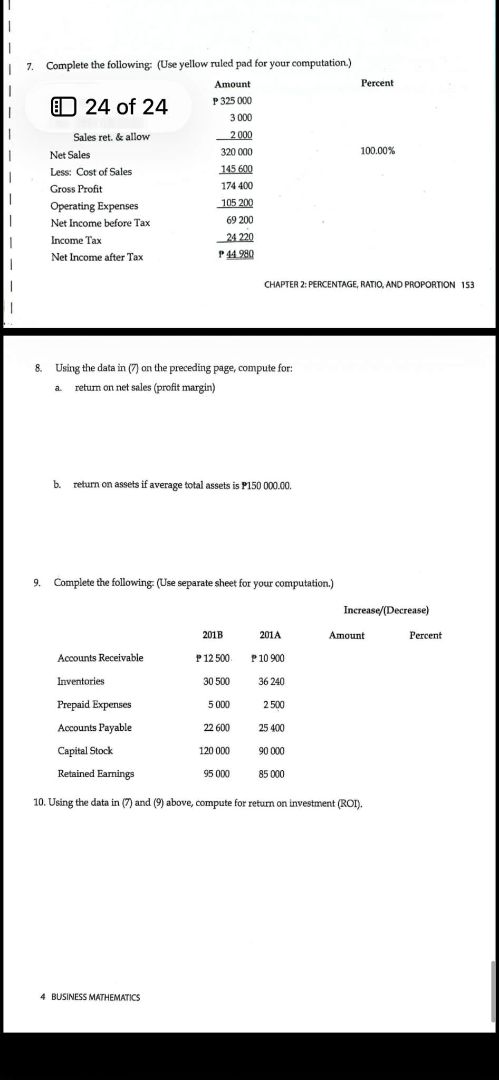
- complete the following: (use yellow ruled pad for your computation.)
\
- using the data in (7) on the preceding page, compute for:
a. return on net sales (profit margin)
b. return on assets if average total assets is p150 000.00.
- complete the following: (use separate sheet for your computation.)
\
- using the data in (7) and (9) above, compute for return on investment (roi).
🆕 New Concept Discovered: Financial Ratio Analysis
Measuring business performance using profitability and investment returns.
Step 1: Return on Net Sales (Profit Margin)
Return on Net Sales (also known as Profit Margin) measures how much net income a business generates as a percentage of its net sales.
Using the data from problem (7):
- Net Income after Tax = \(\text{P } 44,980\)
- Net Sales = \(\text{P } 320,000\)
---
Step 2: Return on Assets (ROA)
Return on Assets measures how efficiently a company uses its assets to generate profit.
Using the data from problem (7) and (8b):
- Net Income after Tax = \(\text{P } 44,980\)
- Average Total Assets = \(\text{P } 150,000.00\)
---
Step 3: Horizontal Analysis of Balance Sheet Items
To complete the table in problem (9), we calculate the change from the base year (\(201\text{A}\)) to the current year (\(201\text{B}\)).
- \(\text{Amount Change} = \text{Amount in } 201\text{B} - \text{Amount in } 201\text{A}\)
- \(\text{Percent Change} = \frac{\text{Amount Change}}{\text{Amount in } 201\text{A}} \times 100\)
Accounts Receivable
- \(\text{Amount Change} = 12,500 - 10,900 = 1,600\)
- \(\text{Percent Change} = \frac{1,600}{10,900} \times 100 \approx 14.68\%\)
Inventories
- \(\text{Amount Change} = 30,500 - 36,240 = -5,740\)
- \(\text{Percent Change} = \frac{-5,740}{36,240} \times 100 \approx -15.84\%\)
Prepaid Expenses
- \(\text{Amount Change} = 5,000 - 2,500 = 2,500\)
- \(\text{Percent Change} = \frac{2,500}{2,500} \times 100 = 100.00\%\)
Accounts Payable
- \(\text{Amount Change} = 22,600 - 25,400 = -2,800\)
- \(\text{Percent Change} = \frac{-2,800}{25,400} \times 100 \approx -11.02\%\)
Capital Stock
- \(\text{Amount Change} = 120,000 - 90,000 = 30,000\)
- \(\text{Percent Change} = \frac{30,000}{90,000} \times 100 \approx 33.33\%\)
Retained Earnings
- \(\text{Amount Change} = 95,000 - 85,000 = 10,000\)
- \(\text{Percent Change} = \frac{10,000}{85,000} \times 100 \approx 11.76\%\)
---
Step 4: Return on Investment (ROI)
Return on Investment (ROI) measures the return generated on the total equity invested by the shareholders (Capital Stock + Retained Earnings).
First, we find the average total stockholders' equity using the data from (9):
- \(\text{Total Equity } 201\text{A} = \text{Capital Stock} + \text{Retained Earnings} = 90,000 + 85,000 = 175,000\)
- \(\text{Total Equity } 201\text{B} = \text{Capital Stock} + \text{Retained Earnings} = 120,000 + 95,000 = 215,000\)
- \(\text{Average Total Equity} = \frac{175,000 + 215,000}{2} = 195,000\)
Now, we calculate ROI using the Net Income after Tax from (7):
- Net Income after Tax = \(\text{P } 44,980\)

Snap & solve any problem in the app
Get step-by-step solutions on Sovi AI
Photo-based solutions with guided steps
Explore more problems and detailed explanations
8. Financial Ratios
- a. Return on net sales (profit margin): \(14.06\%\)
- b. Return on assets: \(29.99\%\)
---
9. Completed Table
| Account | 201B | 201A | Increase/(Decrease) Amount | Increase/(Decrease) Percent |
|---|---|---|---|---|
| Inventories | \(30,500\) | \(36,240\) | \((5,740)\) | \((15.84\%)\) |
| Prepaid Expenses | \(5,000\) | \(2,500\) | \(2,500\) | \(100.00\%\) |
| Accounts Payable | \(22,600\) | \(25,400\) | \((2,800)\) | \((11.02\%)\) |
| Capital Stock | \(120,000\) | \(90,000\) | \(30,000\) | \(33.33\%\) |
| Retained Earnings | \(95,000\) | \(85,000\) | \(10,000\) | \(11.76\%\) |
---
10. Return on Investment (ROI)
- ROI: \(23.07\%\)