QUESTION IMAGE
Question
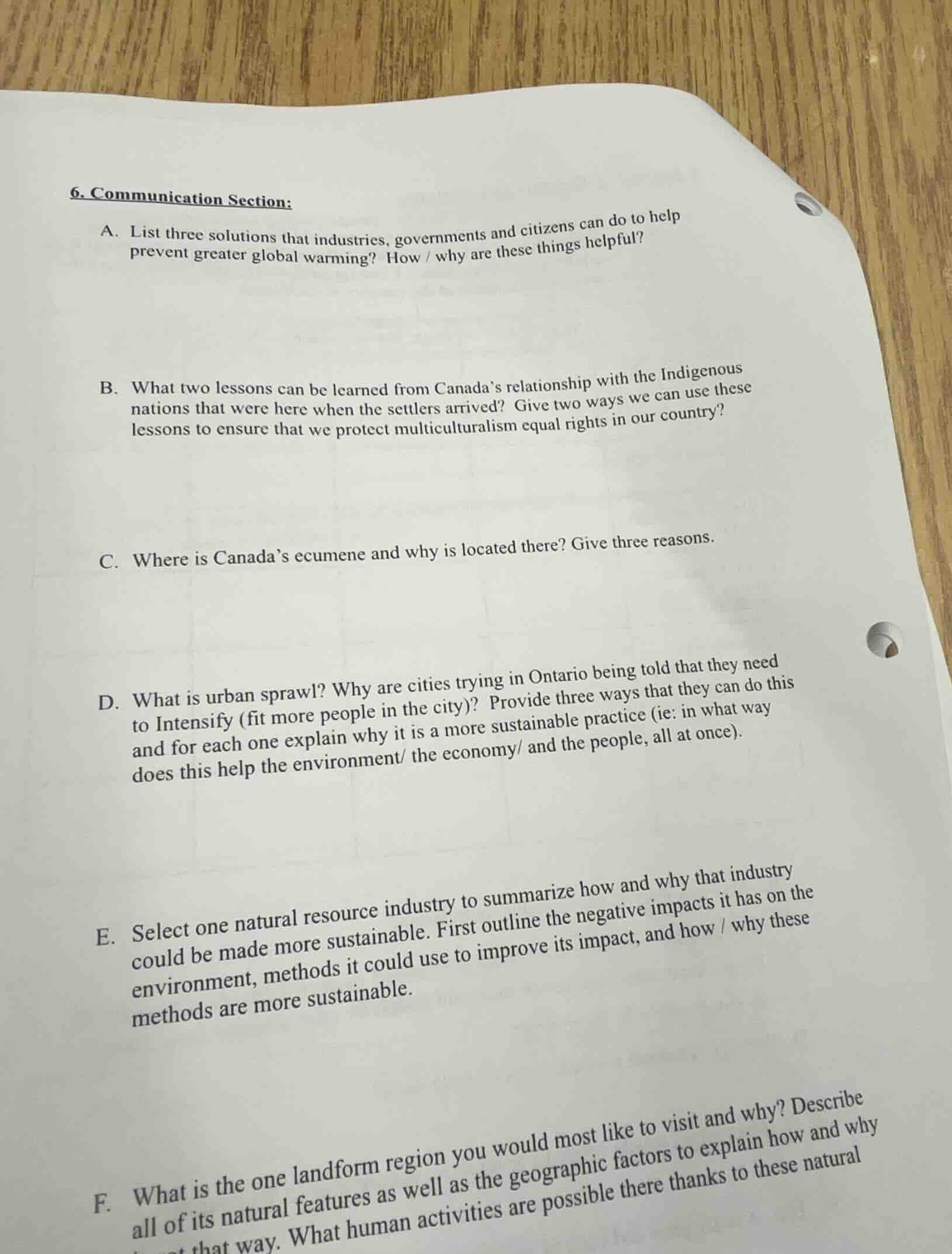
- communication section:
a. list three solutions that industries, governments and citizens can do to help prevent greater global warming? how / why are these things helpful?
b. what two lessons can be learned from canadas relationship with the indigenous nations that were here when the settlers arrived? give two ways we can use these lessons to ensure that we protect multiculturalism equal rights in our country?
c. where is canadas ecumene and why is located there? give three reasons.
d. what is urban sprawl? why are cities trying in ontario being told that they need to intensify (fit more people in the city)? provide three ways that they can do this and for each one explain why it is a more sustainable practice (ie: in what way does this help the environment/ the economy/ and the people, all at once).
e. select one natural resource industry to summarize how and why that industry could be made more sustainable. first outline the negative impacts it has on the environment, methods it could use to improve its impact, and how / why these methods are more sustainable.
f. what is the one landform region you would most like to visit and why? describe all of its natural features as well as the geographic factors to explain how and why it got that way. what human activities are possible there thanks to these natural features?
Solutions for global warming
Using the Environmental Science knowledge point, we address global warming by looking at actions across three distinct societal levels:
- Industries: Transitioning to renewable energy sources (such as wind, solar, or geothermal) to replace fossil fuels. This directly reduces greenhouse gas emissions from manufacturing and power generation.
- Governments: Implementing carbon pricing mechanisms (like carbon taxes or cap-and-trade systems). This incentivizes businesses to lower emissions and funds green infrastructure.
- Citizens: Adopting active transportation (walking, cycling) or public transit instead of driving personal combustion vehicles. This reduces individual carbon footprints and fossil fuel consumption.
Lessons from Indigenous relations
We analyze historical relationships to build a more equitable, multicultural society:
- Lessons learned:
- The importance of respecting treaties and recognizing inherent land rights, rather than imposing unilateral colonial governance.
- The value of traditional ecological knowledge in managing resources sustainably and living in harmony with the environment.
- Ways to protect equal rights:
- Integrating Indigenous perspectives and history into national educational curricula to foster mutual respect and understanding.
- Ensuring meaningful consultation and shared decision-making power regarding land use and resource development projects.
Canada's ecumene
We define the inhabited zone of Canada and analyze its geographic distribution:
- Location: Canada's ecumene (the permanently inhabited zone) is concentrated in a narrow strip along the southern border, particularly in the Great Lakes-St. Lawrence Lowlands and parts of the southern Prairies and coastal British Columbia.
- Reasons for location:
- Climate: The southern region offers a warmer, more moderate climate suitable for agriculture and comfortable human settlement compared to the harsh subarctic and arctic north.
- Transportation and Trade: Proximity to the United States border and major waterways (like the St. Lawrence River and Great Lakes) historically facilitated trade and movement.
- Arable Land: The southern soils and longer growing seasons support robust agricultural production, which originally anchored early communities.
Urban sprawl and intensification
Using the Sustainable Technology knowledge point, we examine urban growth patterns in Ontario:
- Urban Sprawl: The rapid, low-density expansion of cities into surrounding rural and agricultural land.
- Why intensify: Cities in Ontario must intensify to protect valuable farmland, reduce infrastructure costs, and lower greenhouse gas emissions by curbing car dependency.
- Three sustainable intensification methods:
- Brownfield Redevelopment: Converting abandoned industrial sites into residential or mixed-use spaces. This protects greenfield land (environment), boosts local property values and u…

Snap & solve any problem in the app
Get step-by-step solutions on Sovi AI
Photo-based solutions with guided steps
Explore more problems and detailed explanations
Question A
- Three Solutions:
- Industries: Transition to renewable energy sources (solar, wind) to power manufacturing.
- Governments: Implement carbon pricing policies to incentivize emission reductions.
- Citizens: Use public transit or active transportation (walking, biking) instead of personal vehicles.
- Why helpful: These actions directly lower the concentration of greenhouse gases trapped in the atmosphere, slowing down the rise in global temperatures.
Question B
- Two Lessons:
- Treaties and inherent land rights must be respected and upheld.
- Indigenous ecological knowledge is vital for sustainable environmental stewardship.
- Two Ways to Protect Rights:
- Mandate comprehensive Indigenous history and treaty education in schools.
- Ensure equal representation and co-management rights in environmental and resource development decisions.
Question C
- Location: Canada's ecumene is located in a narrow southern band, primarily within the Great Lakes-St. Lawrence Lowlands and along the US border.
- Three Reasons:
- Climate: Warmer temperatures and longer growing seasons.
- Trade/Transportation: Access to major waterways (Great Lakes, St. Lawrence River) and proximity to US markets.
- Agriculture: Fertile soils that support food production and early settlement.
Question D
- Urban Sprawl: The low-density, outward expansion of urban areas into surrounding rural land.
- Why Intensify: To prevent the destruction of agricultural land, reduce municipal infrastructure costs, and lower carbon emissions.
- Three Intensification Methods:
- Brownfield Redevelopment: Cleans up polluted urban land (environment), utilizes existing infrastructure (economy), and revitalizes local neighborhoods (people).
- Transit-Oriented Development: Reduces car dependency and emissions (environment), lowers household transit costs (economy), and increases accessibility to services (people).
- Infill Development (e.g., duplexes, laneway housing): Preserves natural habitats outside cities (environment), increases municipal tax efficiency (economy), and offers diverse housing options (people).
Question E
- Industry: Forestry.
- Negative Impacts: Clear-cutting causes habitat destruction, soil erosion, and biodiversity loss.
- Improvement Methods:
- Selective Logging: Harvesting only specific trees to keep the forest structure intact.
- Mandatory Reforestation: Replanting native species immediately after harvesting.
- Why Sustainable: These methods preserve soil stability and wildlife habitats while ensuring the forest remains a continuous carbon sink and a renewable economic resource.
Question F
- Landform Region: The Canadian Shield.
- Why Visit: To explore its rugged wilderness, ancient rock landscapes, and vast networks of lakes and rivers.
- Natural Features & Geographic Factors: Exposed Precambrian igneous rock and thousands of lakes, formed by billions of years of geological activity and carved out by ice-age glaciation.
- Human Activities: Hydroelectric power generation, forestry, and mineral mining, all made possible by the region's abundant water systems, dense boreal forests, and mineral-rich bedrock.