QUESTION IMAGE
Question
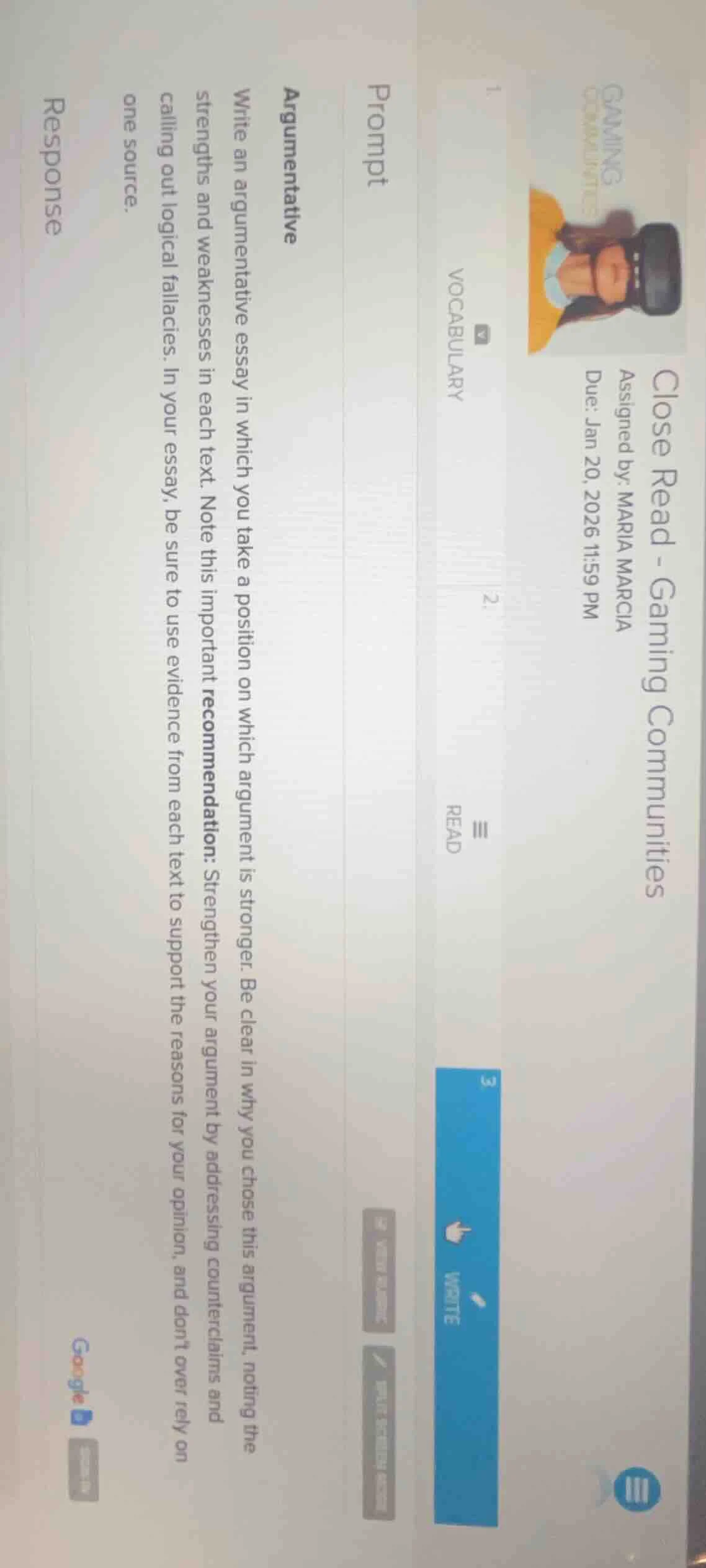
close read - gaming communities
assigned by: maria marcia
due: jan 20, 2026 11:59 pm
1
vocabulary
2
read
3
write
prompt
argumentative
write an argumentative essay in which you take a position on which argument is stronger. be clear in why you chose this argument, noting the strengths and weaknesses in each text. note this important recommendation: strengthen your argument by addressing counterclaims and calling out logical fallacies. in your essay, be sure to use evidence from each text to support the reasons for your opinion, and dont over rely on one source.
response
To address this argumentative essay prompt about gaming communities, here's a structured approach (though the specific texts for analysis aren't provided, this is a general framework):
Step 1: Analyze the Prompt Requirements
Understand that you need to:
- Take a position on which argument (presumably from provided texts) is stronger.
- Identify strengths/weaknesses and logical fallacies in each text.
- Use evidence from each text to support your opinion.
- Address counterclaims and call out logical fallacies.
- Use one source (not over - rely on it).
Step 2: Gather Information (Assuming Texts are Provided)
If there are two texts (let's say Text A and Text B) about gaming communities:
- For Text A:
- Look for its main argument. For example, if it argues that gaming communities are beneficial for social skills, find the evidence it provides (e.g., surveys showing increased communication among gamers).
- Identify strengths: Maybe it has a large sample size in its survey. Weaknesses: Perhaps it only surveys a specific type of gamer (e.g., only PC gamers), which could be a hasty generalization fallacy.
- For Text B:
- If it argues that gaming communities are harmful due to toxic behavior, find its evidence (e.g., reports of harassment in gaming lobbies).
- Strengths: Maybe it has multiple case studies. Weaknesses: Maybe it uses anecdotal evidence too much, which is a fallacy of anecdotal reasoning.
Step 3: Take a Position
Based on the analysis, decide which argument is stronger. For example, if Text A has more empirical evidence and fewer fallacies than Text B, you might choose Text A's argument.
Step 4: Structure the Essay
- Introduction: Introduce the topic of gaming communities and your position on which argument is stronger.
- Body Paragraph 1: Analyze the first text (e.g., Text A), its strengths, weaknesses, and fallacies. Use evidence from the text.
- Body Paragraph 2: Analyze the second text (e.g., Text B), its strengths, weaknesses, and fallacies. Use evidence from the text.
- Body Paragraph 3: Address counterclaims. For example, if your position is that gaming communities are beneficial, address the counterclaim that they are toxic by showing how the benefits outweigh the negatives or how the toxic behavior can be mitigated.
- Conclusion: Summarize your main points and reaffirm your position.
Since the actual texts for analysis are not provided in full, this is a general guide. If you can share the texts (or their main arguments), a more detailed response can be given.
If we assume a common scenario where one text says gaming communities enhance social connections (with survey data of 1000 gamers showing 70% feel more connected) and another says they promote isolation (with anecdotes of 5 gamers who felt lonely), here's a sample essay outline:
Introduction
Gaming communities have become a significant part of modern digital culture. In the debate over their impact, one argument (from Text A) that gaming communities enhance social connections is stronger than the opposing argument (from Text B) that they promote isolation.
Body Paragraph 1: Analyzing Text A
Text A argues that gaming communities enhance social connections. Its strength is a large - scale survey of 1000 gamers, where 70% reported feeling more connected to others. However, a weakness is that it only surveyed gamers from urban areas, which could be a hasty generalization as it doesn't represent rural gamers. A logical fallacy here is the hasty generalization, as the sample is not fully representative.
Body Paragra…

Snap & solve any problem in the app
Get step-by-step solutions on Sovi AI
Photo-based solutions with guided steps
Explore more problems and detailed explanations
To address this argumentative essay prompt about gaming communities, here's a structured approach (though the specific texts for analysis aren't provided, this is a general framework):
Step 1: Analyze the Prompt Requirements
Understand that you need to:
- Take a position on which argument (presumably from provided texts) is stronger.
- Identify strengths/weaknesses and logical fallacies in each text.
- Use evidence from each text to support your opinion.
- Address counterclaims and call out logical fallacies.
- Use one source (not over - rely on it).
Step 2: Gather Information (Assuming Texts are Provided)
If there are two texts (let's say Text A and Text B) about gaming communities:
- For Text A:
- Look for its main argument. For example, if it argues that gaming communities are beneficial for social skills, find the evidence it provides (e.g., surveys showing increased communication among gamers).
- Identify strengths: Maybe it has a large sample size in its survey. Weaknesses: Perhaps it only surveys a specific type of gamer (e.g., only PC gamers), which could be a hasty generalization fallacy.
- For Text B:
- If it argues that gaming communities are harmful due to toxic behavior, find its evidence (e.g., reports of harassment in gaming lobbies).
- Strengths: Maybe it has multiple case studies. Weaknesses: Maybe it uses anecdotal evidence too much, which is a fallacy of anecdotal reasoning.
Step 3: Take a Position
Based on the analysis, decide which argument is stronger. For example, if Text A has more empirical evidence and fewer fallacies than Text B, you might choose Text A's argument.
Step 4: Structure the Essay
- Introduction: Introduce the topic of gaming communities and your position on which argument is stronger.
- Body Paragraph 1: Analyze the first text (e.g., Text A), its strengths, weaknesses, and fallacies. Use evidence from the text.
- Body Paragraph 2: Analyze the second text (e.g., Text B), its strengths, weaknesses, and fallacies. Use evidence from the text.
- Body Paragraph 3: Address counterclaims. For example, if your position is that gaming communities are beneficial, address the counterclaim that they are toxic by showing how the benefits outweigh the negatives or how the toxic behavior can be mitigated.
- Conclusion: Summarize your main points and reaffirm your position.
Since the actual texts for analysis are not provided in full, this is a general guide. If you can share the texts (or their main arguments), a more detailed response can be given.
If we assume a common scenario where one text says gaming communities enhance social connections (with survey data of 1000 gamers showing 70% feel more connected) and another says they promote isolation (with anecdotes of 5 gamers who felt lonely), here's a sample essay outline:
Introduction
Gaming communities have become a significant part of modern digital culture. In the debate over their impact, one argument (from Text A) that gaming communities enhance social connections is stronger than the opposing argument (from Text B) that they promote isolation.
Body Paragraph 1: Analyzing Text A
Text A argues that gaming communities enhance social connections. Its strength is a large - scale survey of 1000 gamers, where 70% reported feeling more connected to others. However, a weakness is that it only surveyed gamers from urban areas, which could be a hasty generalization as it doesn't represent rural gamers. A logical fallacy here is the hasty generalization, as the sample is not fully representative.
Body Paragraph 2: Analyzing Text B
Text B argues that gaming communities promote isolation. Its strength is the use of case studies of 5 gamers who felt lonely. But a major weakness is the over - reliance on anecdotal evidence, which is an anecdotal fallacy. The sample size is too small and not representative of all gamers.
Body Paragraph 3: Addressing Counterclaims
Some may counter that the survey in Text A is flawed due to its urban bias. However, even with this bias, the large sample size still provides more reliable evidence than the anecdotal evidence in Text B. Also, the issue of urban bias can be addressed by future research, but currently, Text A's evidence is more robust.
Conclusion
In conclusion, the argument that gaming communities enhance social connections (from Text A) is stronger. It has more empirical evidence and, despite its flaws, is more persuasive than the anecdote - based argument in Text B.
Please note that this is a hypothetical example. To write the actual essay, the specific content of the provided texts is needed.