QUESTION IMAGE
Question
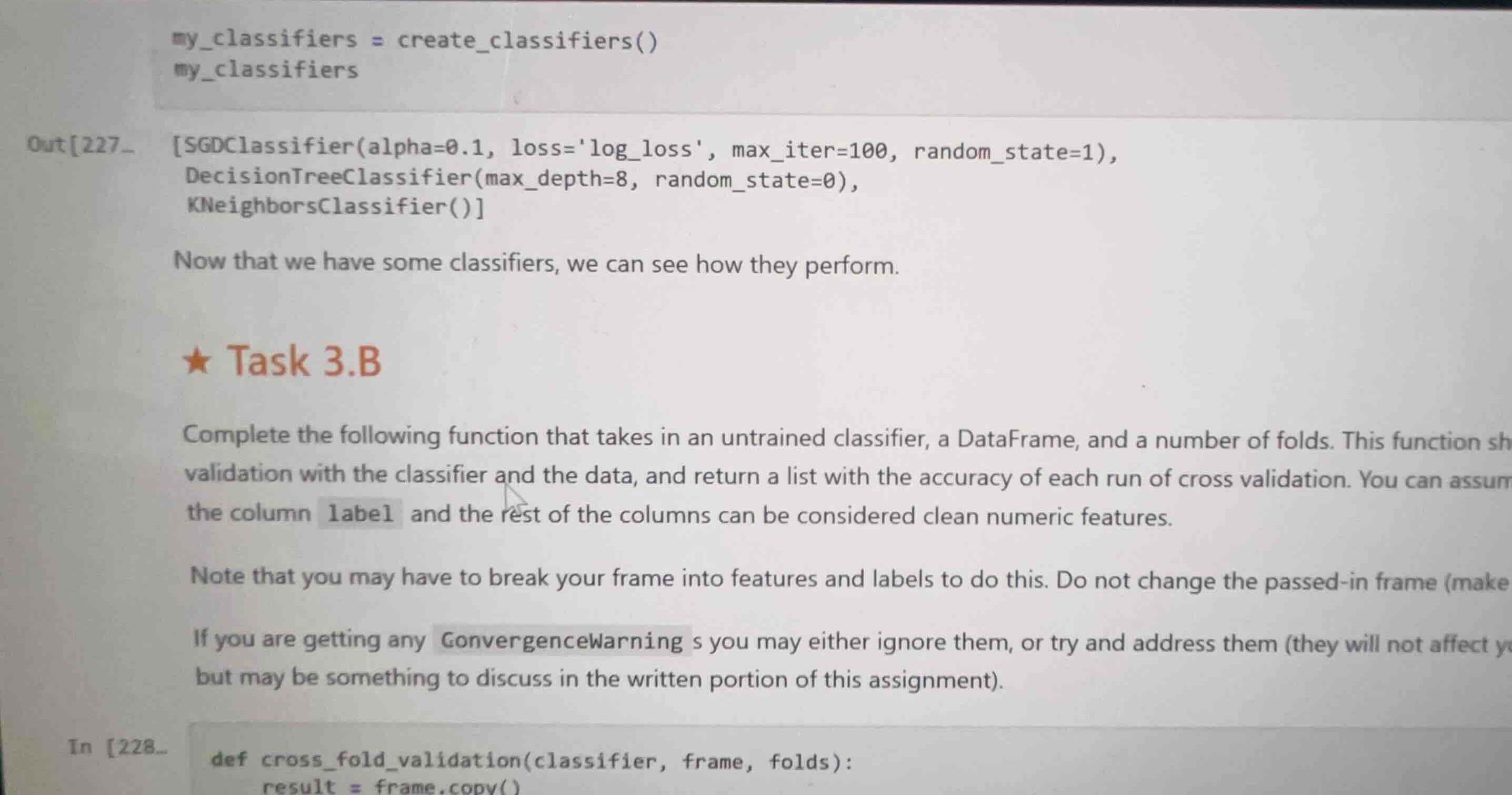
my_classifiers = create_classifiers()
my_classifiers
out 227: sgdclassifier(alpha=0.1, loss=log_loss, max_iter=100, random_state=1),
decisiontreeclassifier(max_depth=8, random_state=0),
kneighborsclassifier()
now that we have some classifiers, we can see how they perform.
task 3.b
complete the following function that takes in an untrained classifier, a dataframe, and a number of folds. this function should perform cross validation with the classifier and the data, and return a list with the accuracy of each run of cross validation. you can assume that the target is in the column label and the rest of the columns can be considered clean numeric features.
note that you may have to break your frame into features and labels to do this. do not change the passed-in frame (make a copy if needed).
if you are getting any convergencewarning s you may either ignore them, or try and address them (they will not affect your grade, but may be something to discuss in the written portion of this assignment).
in 228:
def cross_fold_validation(classifier, frame, folds):
result = frame.copy()
Identify requirements and inputs
The task requires completing a Python function cross_fold_validation(classifier, frame, folds) that performs cross-validation.
- Inputs:
classifier: An untrained scikit-learn classifier.frame: A pandas DataFrame containing features and a target column named'label'.folds: The number of folds for cross-validation.- Outputs:
- A list containing the accuracy of each run of cross-validation.
- Constraints:
- Do not modify the original
frame(use a copy). - Split the frame into features (\(X\)) and labels (\(y\)).
- The target column is named
'label'. - All other columns are clean numeric features.
Separate features and labels
To prepare the data for scikit-learn, we must separate the target column 'label' from the feature columns.
- Target vector \(y\):
frame['label'] - Feature matrix \(X\):
frame.drop(columns=['label']) - We should perform this on a copy of the DataFrame as instructed:
df = frame.copy()
Select cross-validation method
Scikit-learn provides a built-in utility cross_val_score that automates cross-validation.
- We can import
cross_val_scorefromsklearn.model_model_selection. - The function call is:
cross_val_score(classifier, X, y, cv=folds, scoring='accuracy'). - This returns an array of scores (accuracies) for each fold, which can be converted to a list.
Alternative manual implementation
If external imports are restricted, we can use KFold or StratifiedKFold from sklearn.model_selection to manually split, fit, and score. However, using cross_val_score is the standard, most robust, and cleanest way to implement this in scikit-learn. Let's provide the standard cross_val_score solution as it is highly reliable and concise.
Construct the final function
Let's write out the complete Python code block:
from sklearn.model_selection import cross_val_score

def cross_fold_validation(classifier, frame, folds):
    # Make a copy of the frame to avoid modifying the original data
    df = frame.copy()

    # Separate features (X) and target label (y)
    X = df.drop(columns=['label'])
    y = df['label']

    # Perform cross-validation and obtain accuracy scores
    scores = cross_val_score(classifier, X, y, cv=folds, scoring='accuracy')

    # Return the scores as a list
    return list(scores)
Snap & solve any problem in the app
Get step-by-step solutions on Sovi AI
Photo-based solutions with guided steps
Explore more problems and detailed explanations
from sklearn.model_selection import cross_val_score

def cross_fold_validation(classifier, frame, folds):
    # Create a copy to avoid modifying the original DataFrame
    df = frame.copy()

    # Separate the target column 'label' from the feature columns
    X = df.drop(columns=['label'])
    y = df['label']

    # Compute cross-validation scores using accuracy as the metric
    scores = cross_val_score(classifier, X, y, cv=folds, scoring='accuracy')

    # Return the scores as a list
    return list(scores)