QUESTION IMAGE
Question
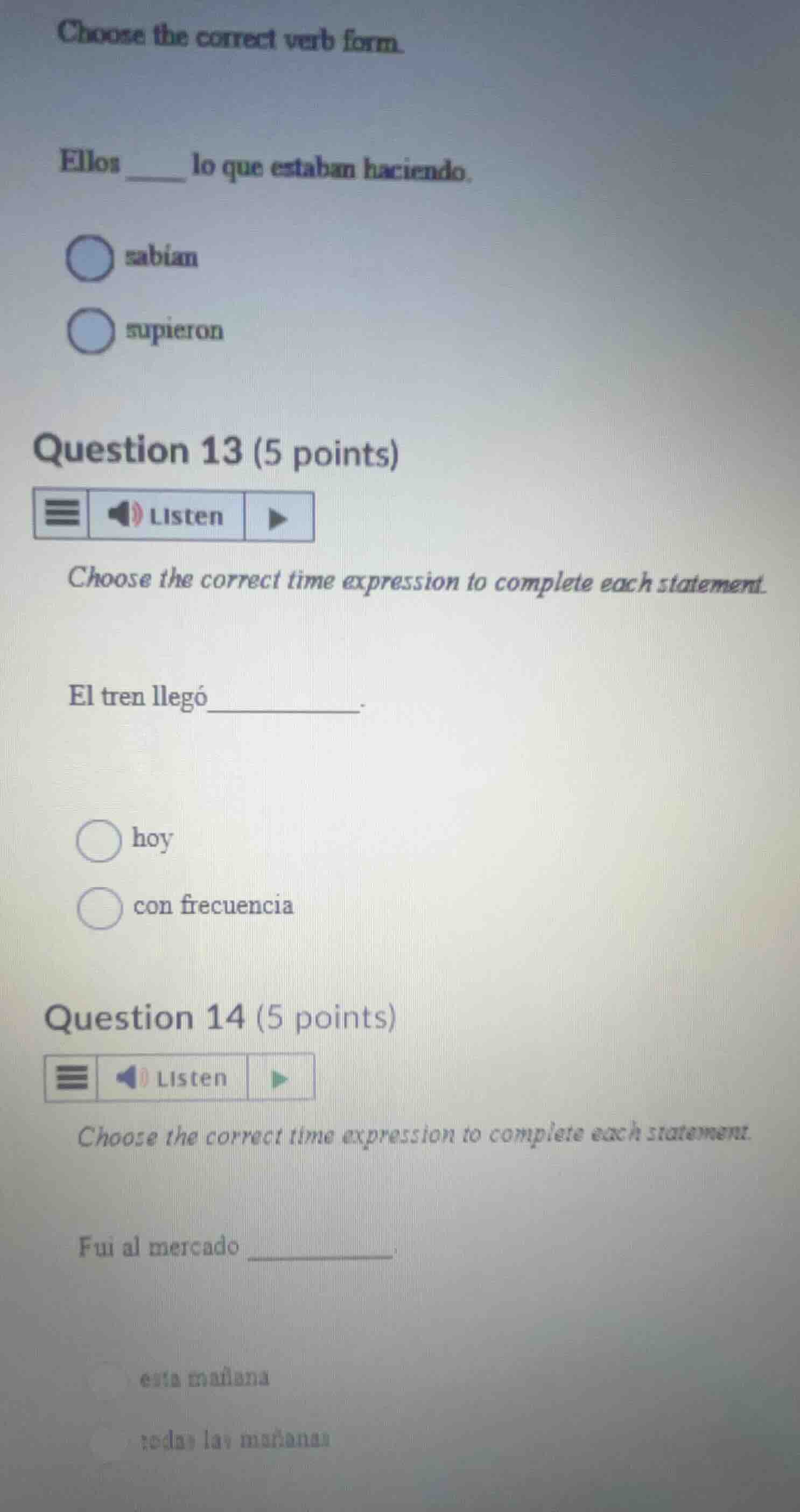
choose the correct verb form.
ellos ______ lo que estaban haciendo.
sabían
supieron
question 13 (5 points)
choose the correct time expression to complete each statement.
el tren llegó ______.
hoy
con frecuencia
question 14 (5 points)
choose the correct time expression to complete each statement.
fui al mercado ______.
esta mañana
todas las mañanas
<pre_analysis>
{
"quality": "clear",
"question_count": 3,
"skills_matched": [
"direct_cot",
"multiple_choice_formatter",
"explain_then_answer",
"quick"
],
"needs_drawing": false,
"concepts_used": [
"Spanish Preterite vs Imperfect",
"Spanish Time Expressions"
],
"new_concepts": [],
"current_concepts": [
"Spanish Preterite vs Imperfect",
"Spanish Time Expressions"
]
}
</pre_analysis>
<reasoning>
Analyze the first question
The sentence is "Ellos ______ lo que estaban haciendo" (They knew/found out what they were doing). The verb "saber" in the imperfect ("sabían") means "knew" (ongoing state of knowledge), while in the preterite ("supieron") it means "found out" (sudden event). The context "lo que estaban haciendo" (what they were doing) describes an ongoing background state, making the imperfect "sabían" the correct choice.
Analyze Question 13
The sentence is "El tren llegó ____" (The train arrived ____), where "llegó" is in the preterite tense, indicating a completed action at a specific point in time. "Hoy" (today) fits a specific completed action in the preterite, whereas "con frecuencia" (frequently) triggers the imperfect tense.
Analyze Question 14
The sentence is "Fui al mercado ____" (I went to the market ____), where "fui" is in the preterite tense, indicating a completed action. "Esta mañana" (this morning) refers to a specific completed time frame, whereas "todas las mañanas" (every morning) indicates habitual action which would require the imperfect tense.
</reasoning>
<answer>
Question 1
<mcq-correct>sabían</mcq-correct>
<mcq-option>supieron</mcq-option>
Question 13
<mcq-correct>hoy</mcq-correct>
<mcq-option>con frecuencia</mcq-option>
Question 14
<mcq-correct>esta mañana</mcq-correct>
<mcq-option>todas las mañanas</mcq-option>
</answer>
<post_analysis>
{
"subject": "Others",
"question_type": "Multiple Choice",
"knowledge_point": [
"Others",
"Spanish",
"Spanish Preterite vs Imperfect"
]
}
</post_analysis>
Snap & solve any problem in the app
Get step-by-step solutions on Sovi AI
Photo-based solutions with guided steps
Explore more problems and detailed explanations
<pre_analysis>
{
"quality": "clear",
"question_count": 3,
"skills_matched": [
"direct_cot",
"multiple_choice_formatter",
"explain_then_answer",
"quick"
],
"needs_drawing": false,
"concepts_used": [
"Spanish Preterite vs Imperfect",
"Spanish Time Expressions"
],
"new_concepts": [],
"current_concepts": [
"Spanish Preterite vs Imperfect",
"Spanish Time Expressions"
]
}
</pre_analysis>
<reasoning>
Analyze the first question
The sentence is "Ellos ______ lo que estaban haciendo" (They knew/found out what they were doing). The verb "saber" in the imperfect ("sabían") means "knew" (ongoing state of knowledge), while in the preterite ("supieron") it means "found out" (sudden event). The context "lo que estaban haciendo" (what they were doing) describes an ongoing background state, making the imperfect "sabían" the correct choice.
Analyze Question 13
The sentence is "El tren llegó ____" (The train arrived ____), where "llegó" is in the preterite tense, indicating a completed action at a specific point in time. "Hoy" (today) fits a specific completed action in the preterite, whereas "con frecuencia" (frequently) triggers the imperfect tense.
Analyze Question 14
The sentence is "Fui al mercado ____" (I went to the market ____), where "fui" is in the preterite tense, indicating a completed action. "Esta mañana" (this morning) refers to a specific completed time frame, whereas "todas las mañanas" (every morning) indicates habitual action which would require the imperfect tense.
</reasoning>
<answer>
Question 1
<mcq-correct>sabían</mcq-correct>
<mcq-option>supieron</mcq-option>
Question 13
<mcq-correct>hoy</mcq-correct>
<mcq-option>con frecuencia</mcq-option>
Question 14
<mcq-correct>esta mañana</mcq-correct>
<mcq-option>todas las mañanas</mcq-option>
</answer>
<post_analysis>
{
"subject": "Others",
"question_type": "Multiple Choice",
"knowledge_point": [
"Others",
"Spanish",
"Spanish Preterite vs Imperfect"
]
}
</post_analysis>