QUESTION IMAGE
Question
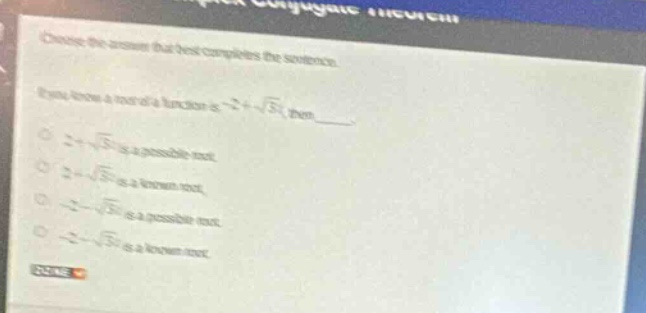
choose the answer that best completes the sentence.
if you know a root of a function is (-2 + sqrt{5}i), then ______.
- (2 + sqrt{5}i) is a possible root.
- (2 - sqrt{5}i) is a known root.
- (-2 - sqrt{5}i) is a possible root.
- (-2 - sqrt{5}i) is a known root.
🆕 New Concept Discovered: Complex Conjugate Theorem
Irrational and complex roots of polynomials with rational coefficients always come in conjugate pairs.
Step 1: Identify the given root
The problem states that a known root of a polynomial function is:
This is a complex number in the form \( a + bi \), where \( a = -2 \) and \( b = \sqrt{3} \).
Step 2: Apply the Complex Conjugate Theorem
The Complex Conjugate Theorem states that if a polynomial has real coefficients and a complex number \( a + bi \) is a root, then its complex conjugate \( a - bi \) must also be a root of the function.
To find the conjugate, we change the sign of the imaginary part:
Since the theorem guarantees this conjugate is a root, it is a known root, not just a possible one.

Snap & solve any problem in the app
Get step-by-step solutions on Sovi AI
Photo-based solutions with guided steps
Explore more problems and detailed explanations
\(-2 - \sqrt{3}i\) is a known root.