QUESTION IMAGE
Question
chocolate research
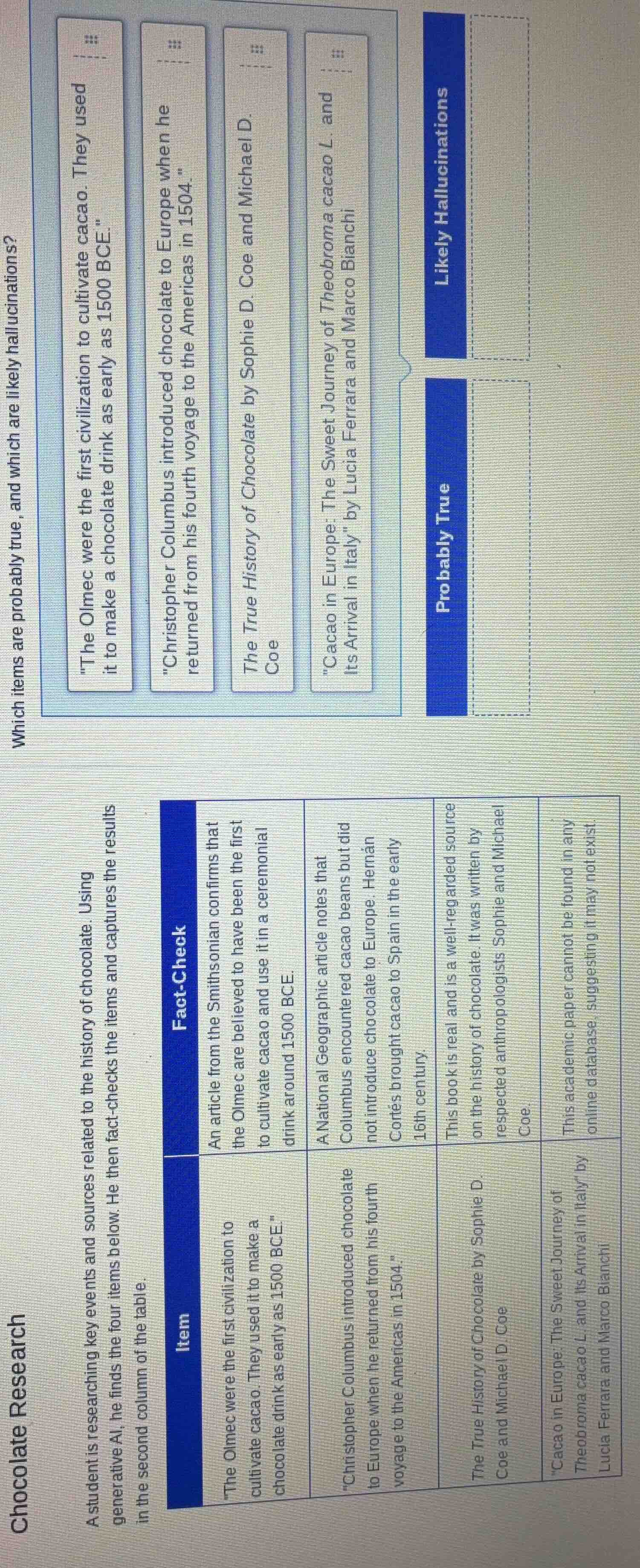
a student is researching key events and sources related to the history of chocolate. using
generative al, he finds the four items below. he then fact - checks the items and captures the results
in the second column of the table.
| item | fact - check |
|---|---|
| \christopher columbus introduced chocolate to europe when he returned from his fourth voyage to the americas in 1504.\ | a national geographic article notes that columbus encountered cacao beans but did not introduce chocolate to europe. hernán cortés brought cacao to spain in the early 16th century. |
| the true history of chocolate by sophie d. coe and michael d. coe | this book is real and is a well - regarded source on the history of chocolate. it was written by respected anthropologists sophie and michael coe. |
| \cacao in europe: the sweet journey of theobroma cacao l. and its arrival in italy\ by lucia ferrara and marco bianchi | this academic paper cannot be found in any online database, suggesting it may not exist. |
which items are probably true, and which are likely hallucinations?
there are four items:
- \the olmec were the first civilization to cultivate cacao. they used it to make a chocolate drink as early as 1500 bce.\
- \christopher columbus introduced chocolate to europe when he returned from his fourth voyage to the americas in 1504.\
- the true history of chocolate by sophie d. coe and michael d. coe
- \cacao in europe: the sweet journey of theobroma cacao l. and its arrival in italy\ by lucia ferrara and marco bianchi
and two categories: probably true and likely hallucinations. the task is to classify each item into the appropriate category.
To solve this, we analyze each item against the fact - checks:
1. For the item "The Olmec were the first civilization to cultivate cacao. They used it to make a chocolate drink as early as 1500 BCE."
The fact - check from the Smithsonian article confirms that the Olmec are believed to be the first to cultivate cacao and use it in a ceremonial drink around 1500 BCE. So this item is consistent with the fact - check and should be placed in the "Probably True" category.
2. For the item "Christopher Columbus introduced chocolate to Europe when he returned from his fourth voyage to the Americas in 1504."
The National Geographic article notes that Columbus encountered cacao beans but did not introduce chocolate to Europe (Hernán Cortés brought cacao to Spain in the early 16th century). So this item does not match the fact - check and should be placed in the "Likely Hallucinations" category.
3. For the item "The True History of Chocolate by Sophie D. Coe and Michael D. Coe"
The fact - check states that this book is real, a well - regarded source on the history of chocolate, and was written by respected anthropologists Sophie and Michael Coe. So this item is consistent with the fact - check and should be placed in the "Probably True" category.
4. For the item "Cacao in Europe: The Sweet Journey of Theobroma cacao L. and Its Arrival in Italy" by Lucia Ferrara and Marco Bianchi
The fact - check says that this academic paper cannot be found in any online database, suggesting it may not exist. So this item does not match the fact - check and should be placed in the "Likely Hallucinations" category.
Probably True:
- "The Olmec were the first civilization to cultivate cacao. They used it to make a chocolate drink as early as 1500 BCE."
- "The True History of Chocolate by Sophie D. Coe and Michael D. Coe"
Likely Hallucinations:
- "Christopher Columbus introduced chocolate to Europe when he returned from his fourth voyage to the Americas in 1504."
- "Cacao in Europe: The Sweet Journey of Theobroma cacao L. and Its Arrival in Italy" by Lucia Ferrara and Marco Bianchi

Snap & solve any problem in the app
Get step-by-step solutions on Sovi AI
Photo-based solutions with guided steps
Explore more problems and detailed explanations
To solve this, we analyze each item against the fact - checks:
1. For the item "The Olmec were the first civilization to cultivate cacao. They used it to make a chocolate drink as early as 1500 BCE."
The fact - check from the Smithsonian article confirms that the Olmec are believed to be the first to cultivate cacao and use it in a ceremonial drink around 1500 BCE. So this item is consistent with the fact - check and should be placed in the "Probably True" category.
2. For the item "Christopher Columbus introduced chocolate to Europe when he returned from his fourth voyage to the Americas in 1504."
The National Geographic article notes that Columbus encountered cacao beans but did not introduce chocolate to Europe (Hernán Cortés brought cacao to Spain in the early 16th century). So this item does not match the fact - check and should be placed in the "Likely Hallucinations" category.
3. For the item "The True History of Chocolate by Sophie D. Coe and Michael D. Coe"
The fact - check states that this book is real, a well - regarded source on the history of chocolate, and was written by respected anthropologists Sophie and Michael Coe. So this item is consistent with the fact - check and should be placed in the "Probably True" category.
4. For the item "Cacao in Europe: The Sweet Journey of Theobroma cacao L. and Its Arrival in Italy" by Lucia Ferrara and Marco Bianchi
The fact - check says that this academic paper cannot be found in any online database, suggesting it may not exist. So this item does not match the fact - check and should be placed in the "Likely Hallucinations" category.
Probably True:
- "The Olmec were the first civilization to cultivate cacao. They used it to make a chocolate drink as early as 1500 BCE."
- "The True History of Chocolate by Sophie D. Coe and Michael D. Coe"
Likely Hallucinations:
- "Christopher Columbus introduced chocolate to Europe when he returned from his fourth voyage to the Americas in 1504."
- "Cacao in Europe: The Sweet Journey of Theobroma cacao L. and Its Arrival in Italy" by Lucia Ferrara and Marco Bianchi