QUESTION IMAGE
Question
chapter 5 - work, energy & power
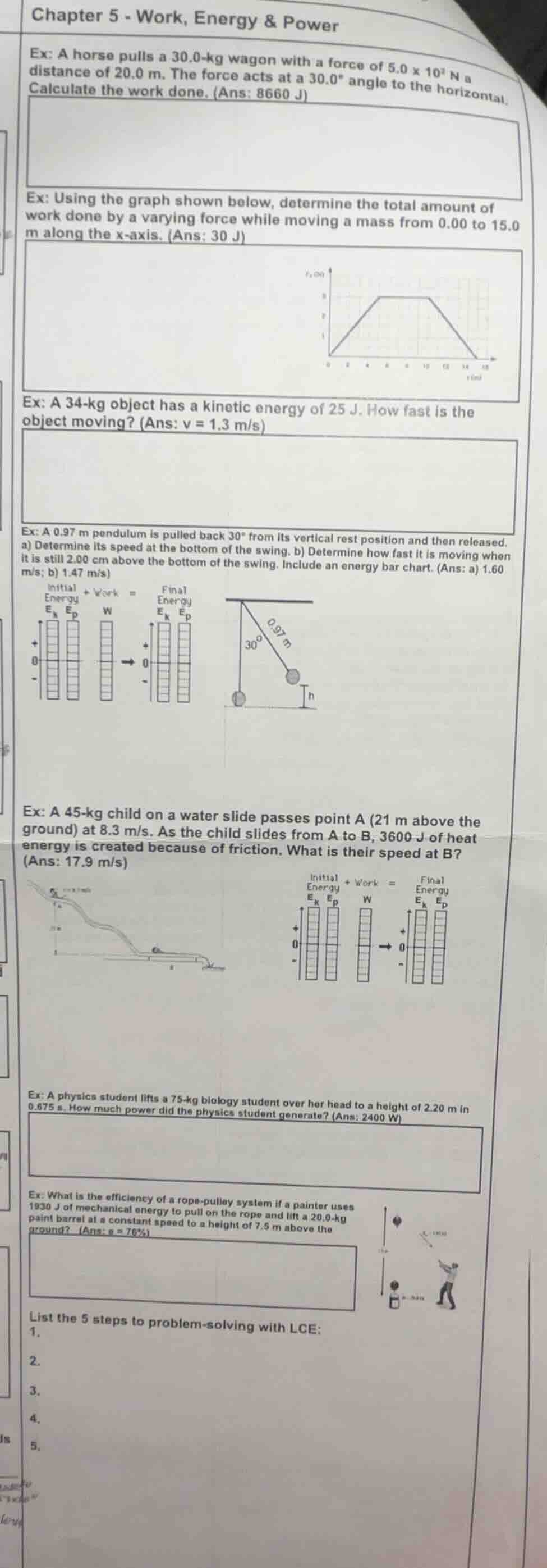
ex: a horse pulls a 30.0-kg wagon with a force of \\(5.0 \times 10^2\text{ n}\\) a distance of 20.0 m. the force acts at a \\(30.0^\circ\\) angle to the horizontal. calculate the work done. (ans: 8660 j)
ex: using the graph shown below, determine the total amount of work done by a varying force while moving a mass from 0.00 to 15.0 m along the x-axis. (ans: 30 j)
ex: a 34-kg object has a kinetic energy of 25 j. how fast is the object moving? (ans: \\(v = 1.3\text{ m/s}\\))
ex: a 0.97 m pendulum is pulled back \\(30^\circ\\) from its vertical rest position and then released. a) determine its speed at the bottom of the swing. b) determine how fast it is moving when it is still 2.00 cm above the bottom of the swing. include an energy bar chart. (ans: a) 1.60 m/s; b) 1.47 m/s)
ex: a 45-kg child on a water slide passes point a (21 m above the ground) at 8.3 m/s. as the child slides from a to b, 3600 j of heat energy is created because of friction. what is their speed at b? (ans: 17.9 m/s)
ex: a physics student lifts a 75-kg biology student over her head to a height of 2.20 m in 0.675 s. how much power did the physics student generate? (ans: 2400 w)
ex: what is the efficiency of a rope-pulley system if a painter uses 1930 j of mechanical energy to pull on the rope and lift a 20.0-kg paint barrel at a constant speed to a height of 7.5 m above the ground? (ans: \\(e = 76\\%\\))
list the 5 steps to problem-solving with lce:
1.
2.
3.
4.
5.
Calculate work done by a constant force
To find the work done by a constant force, we use the formula:
Given:
- Force \(F = 5.0 \times 10^2\text{ N}\)
- Distance \(d = 20.0\text{ m}\)
- Angle \(\theta = 30.0^\circ\)
Substituting the values:
Determine work done from a force-displacement graph
The work done by a varying force is equal to the area under the force-displacement (\(F_x\) vs. \(x\)) curve.
From \(x = 0.00\text{ m}\) to \(x = 15.0\text{ m}\), the shape under the curve is a trapezoid:
- Lower base \(b_1 = 15.0\text{ m}\) (from \(0\) to \(15\))
- Upper base \(b_2 = 5.0\text{ m}\) (from \(5\) to \(10\))
- Height \(h = 3.0\text{ N}\)
Using the area formula for a trapezoid:
Calculate speed from kinetic energy
The formula for kinetic energy is:
Given:
- Mass \(m = 34\text{ kg}\)
- Kinetic energy \(E_k = 25\text{ J}\)
Solving for speed \(v\):
Analyze pendulum motion using conservation of energy
Let the lowest point of the swing be the reference height \(y = 0\).
The pendulum length is \(L = 0.97\text{ m}\).
At the maximum angle \(\theta = 30^\circ\), the height \(h_0\) above the bottom is:
a) Speed at the bottom of the swing (where \(h = 0\)):
By conservation of mechanical energy:
b) Speed when it is \(2.00\text{ cm} = 0.0200\text{ m}\) above the bottom:
Apply work-energy theorem with friction on a slide
Using the conservation of energy including non-conservative work (heat generated by friction):
Let ground level be \(y = 0\), so \(h_B = 0\) and \(h_A = 21\text{ m}\).
Given:
- \(m = 45\text{ kg}\)
- \(v_A = 8.3\text{ m/s}\)
- \(h_A = 21\text{ m}\)
- \(Q_{\text{heat}} = 3600\text{ J}\)
Calculate initial mechanical energy:
Subtract heat…

Snap & solve any problem in the app
Get step-by-step solutions on Sovi AI
Photo-based solutions with guided steps
Explore more problems and detailed explanations
| No. | Problem | Answer |
|---|---|---|
| 2 | Work done by varying force from graph | \(30\text{ J}\) |
| 3 | Speed of a 34-kg object with 25 J of kinetic energy | \(1.3\text{ m/s}\) |
| 4 | Pendulum speed: a) at bottom, b) at 2.00 cm above bottom | a) \(1.60\text{ m/s}\), b) \(1.47\text{ m/s}\) |
| 5 | Speed of child at bottom of water slide B with friction | \(17.9\text{ m/s}\) |
| 6 | Power generated lifting a 75-kg student | \(2400\text{ W}\) |
| 7 | Efficiency of rope-pulley system | \(76\%\) |
| 8 | 5 steps to problem-solving with LCE | 1. Define the system and reference level.<br>2. Identify initial and final states.<br>3. Write the energy conservation equation.<br>4. Substitute known values.<br>5. Solve for the unknown. |