QUESTION IMAGE
Question
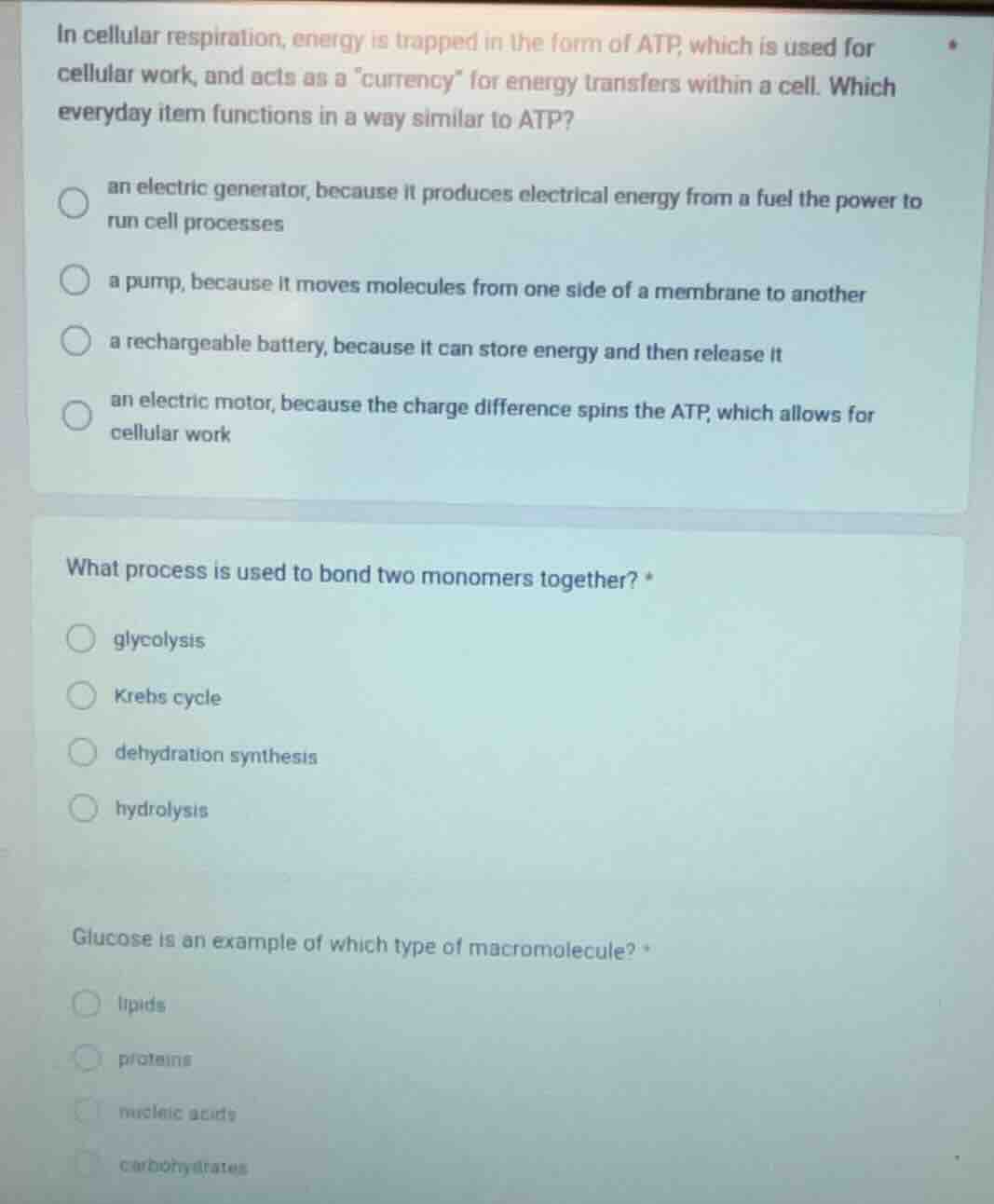
in cellular respiration, energy is trapped in the form of atp, which is used for cellular work, and acts as a \currency\ for energy transfers within a cell. which everyday item functions in a way similar to atp?
an electric generator, because it produces electrical energy from a fuel the power to run cell processes
a pump, because it moves molecules from one side of a membrane to another
a rechargeable battery, because it can store energy and then release it
an electric motor, because the charge difference spins the atp, which allows for cellular work
what process is used to bond two monomers together?
glycolysis
krebs cycle
dehydration synthesis
hydrolysis
glucose is an example of which type of macromolecule?
lipids
proteins
nucleic acids
carbohydrates
Analyze ATP analogy
Using the Aerobic Cellular Respiration knowledge point
ATP functions as a temporary energy storage molecule that can be charged (ADP + Pi -> ATP) and discharged (ATP -> ADP + Pi) repeatedly. This cyclic storage and release of energy is functionally analogous to a rechargeable battery.
Analyze monomer bonding process
Using the Dehydration Synthesis knowledge point
To bond two monomers together covalently, a water molecule is removed (dehydration) to form a new bond (synthesis). Glycolysis, on the other hand, is the metabolic pathway that breaks down glucose to extract energy, which is not a polymerization process.
Classify glucose macromolecule
Using the Biomolecules knowledge point
Glucose is a simple sugar (monosaccharide) containing carbon, hydrogen, and oxygen in a 1:2:1 ratio, which classifies it as a carbohydrate.

Snap & solve any problem in the app
Get step-by-step solutions on Sovi AI
Photo-based solutions with guided steps
Explore more problems and detailed explanations
Question 1
- an electric generator, because it produces electrical energy from a fuel the power to run cell processes
- a pump, because it moves molecules from one side of a membrane to another
- a rechargeable battery, because it can store energy and then release it (Correct answer)
- an electric motor, because the charge difference spins the ATP, which allows for cellular work
Question 2
- glycolysis
- Krebs cycle
- dehydration synthesis (Correct answer)
- hydrolysis
Question 3
- lipids
- proteins
- nucleic acids
- carbohydrates (Correct answer)